 Ramrajeshbee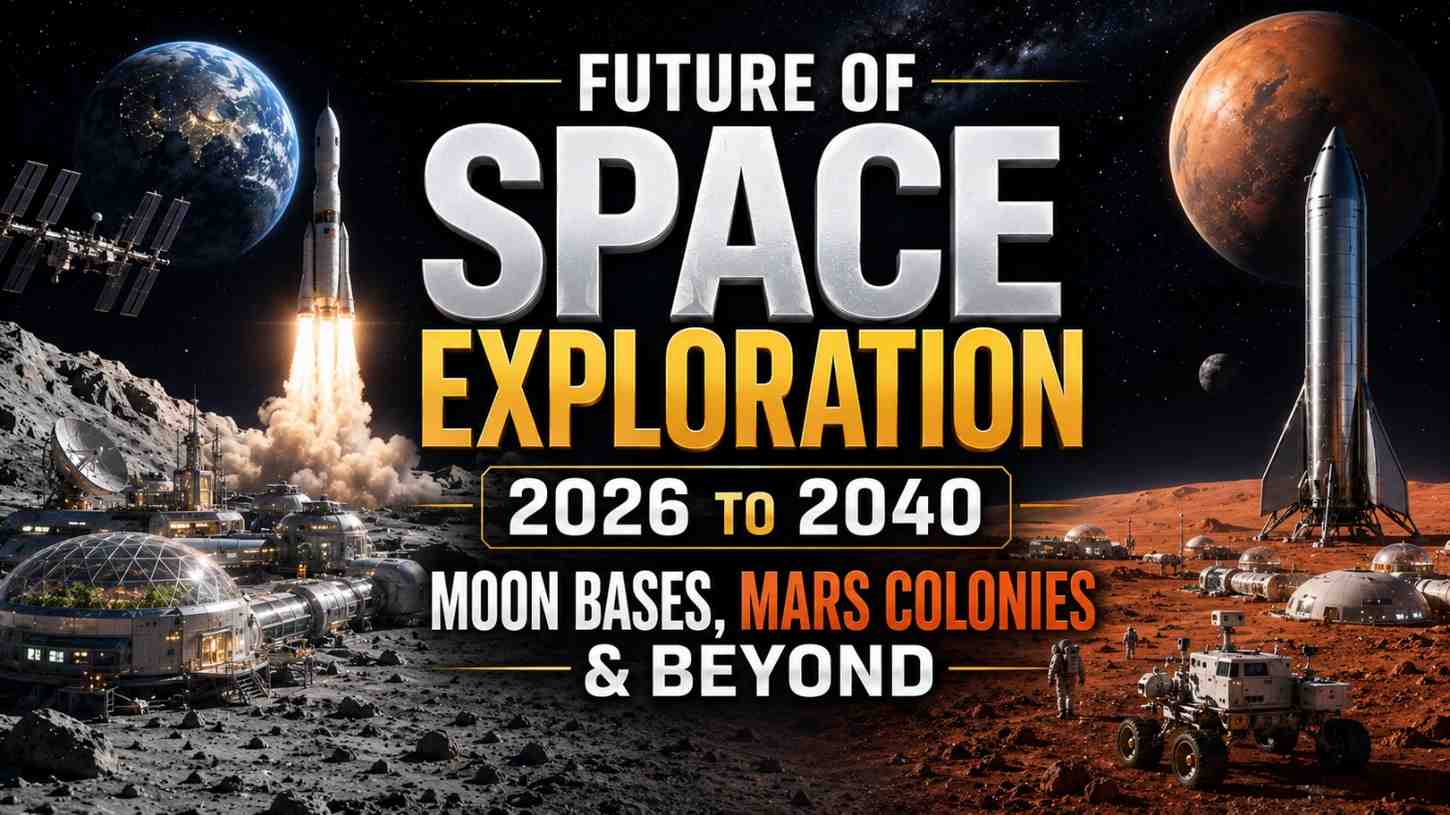
Introduction
The future of space exploration, 2026 to 2040, is not science fiction anymore—it’s a signed contract, a launch schedule, and a construction blueprint.
Right now, space agencies and private companies are racing to put humans back on the Moon, establish the first permanent lunar outpost, and eventually plant boots on Mars. The next 15 years will be the most consequential in the history of human spaceflight.
This article breaks down exactly what’s coming, who’s leading the charge, and why the future of space exploration, 2026 to 2040, matters for every person on Earth.
Why 2026 to 2040 Is the Most Important Era in Space History
We’ve had space exploration for over 60 years. So why is the future of space exploration 2026 to 2040 different?
Three reasons:
- Cost has collapsed. SpaceX’s Falcon 9 reduced launch costs by over 90% compared to the Space Shuttle era.
- Private investment is surging. Over $20 billion was invested in commercial space in 2023 alone, according to Space Investment Quarterly.
- Geopolitical urgency is real. The US, China, India, and Europe are all competing for lunar presence — and that competition accelerates everything.
The future of space exploration 2026 to 2040 is shaped by this perfect storm of technology, money, and ambition.
The Moon: Humanity’s First Permanent Outpost (2026–2030)
NASA’s Artemis Program — The Return to the Moon
NASA’s Artemis missions are the cornerstone of the future of space exploration 2026 to 2040 strategy.
- Artemis III (2026): First crewed lunar landing since Apollo 17 in 1972
- Artemis IV (2028): Begins assembly of Gateway — the lunar space station
- Artemis V and beyond: Sustained lunar presence begins
The lunar South Pole is the target. Why? Water ice. That ice can be split into hydrogen and oxygen — rocket fuel. Whoever controls it shapes deep-space access for decades.
The Lunar Gateway — A Space Station in Moon Orbit
Gateway is not just a pit stop. It’s a permanent hub that will enable missions deeper into the solar system.
Built jointly by NASA, ESA, JAXA, and CSA, Gateway orbits the Moon in a unique near-rectilinear halo orbit. It provides:
- Crew quarters and life support
- Docking ports for lunar landers
- A science platform for Earth, Moon, and deep-space research
By 2030, the future of space exploration 2026 to 2040 will include a permanent human presence in cislunar space for the first time ever.
Related: Moon Base Construction Plan 2026–2035 — NASA Gateway Explained
Mars: The 2030s Goal That Could Actually Happen
SpaceX’s Mars Mission Timeline
SpaceX has been the loudest voice about Mars for years. But by 2026, Starship will have proven itself capable of carrying 100 tonnes to orbit — making Mars missions physically possible.
Elon Musk has stated that uncrewed Starship cargo missions to Mars could launch as early as 2026, with crewed flights targeting 2029–2031.
That’s not a guarantee. But the hardware exists, which is more than we could say five years ago.
What a Mars Colony Actually Looks Like
The future of space exploration 2026 to 2040 includes realistic planning for Mars surface habitation:
- Phase 1 (2026–2030): Uncrewed missions deliver equipment, fuel production units, and food systems
- Phase 2 (2031–2035): First 6–12 person crew lands, establishes a pressurized base
- Phase 3 (2036–2040): Permanent settlement grows; in-situ resource utilization (ISRU) becomes operational
Mars gravity is 38% of Earth’s. That’s actually workable for long-term habitation, unlike microgravity. The bigger challenge? Radiation, dust storms, and the 20-minute communication delay with Earth.
Deep Space: Beyond Mars in the 2035–2040 Window
The Asteroid Belt and Jupiter’s Moons
The future of space exploration 2026 to 2040 extends past Mars. NASA’s Europa Clipper launched in 2024 and arrives at Jupiter in 2030. It will confirm whether Europa’s subsurface ocean could host life.
This won’t be a human mission in this window — but it opens the scientific case for a crewed Jupiter-moon mission in the 2040s.
Related: Will Humans Reach Jupiter Moons? Europa Clipper and the Search for Life
Nuclear Propulsion — The Game-Changer
Chemical rockets take 7–9 months to reach Mars. Nuclear thermal propulsion could cut that to 3–4 months, dramatically reducing radiation exposure for crews.
NASA and DARPA’s DRACO program is targeting a nuclear rocket demonstration by 2027. If successful, this technology redefines what’s achievable in the future of space exploration 2026 to 2040 and beyond.
Learn more at NASA’s official exploration page.
China and India: The New Space Powers
The future of space exploration 2026 to 2040 is not a NASA-only story.
China plans to:
- Land humans on the Moon by 2030
- Build a joint lunar research station with Russia by 2035
- Launch its own crewed Mars mission by 2040
India has:
- Successfully reached Mars (Mangalyaan, 2014)
- Soft-landed on the Moon’s South Pole (Chandrayaan-3, 2023)
- Its first crewed spaceflight (Gaganyaan) launching in 2026
This multi-nation race accelerates timelines and increases investment across the board. Competition, in this case, benefits all of humanity.
Commercial Space Stations: What Replaces the ISS?
The ISS retires in 2030. The future of space exploration 2026 to 2040 requires a replacement — and that replacement will be commercial.
Companies including Axiom Space, Voyager Space (Starlab), and Sierra Space are all building private space stations. NASA is funding them through its Commercial Low Earth Orbit Destinations (CLD) program.
The transition from government to commercial in low Earth orbit frees NASA to focus on deep space — the Moon, Mars, and beyond.
Technologies That Will Define 2026–2040
In-Situ Resource Utilization (ISRU)
Living on the Moon or Mars without resupply from Earth requires making things locally. ISRU means:
- Extracting water from lunar ice
- Producing oxygen from Moon regolith
- 3D-printing habitats from Martian soil
NASA’s MOXIE experiment on Perseverance already demonstrated oxygen production on Mars in 2021. Scaled-up versions will arrive with early cargo missions.
Artificial Intelligence in Space
AI is transforming the future of space exploration 2026 to 2040 by:
- Autonomously navigating spacecraft across communication delays
- Managing life support systems without human input
- Analyzing scientific data in real time on distant planets
5 Frequently Asked Questions
Q1: When will humans return to the Moon? NASA’s Artemis III mission targets 2026 as the year humans land on the lunar South Pole for the first time since 1972.
Q2: Will humans reach Mars before 2040? SpaceX is targeting crewed Mars missions by 2029–2031. Most analysts consider 2033–2035 more realistic, but within the 2040 window, a crewed Mars landing is highly probable.
Q3: Is the future of space exploration 2026 to 2040 mostly government or private? Both. Government agencies like NASA, ESA, and ISRO fund and lead flagship missions. Private companies like SpaceX, Blue Origin, and Rocket Lab provide the launch infrastructure and commercial services.
Q4: How much will it cost to build a Moon base? Estimates range from $35 billion to over $100 billion over 10 years, depending on scope. Commercial partnerships are designed to reduce the NASA share significantly.
Q5: What is the biggest risk in the future of space exploration 2026 to 2040? Radiation is the leading medical risk for long-duration deep-space missions. Political and funding instability is the biggest programmatic risk — space budgets change with administrations.
Conclusion
The future of space exploration 2026 to 2040 is the most exciting chapter humanity has ever written. Moon bases are moving from concept to construction. Mars colonies are moving from fiction to engineering. And entirely new spacefaring nations are joining the story.
The decisions made between now and 2030 — on lunar infrastructure, propulsion technology, and international cooperation — will determine whether humanity becomes a multi-planetary species within this century.
Ready to follow the journey? Bookmark this page and explore our complete space exploration coverage below.
Related: SpaceX Starship Version 3 Capabilities 2026 — What the New Rocket Can Actually Do
External sources: NASA Moon to Mars | Bryce Space Investment Quarterly