 Ramrajeshbee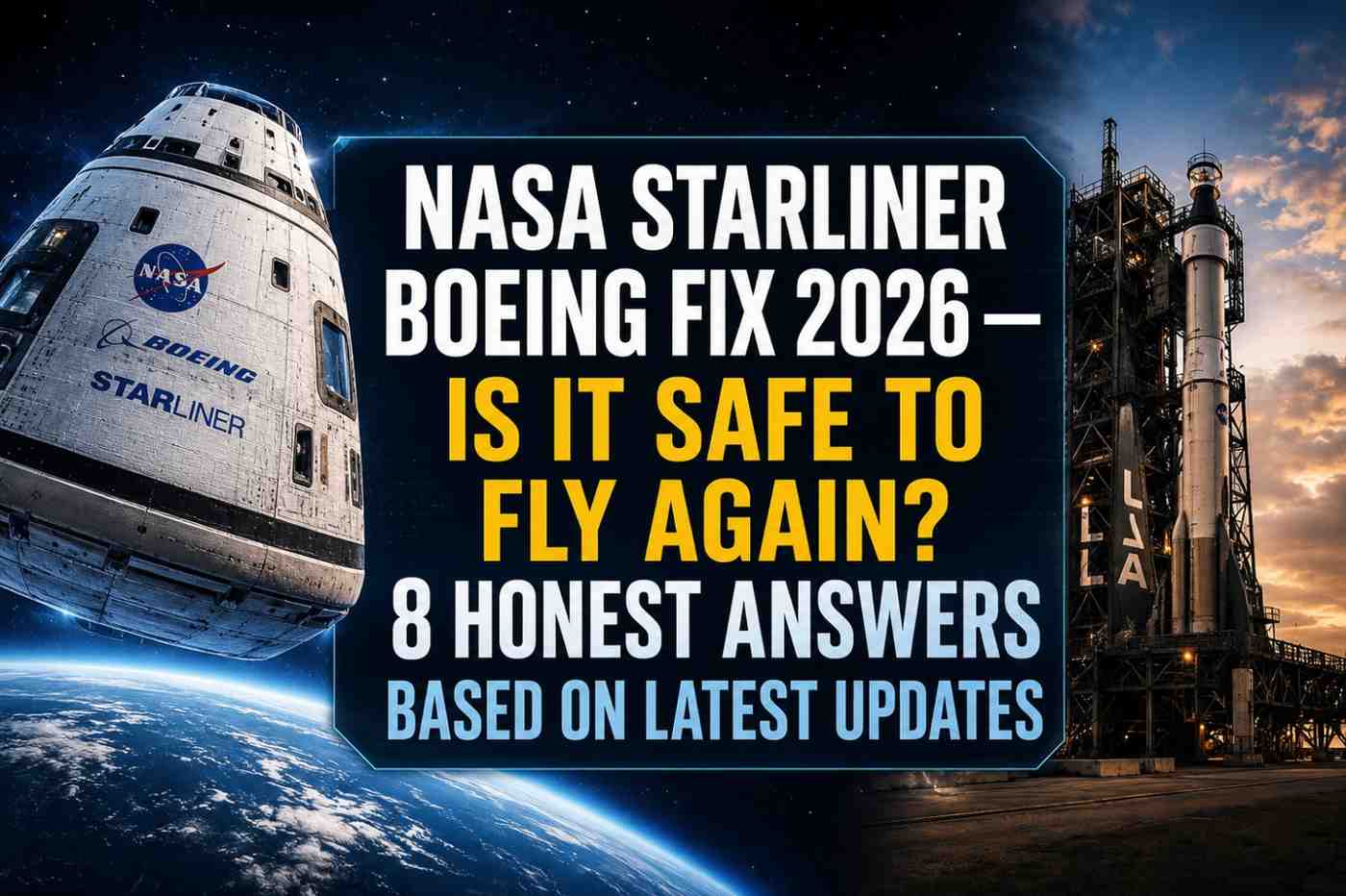
Introduction
The NASA Starliner Boeing fix 2026 situation is one of the most consequential stories in human spaceflight — and one of the most closely watched by NASA engineers, astronauts, policymakers, and the public alike.
In June 2024, Boeing’s Starliner capsule launched its first crewed test flight, carrying NASA astronauts Butch Wilmore and Suni Williams to the International Space Station for what was supposed to be a 7-to-14-day stay. Instead, they stayed for 10 months — stuck in orbit while NASA investigated helium leaks and thruster failures that had struck Starliner during its journey to the station. In September 2024, NASA sent Starliner home empty — without its astronauts — and Wilmore and Williams returned to Earth in March 2025 aboard a SpaceX Crew Dragon.
Since then, the story of the NASA Starliner Boeing fix 2026 has been a complicated mix of investigations, technical work, organizational reckoning, and difficult questions about the future of Boeing’s role in human spaceflight.
This guide provides 8 honest, up-to-date answers to the most important questions about Starliner right now.
Question 1: What Exactly Went Wrong with Starliner During the 2024 Crew Flight Test?
The problems Starliner experienced during its June 2024 Crew Flight Test (CFT) involved two separate but related issues.
Issue 1: Helium Leaks Starliner experienced leaks in its helium pressurization system. Helium is used to pressurize the propulsion system that feeds the thrusters. While helium leaks are not immediately dangerous, they raised serious concerns about the spacecraft’s overall propulsion system integrity.
Issue 2: Thruster Failures During the docking approach to the ISS, 5 of 28 reaction control system (RCS) thrusters failed. These thrusters are used for fine attitude and trajectory adjustments — including the precise movements required for docking. Astronaut Butch Wilmore manually took control and stabilized the spacecraft, describing the moment as one where he thought they “almost had a really terrible day.”
The post-mission investigation, completed in November 2025 and released in February 2026, identified the root cause: oxidizer heating and valve seal deformation inside the thruster “doghouses” (small enclosures protecting the thrusters). When thrusters fired, the heat they generated caused nitrogen tetroxide oxidizer to partially vaporize before reaching the combustion chamber — creating gas bubbles and reducing propellant flow, which caused thruster failure.
Critically, the oxidizer valves were not designed to be opened and closed while the RCS thrusters were simultaneously operating. The RCS firings changed temperature conditions in the valves in ways that were never adequately tested before flight.
Question 2: How Serious Were the Failures? NASA’s Official Classification
In February 2026, NASA formally classified the Starliner Crew Flight Test as a Type A mishap — NASA’s most severe failure category, typically reserved for missions involving loss of vehicle or crew.
This is a significant declaration. NASA Administrator Jared Isaacman stated: “The Boeing Starliner spacecraft has design and engineering deficiencies requiring correction.”
But Isaacman said he was “most troubled” not by the technical failures themselves, but by the failures in decision-making and leadership at both NASA and Boeing. The investigation found that overarching programmatic objectives — specifically the desire to have two independent providers capable of transporting crew to the ISS — had influenced engineering and operational decisions in ways that compromised safety standards.
In other words: the push to certify Starliner as quickly as possible led people to downplay warning signs they should have acted on.
Question 3: What Is the NASA Starliner Boeing Fix 2026 Plan?
The NASA Starliner Boeing fix 2026 plan has three main components:
Technical Fix — The Thruster Doghouses Boeing and NASA are redesigning or modifying the temperature management systems inside the thruster doghouses to prevent the oxidizer heating conditions that caused thruster failures. This involves changes to how heat is managed during propulsion system operations, as well as potential modifications to the valve timing and sequencing logic.
Ground testing at NASA’s White Sands Test Facility in New Mexico has been ongoing since 2024 to validate these fixes. As of May 2026, NASA confirmed that teams “continue to work through the technical problems” and are considering appropriate launch opportunities for the Starliner-1 mission.
Contract Modification Boeing and NASA updated their Commercial Crew Transportation Capability (CCtCap) contract in late 2025. The original contract included six crewed flights after successful completion of the test program. The revised contract now provides for:
- One uncrewed cargo resupply mission (Starliner-1)
- Three crewed rotation flights (Starliner-2, -3, -4), pending certification
- Two optional additional missions
- Starliner-1 will NOT carry crew — it will carry cargo and serve as an in-flight validation of the technical fixes
Organizational and Cultural Reforms The February 2026 investigation report identified leadership failures at both NASA and Boeing. NASA has committed to corrective actions to address the report’s findings — including changes to how programmatic pressure is allowed to influence safety engineering decisions.
Internal Link: NASA Artemis II Mission Results 2026 — 10 Proven Breakthroughs
Question 4: When Will Starliner-1 (Cargo Mission) Launch?
The Starliner-1 uncrewed cargo mission was originally targeting April 2026. That window came and went with no launch.
As of May 2026, NASA has not provided a specific new launch date. NASA’s updated ISS schedule shows Starliner-1 is listed for launch at an unspecified date, with “teams continuing to work through the technical problems.”
On May 2, 2026, NASA confirmed that Starliner-1 will act as an ISS resupply mission — not a crewed flight. The mission will deliver cargo to the space station while also serving as an in-flight demonstration of the technical changes Boeing has made to the thruster system.
The honest answer: Starliner-1 does not have a firm launch date as of May 2026. The technical work is ongoing.
Question 5: When Will Starliner Fly Astronauts Again?
Under the updated contract and NASA’s planning, the first crewed Starliner rotation mission (Starliner-2) will not fly until NASA certifies the spacecraft as safe following a successful Starliner-1 cargo flight.
Based on publicly available NASA ISS scheduling, this puts the earliest possible crewed Starliner flight at late 2026 at the absolute earliest — and more realistically, 2027.
Commercial Crew Program manager Steve Stich stated that NASA is “optimistic that another manned Starliner flight would take place for the second slot in the crew program in the later part of 2026.” However, that timeline appears increasingly difficult given the current state of technical work.
The bottom line: astronauts will not fly on Starliner again until NASA is fully satisfied that the thruster issues are resolved and that the organizational changes needed to make safe decisions have been implemented.
Question 6: Is Starliner Safe to Fly — Honestly?
This is the question every space fan wants answered directly.
As of May 2026, Starliner is not certified for crewed flight. NASA has explicitly stated that the spacecraft has technical deficiencies that require correction before it can safely carry astronauts.
The investigation report found that Starliner had “qualification deficiencies” and is “less reliable for crew survival” compared to other vehicles currently in operation (i.e., SpaceX Crew Dragon).
However, NASA has also committed to working with Boeing to fix these issues and return Starliner to flight — first with cargo, then with crew. NASA Administrator Isaacman stated clearly: “We look forward to working with Boeing as both organizations implement corrective actions and return Starliner to flight only when ready.”
The word “only when ready” is doing a lot of work in that sentence. NASA is not rushing this.
Question 7: Could Starliner Be Cancelled?
This is the most uncomfortable question about the NASA Starliner Boeing fix 2026 situation — and it is a legitimate one.
Boeing’s financial situation has been deeply troubled for years, largely due to problems with its commercial aircraft programs. Adding Starliner’s losses to that pile has been painful. In October 2024, reports emerged that Boeing was exploring a sale of some of its space division programs, including Starliner.
However, Boeing CEO Kelly Ortberg committed in August 2024 to continuing the Starliner program, and the updated NASA contract provides a clear path forward — if Boeing can fix the technical issues and demonstrate safe crewed flight.
The updated contract actually has a strategic advantage for Boeing: fewer guaranteed flights than the original contract, but with a clear certification path and the potential for commercial flights (space tourists) on future Starliner missions.
Cancellation is possible — but as of May 2026, both NASA and Boeing are committed to the NASA Starliner Boeing fix 2026 path and the eventual return to crewed flight.
According to NASA’s official commercial crew program page, NASA views the continued development of Starliner as an important part of maintaining redundant access to the ISS — a strategic goal that gives the US a backup to SpaceX Crew Dragon.
Question 8: What Does This Mean for NASA’s ISS Plans?
While the NASA Starliner Boeing fix 2026 work continues, NASA has adapted its ISS crew rotation planning to rely primarily on SpaceX Crew Dragon.
The immediate 2026 ISS schedule:
- May 12, 2026: SpaceX CRS-34 cargo Dragon launches (6,400 lbs of cargo)
- July 2026: NASA astronaut Anil Menon launches on Soyuz MS-29 for his first spaceflight
- Late 2026 (TBD): Starliner-1 uncrewed cargo mission — if technical work is complete
The ISS itself is currently slated for decommissioning after 2030, with a planned controlled reentry in 2031. There has been discussion about extending the station’s life until at least one commercial space station is operational — which would give Starliner more time to be certified and fly operational missions.
Canadian astronaut Joshua Kutryk, who was originally assigned to a Starliner mission, has been moved to a SpaceX Crew Dragon mission — a practical reflection of where things stand today.
The Bigger Picture: What Starliner’s Struggles Reveal
The NASA Starliner Boeing fix 2026 story is ultimately about more than a faulty thruster valve. It is a case study in the risks of large aerospace programs, the culture of human spaceflight safety, and the challenges facing Boeing as a company.
The Type A mishap classification — the most serious designation NASA assigns — reflects not just hardware failure but organizational failure. The investigation found that the desire to achieve programmatic objectives (getting a second crew provider certified) created pressure that compromised safety decision-making.
NASA’s response — the transparent investigation report, the corrective actions, the willingness to fly cargo first and crew only when ready — reflects the agency’s commitment to safety that was forged in the tragedies of Apollo 1, Challenger, and Columbia.
Internal Link: NASA Commercial Lunar Payload Services CLPS 2026 — All Missions Explained Simply
Learn more about NASA’s Commercial Crew Program at the official NASA Commercial Crew page.
Conclusion
The NASA Starliner Boeing fix 2026 story is not over — but it is moving in the right direction. The root causes have been identified. The investigation report has been released. The contract has been restructured. The technical fixes are being developed and tested.
But Starliner will not fly astronauts again until NASA is fully confident it is safe. After everything that Butch Wilmore and Suni Williams experienced — a 10-month odyssey that began as a one-week trip — that commitment to “only when ready” is exactly what the situation demands.
Want to stay updated on every Starliner milestone? Follow NASA’s official Starliner news page and Boeing’s space division updates for the latest on the path back to flight.