 Ramrajeshbee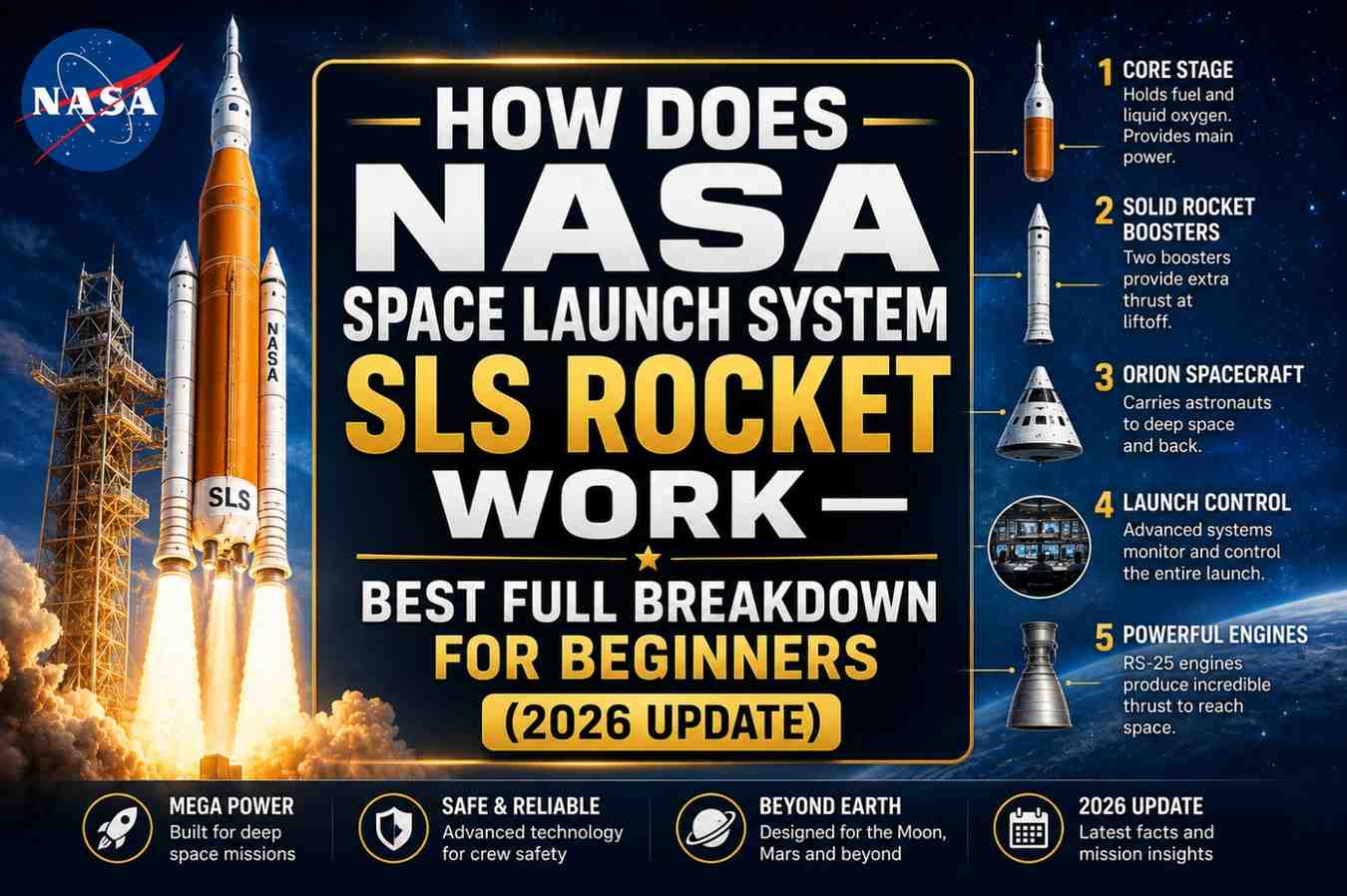
Introduction
How does the NASA Space Launch System SLS rocket work? It’s one of the most common questions people ask after watching the jaw-dropping Artemis II launch on April 1, 2026 — when four astronauts blazed off into the sky on the most powerful rocket NASA has ever flown, and completed the first crewed lunar flyby in over 50 years.
If you’ve ever wondered what’s happening in those first dramatic minutes after liftoff, this guide is for you.
Understanding how the NASA Space Launch System SLS rocket work doesn’t require an engineering degree. We’ll walk through every major component, every stage of flight, and every key system — in plain language that anyone can follow.
By the end, you’ll understand exactly how this extraordinary machine gets humans to the Moon.
What Is the NASA Space Launch System?
The Space Launch System — commonly called SLS — is NASA’s super heavy-lift rocket. It is the most powerful rocket NASA has ever built, and the first rocket since the Saturn V of the Apollo era capable of carrying astronauts directly to the Moon on a single launch.
SLS is the primary launch vehicle for NASA’s Artemis program — the initiative to return humans to the Moon and eventually send astronauts to Mars. It is designed specifically to carry the Orion spacecraft (and its four-person crew) on trans-lunar injection trajectories: the precise paths needed to reach the Moon.
The rocket first launched on November 16, 2022, carrying the uncrewed Artemis I mission. Its first crewed flight was Artemis II — the historic lunar flyby on April 1, 2026, which carried astronauts Reid Wiseman, Victor Glover, Christina Koch, and Jeremy Hansen farther from Earth than any humans have ever traveled.
NASA Space Launch System SLS Rocket Work: The Key Numbers
Before understanding how the NASA Space Launch System SLS rocket work, here are the numbers that put its power in perspective:
| Specification | Value |
|---|---|
| Total Height | 322 feet (98 meters) |
| Total Weight at Launch | 5.75 million pounds (2.6 million kg) |
| Maximum Thrust at Liftoff | 8.8 million pounds of thrust |
| Payload to Lunar Vicinity | 27+ metric tons (59,500+ lbs) |
| Time from Launch to Orbit | ~8 minutes |
| Speed at Upper Stage Ignition | ~25,000 mph |
| Primary Mission | Artemis crewed Moon missions |
For comparison: the Saturn V — the legendary rocket that sent Apollo astronauts to the Moon — produced approximately 7.6 million pounds of thrust. SLS Block 1 produces 15% more thrust than Saturn V.
The Major Components of the SLS Rocket
Understanding how the NASA Space Launch System SLS rocket work starts with its four major sections, from the bottom to the top:
1. The Two Solid Rocket Boosters (SRBs)
Strapped to either side of the core stage are two massive Solid Rocket Boosters, each standing 177 feet tall. Built by Northrop Grumman, these are the largest, most powerful solid rocket boosters ever flown for spaceflight.
Each booster contains five segments of pre-packed solid propellant — a rubbery mixture that burns intensely and cannot be turned off once ignited. Together, the two SRBs produce approximately 75% of the total thrust at liftoff — roughly 3.6 million pounds of force each.
They burn for about 126 seconds — just over two minutes — before burning out and separating from the core stage. At that point, they fall away into the ocean, leaving the core stage to carry on alone.
2. The Core Stage — The “Spine” of SLS
The core stage is the largest single rocket stage NASA has ever built. Standing 212 feet tall with a diameter of 27.6 feet, it is built by Boeing at NASA’s Michoud Assembly Facility in New Orleans.
Inside, it holds two massive tanks:
- Liquid hydrogen (LH2) — the fuel, stored at -423°F (-253°C)
- Liquid oxygen (LOX) — the oxidizer, stored at -297°F (-183°C)
These cryogenic propellants feed four RS-25 engines at the bottom of the core stage — engines originally developed for the Space Shuttle, then upgraded for SLS performance requirements.
3. The Four RS-25 Engines — The Core Stage’s Heartbeat
The RS-25 is one of the most efficient rocket engines ever built. Each engine burns liquid hydrogen and liquid oxygen in a staged combustion cycle — an advanced process that extracts maximum energy from the propellants.
At full power, each RS-25 engine produces about 512,000 pounds of thrust and can be throttled between 65% and 109% of rated power level. Together, all four RS-25 engines produce approximately 2 million pounds of thrust — combined with the SRBs, this gives SLS its total liftoff power of 8.8 million pounds.
After the solid rocket boosters separate, the RS-25 engines continue burning for several minutes as the core stage drives Orion toward orbital insertion. Once the core stage’s propellant is depleted, it too separates and falls back into the ocean — SLS Block 1 is an expendable rocket.
4. The Interim Cryogenic Propulsion Stage (ICPS) — The Moon Shot
Sitting above the core stage is the Interim Cryogenic Propulsion Stage — the component that actually sends Orion toward the Moon.
The ICPS is powered by a single RL-10 engine burning liquid hydrogen and liquid oxygen. After the core stage separates, the ICPS ignites and performs the critical trans-lunar injection burn — a precisely timed engine firing that accelerates Orion to the speed needed to escape Earth’s gravity well and travel toward the Moon.
For the Artemis II mission, this burn happened on April 2, 2026, at 7:49 PM EDT — sending the crew on their journey to the Moon at speeds exceeding 24,000 mph.
Starting from Artemis IV, the ICPS will be replaced by the more powerful Centaur V upper stage.
5. The Orion Spacecraft — The Crew Module at the Top
Atop the entire SLS stack sits the Orion spacecraft — the capsule that carries the crew to the Moon and back. Orion has two main sections:
- Crew Module: The cone-shaped capsule where the four astronauts live, work, and return to Earth in
- European Service Module (ESM): The cylindrical section below the crew module, providing propulsion, power (via four solar arrays), and life support for the journey
Orion’s crew module is protected by a heat shield designed to withstand temperatures of approximately 5,000°F (2,760°C) during reentry — when the spacecraft is traveling at around 25,000 mph through Earth’s atmosphere.
6. The Launch Abort System (LAS) — The Emergency Escape Hatch
At the very tip of the SLS stack sits the Launch Abort System — a critical safety device designed to pull the Orion crew module away from the rocket in less than a second if something goes catastrophically wrong during launch or early ascent.
The LAS uses its own solid rocket motor to violently yank the crew capsule away and pull it to a safe altitude, where parachutes deploy and the crew descends to a safe landing in the ocean. The LAS was jettisoned early in the Artemis II flight, as planned, once the rocket had climbed high enough that an emergency escape was no longer needed.
How the NASA Space Launch System SLS Rocket Work: Step-by-Step Launch Sequence
Now that you know the parts, here’s exactly what happens during a launch:
T-0: Ignition and Liftoff
The four RS-25 engines ignite first, building up to full thrust over about 6 seconds. Then the two solid rocket boosters ignite simultaneously — at this moment, the full 8.8 million pounds of thrust is unleashed and the rocket is committed to launch. The SRBs produce so much force that the SLS cannot be stopped once they ignite.
T+0 to T+2 minutes: Maximum Thrust
The rocket climbs through Earth’s atmosphere with all six propulsion systems firing — four RS-25 liquid engines and two solid rocket boosters. This is the most dynamic phase of flight, with the rocket accelerating through layers of increasingly thin atmosphere and experiencing maximum aerodynamic pressure (called “Max Q”) at roughly 90 seconds.
The SLS’s three flight computers — with at least two required to be functioning correctly at all times — guide the rocket’s trajectory with extraordinary precision, constantly adjusting engine gimbal angles to keep the stack on course.
T+2 minutes: SRB Separation
After about 126 seconds, the solid rocket boosters burn out. Explosive separation bolts fire and small separation motors push the boosters away from the core stage. They fall in a ballistic arc into the ocean below.
T+2 to T+8 minutes: Core Stage Solo Flight
The core stage’s four RS-25 engines continue firing alone, driving Orion toward the velocity needed for orbital insertion. At this stage, the rocket is already above most of Earth’s atmosphere.
T+8 minutes: Core Stage Separation
After approximately eight minutes of flight, the core stage depletes its propellant and shuts down. Separation occurs, and the core stage falls away and is lost — it burns up during reentry. The ICPS, with Orion attached, continues on in Earth orbit.
T+Hours: Trans-Lunar Injection (TLI) Burn
After one to two orbits of Earth to check spacecraft systems, the RL-10 engine on the ICPS ignites for the trans-lunar injection burn. This precisely timed maneuver accelerates Orion to approximately 24,500 mph — the speed needed to break free from Earth’s gravitational influence and travel to the Moon.
The ICPS then separates from Orion, and the spacecraft is on its own for the rest of the journey.
What Makes NASA Space Launch System SLS Rocket Work So Uniquely Capable?
The key advantage that makes the NASA Space Launch System SLS rocket work for deep space missions is its direct injection capability.
SLS can send Orion, four astronauts, and large cargo directly to the Moon in a single launch — no assembly, no rendezvous in Earth orbit required. This simplicity reduces mission complexity, risk, and cost.
According to NASA’s official SLS page, SLS can deliver more than 27 metric tons to the lunar vicinity — more payload mass, volume, and departure energy than any other single rocket currently operational.
For comparison, commercial rockets like SpaceX Falcon Heavy can deliver similar payloads to low Earth orbit — but cannot send large crews and cargo directly to the Moon in a single launch without additional missions or complex orbital assembly.
Is SLS Here to Stay?
This is a hotly debated question in the space community. SLS is extraordinarily capable — but it is also extraordinarily expensive, with each launch costing an estimated $4 billion.
Critics argue that commercial rockets like SpaceX Starship — which is reusable and costs far less per launch — could eventually replace SLS for Moon missions. In February 2026, NASA did cancel plans for the more powerful SLS Block 1B and Block 2 configurations, announcing it would standardize on the current Block 1 design to “reduce risk and maintain schedule stability.”
What is clear is that for now, the NASA Space Launch System SLS rocket work is the only proven deep-space heavy-lift vehicle that has carried humans beyond Earth orbit. Until a commercial alternative is human-rated, certified, and proven in flight, SLS remains NASA’s path to the Moon.
Internal Link: NASA Artemis II Mission Results 2026 — 10 Proven Breakthroughs
Internal Link: Complete Guide to NASA Artemis III Moon Landing Mission 2026
Conclusion
Understanding how the NASA Space Launch System SLS rocket work reveals a machine of extraordinary complexity, precision, and power — one that draws on decades of Space Shuttle engineering heritage while pushing human spaceflight to new limits.
From the moment the RS-25 engines ignite to the moment the ICPS fires its trans-lunar injection burn, every second of an SLS launch is a triumph of engineering and human ingenuity. And with Artemis III planned for late 2027 and the first Moon landing since 1972 targeted for 2028, SLS will be the rocket that carries humanity back to the lunar surface.
Want to go deeper on SLS and the Artemis program? Explore NASA’s official SLS resource guide for technical specs, imagery, and mission updates.