 Ramrajeshbee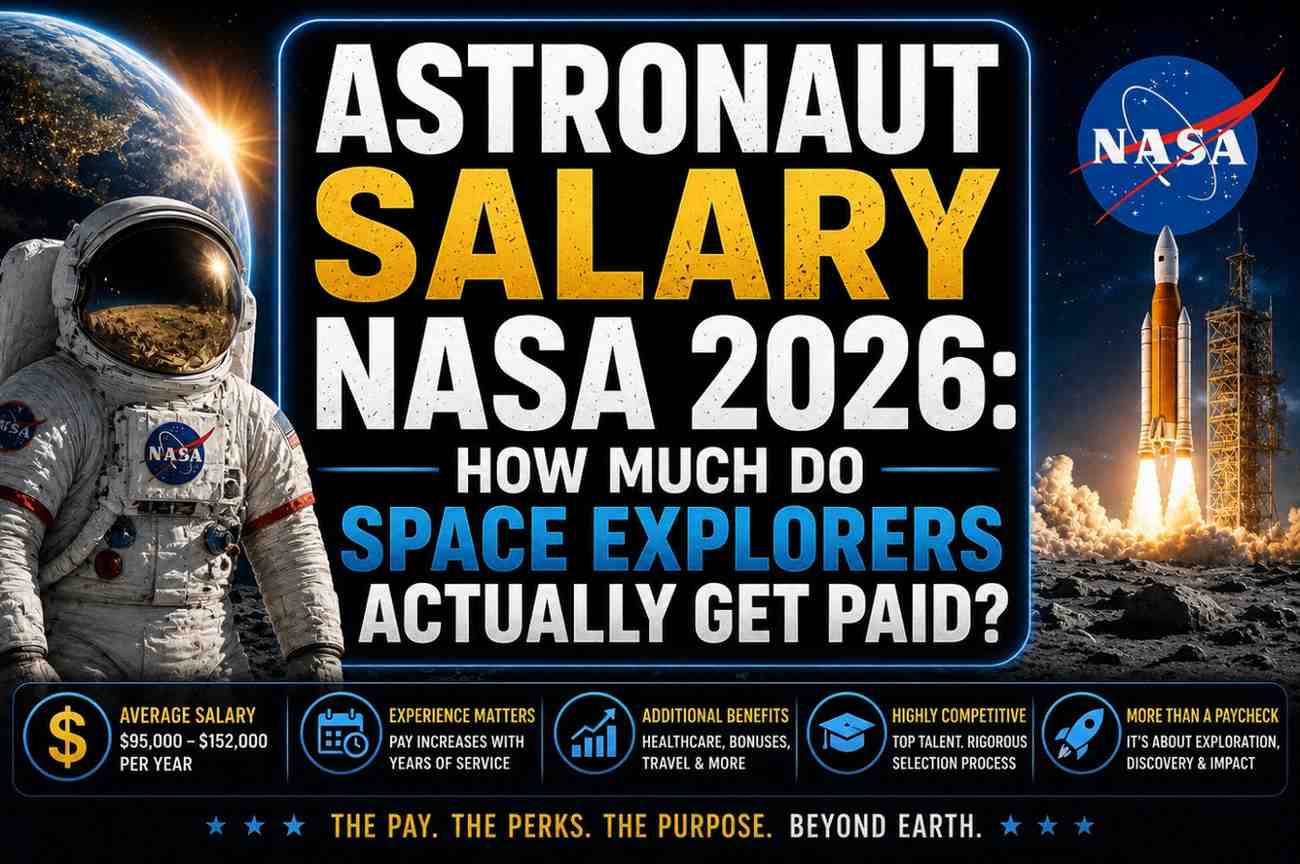
Introduction
Astronaut salary NASA 2026 might surprise you. Given that these are the most elite professionals on Earth — people who’ve spent decades in military service, earned advanced degrees, and been selected from tens of thousands of applicants — you might expect extraordinary pay.
The reality is more nuanced. NASA astronauts are federal government employees, and their salaries reflect that. But there’s much more to the compensation picture than the base paycheck.
Here’s a complete breakdown of astronaut salary NASA 2026 — from base pay to benefits to the reality of what this extraordinary career actually pays.
Astronaut Salary NASA 2026: The Base Pay
NASA astronauts are classified under the federal government’s General Schedule (GS) pay scale. In 2026, astronauts typically fall between GS-12 and GS-15, depending on experience and rank.
Here’s what the GS pay bands look like for the Washington D.C./Houston area (where locality pay is included):
| Pay Grade | Annual Salary Range (2026 estimate) |
|---|---|
| GS-12 | $90,000 – $117,000 |
| GS-13 | $107,000 – $139,000 |
| GS-14 | $126,000 – $164,000 |
| GS-15 | $148,000 – $191,000 |
Most experienced career astronauts fall at GS-14 or GS-15 — putting their astronaut salary NASA 2026 at $126,000 to $191,000 per year.
New astronaut candidates (ASCANs) during their two-year training typically start at GS-12 or GS-13 while they complete the program.
Does the Astronaut Salary Change During Spaceflight?
Here’s something most people don’t know: astronaut salary NASA 2026 does not automatically increase when an astronaut launches to the ISS.
Astronauts receive the same GS pay whether they’re on Earth or in orbit. However, during missions, many regular expenses disappear — no rent, no groceries, no commuting costs. Some astronauts save significantly during long-duration missions for this reason.
There are also specific per diem allowances for mission travel, but these are modest.
Military Astronauts: A Different Pay Structure
Many NASA astronauts come from military backgrounds — Navy test pilots, Air Force officers, Army aviators. These individuals are on military detail to NASA and continue to receive military pay rather than the GS scale.
Military O-5 (Commander/Lt. Colonel) to O-6 (Captain/Colonel) pay in 2026 ranges roughly:
- O-5 with 16+ years service: ~$108,000–$130,000
- O-6 with 20+ years service: ~$130,000–$155,000
Plus military benefits, housing allowances, and retirement contributions — which can make the total compensation package considerably larger than the base figures suggest.
The Full Compensation Package for NASA Astronauts
Astronaut salary NASA 2026 is only part of the picture. The full government compensation package includes:
- Federal health insurance (FEHB) — some of the best coverage in the country, heavily subsidized
- Federal retirement (FERS pension) — significant defined benefit after 20+ years
- Thrift Savings Plan (TSP) — 401k equivalent with government matching
- Life insurance (FEGLI)
- Paid time off — generous federal leave policies
- Training and education — ongoing flight training, language courses, etc.
For military astronauts, this also includes BAH (housing allowance), BAS (food allowance), and the full military benefits package.
Astronaut Salary Compared to Other Elite Careers
How does astronaut salary NASA 2026 compare to other highly competitive careers?
| Career | Average Annual Salary |
|---|---|
| NASA Astronaut (GS-15) | $148,000–$191,000 |
| Commercial Airline Captain | $200,000–$350,000 |
| Neurosurgeon | $600,000–$800,000 |
| SpaceX Astronaut (commercial) | Estimated $150,000–$250,000+ |
| Fighter Pilot (military) | $80,000–$130,000 |
| Petroleum Engineer | $130,000–$180,000 |
Notably, NASA astronauts are paid significantly less than commercial airline captains with comparable flight hours — and far less than medical specialists with comparable education levels.
The astronaut salary NASA 2026 reflects the government pay scale constraint, not the market value of the skills and qualifications required.
Commercial Astronauts: A Different World
Private companies like SpaceX, Blue Origin, and Virgin Galactic are creating a new category of professional astronauts — and compensation structures are far less transparent.
SpaceX’s astronaut program (for company employees who fly on Dragon) is believed to offer salaries well above the NASA GS scale, along with equity compensation and other private sector benefits.
As commercial spaceflight expands, the astronaut salary landscape will become increasingly complex and varied.
Why People Become Astronauts Despite the Pay
Given the education required, the training time invested, and the risks involved, astronaut salary NASA 2026 is arguably modest for what the job demands.
So why do people pursue it? The answers are consistent across every astronaut biography:
- Mission purpose — the sense of contributing to human exploration
- Unprecedented experiences — views, challenges, and achievements no money can buy
- Scientific contribution — advancing knowledge for all humanity
- Legacy — becoming part of history
- Community — belonging to one of the most elite and tightly bonded professional communities on Earth
For most astronauts, the NASA salary is secondary to why they’re there.
Related Article: How to Become a NASA Astronaut 2026 — Step by Step Guide
Do Astronauts Get Hazard Pay?
Given the genuine life-threatening risks of spaceflight, you might wonder if astronaut salary NASA 2026 includes hazard pay. The answer is: technically, yes — but minimally.
Federal employees who work in hazardous conditions can receive small hazard pay differentials (usually 25% of base pay for the specific hazardous duty days). But this is not a substantial addition to overall compensation.
The assumption embedded in astronaut selection is that candidates fully understand and accept the risks — compensation is not structured around hazard premiums.
External Resources
FAQ: Astronaut Salary NASA 2026
Q1: How much do NASA astronauts make in 2026? The astronaut salary NASA 2026 ranges from approximately $90,000 for entry-level candidates to $191,000 for senior GS-15 astronauts, plus federal benefits.
Q2: Do astronauts get paid more when they’re in space? No — astronaut salary NASA 2026 does not automatically increase during spaceflight. Pay remains on the standard GS scale.
Q3: Do military astronauts earn more than civilian astronauts? Military astronauts receive military pay (O-5/O-6 range) plus housing and food allowances, which can equal or exceed civilian GS pay when total compensation is compared.
Q4: Is NASA astronaut pay competitive with private sector space companies? Commercial companies like SpaceX are believed to offer higher salaries, but NASA’s federal benefits package — retirement, health insurance, pension — adds significant long-term value.
Q5: What benefits do NASA astronauts receive besides salary? Federal health insurance, FERS pension, Thrift Savings Plan matching, life insurance, generous leave, and ongoing training are all part of the full astronaut compensation package.
Conclusion
Astronaut salary NASA 2026 sits in the $90,000–$191,000 range depending on grade and experience — competitive by government standards, but modest given the extraordinary qualifications required.
The full compensation picture — federal benefits, retirement, health coverage, and military add-ons — makes the total package more attractive than base pay alone suggests.
But at the end of the day, the astronauts floating above your head right now aren’t there for the paycheck. They’re there because they love exploration, science, and the extraordinary privilege of seeing Earth from above.
Interested in one day earning the NASA astronaut salary yourself? Start building your qualifications now — the next selection window will come sooner than you think.