 Ramrajeshbee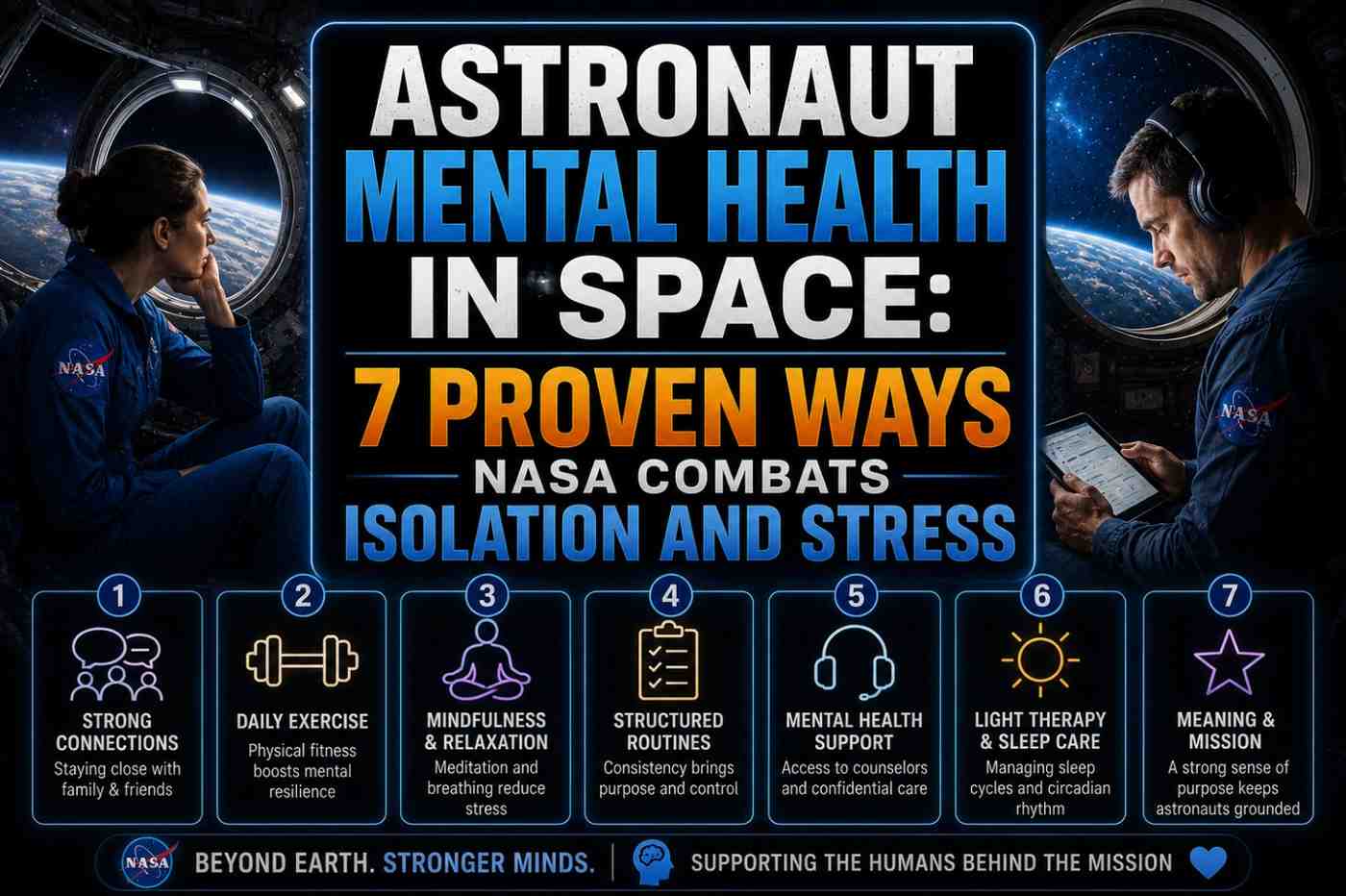
Introduction
Astronaut mental health in space rarely makes headlines — but it’s one of NASA’s most serious ongoing challenges. You can engineer a spacecraft to perfection, but you can’t fully engineer the human mind.
Months of isolation, confinement, endless recycled air, and the ever-present awareness that you’re 250 miles above the only home humanity has ever known — these take a toll.
Here’s how NASA prepares and protects astronaut mental health in space — and why it matters more than ever as missions extend toward the Moon and Mars.
The Unique Mental Health Challenges of Spaceflight
Astronaut mental health in space is challenged by a specific constellation of stressors that don’t exist anywhere else on Earth:
- Isolation — physically cut off from family and friends
- Confinement — living and working in a space roughly the size of a six-bedroom house with the same 5–6 people for months
- Monotony — repetitive routines day after day
- Danger awareness — constant background knowledge of the life-threatening environment outside
- Communication delay — for deep space missions, real-time conversation with loved ones becomes impossible
- Limited privacy — nearly every action is monitored for safety
- Workload stress — high-stakes tasks with little room for error
NASA has studied astronaut mental health in space intensively since the early Shuttle and Mir programs — and the lessons are profound.
7 Proven Strategies NASA Uses to Protect Astronaut Mental Health in Space
1. Psychological Screening Before Selection
The first line of defense for astronaut mental health in space happens before launch. NASA’s astronaut selection process includes extensive psychological evaluation — personality tests, stress interviews, group dynamics assessments, and background reviews.
Candidates are selected partly for psychological resilience, emotional intelligence, and the ability to function under extreme conditions.
2. Private Weekly Sessions with Psychologists
Every ISS crew member has private, confidential video calls with a psychologist at least weekly. These sessions are completely private — not shared with mission commanders or NASA administrators.
This confidentiality is crucial. Astronauts must feel safe discussing struggles without fear of being grounded or reassigned.
3. Family Communication Support
Astronaut mental health in space depends heavily on maintaining connections with loved ones. NASA facilitates:
- Daily private video calls with family
- Email and text messaging
- Arranged surprise calls with friends or mentors
- Family counseling support on the ground to help families cope
The loneliness of separation is real, and maintaining those bonds is clinically important.
4. Crew Cohesion Training
Before launch, crews spend months in group training — including wilderness survival exercises, cave exploration, and underwater habitat simulations — designed to build trust and cohesion.
A crew that functions as a genuine team is far more resilient than a group of individuals. NASA’s research shows that crew dynamics are among the most powerful predictors of mission psychological success.
5. Structured Off-Time and Recreation
Astronaut mental health in space requires genuine rest and recreation — not just sleep. ISS schedules include designated free time for:
- Reading or watching movies
- Playing musical instruments (guitars and keyboards have been aboard the ISS)
- Earth observation photography — a universally beloved activity
- Exercise beyond the mandatory requirement
- Personal hobbies and creative pursuits
Scott Kelly’s time-lapse photography from the ISS became a worldwide sensation. For him, it was also a critical psychological anchor.
6. Real-Time Monitoring and Support
NASA flight surgeons and behavioral health specialists monitor crew members continuously through behavioral observation, communication patterns, sleep quality data, and physical health metrics.
If signs of psychological distress emerge, support is deployed immediately — adjusting schedules, increasing communication support, or in extreme cases, considering early return.
7. Preparation for Deep Space Isolation
For Artemis missions and beyond, astronaut mental health in space will face new challenges. Communication delays of minutes or hours make real-time support impossible.
NASA is developing AI-based mental health support tools, autonomous counseling protocols, and group therapy frameworks that can function without Earth contact.
Related Article: How Astronauts Sleep in Space — Zero Gravity Sleep Explained
The Historical Record: When Mental Health Became a Crisis
Astronaut mental health in space has led to documented crises in the past. During the Skylab 4 mission in 1973, the crew staged an informal “mutiny” — taking a day off from their intense schedule without mission control’s permission, citing burnout and exhaustion.
It was a watershed moment that led NASA to fundamentally redesign how crew schedules and autonomy are managed.
More recently, research on long-duration simulations like the Mars-500 project revealed that monotony, confinement, and interpersonal friction — not fear of danger — are the primary threats to astronaut mental health in space.
Mental Health for Future Mars Missions
For a Mars mission lasting 2–3 years, with communication delays up to 20 minutes each way, astronaut mental health in space will be tested like never before. Real-time Earth support will be impossible.
NASA’s human factors teams are developing:
- Autonomous psychological assessment tools
- AI companions for mental health support
- Enhanced crew cohesion protocols for small group long-duration confinement
- Augmented reality systems to simulate environments from home
The future of astronaut mental health in space is one of the most important frontiers in human spaceflight research.
External Resources
FAQ: Astronaut Mental Health in Space
Q1: Is mental health screening part of astronaut selection? Yes — extensive psychological evaluation is a core part of NASA’s astronaut selection process.
Q2: Do astronauts get therapy in space? Yes — each crew member has confidential weekly sessions with a NASA psychologist via private video call.
Q3: What is the biggest mental health challenge in space? Research consistently identifies isolation, monotony, and interpersonal conflict — not fear of danger — as the primary threats to astronaut mental health in space.
Q4: Has an astronaut ever had a serious mental health crisis in space? There have been documented cases of significant psychological distress, including the informal Skylab 4 “mutiny” in 1973 due to crew burnout.
Q5: How will NASA handle mental health on a Mars mission? For Mars, NASA is developing autonomous mental health support tools and AI-based resources since real-time communication with Earth will not be possible.
Conclusion
Astronaut mental health in space is not a secondary concern — it’s a mission-critical priority. The physical environment of space is dangerous, but the psychological environment can be equally challenging.
NASA’s evidence-based approach to astronaut mental health — combining rigorous selection, ongoing support, and cutting-edge research — represents some of the most advanced applied psychology in human history.
As we prepare for longer and more distant missions, these lessons will matter more than ever.