
 Ramrajeshbee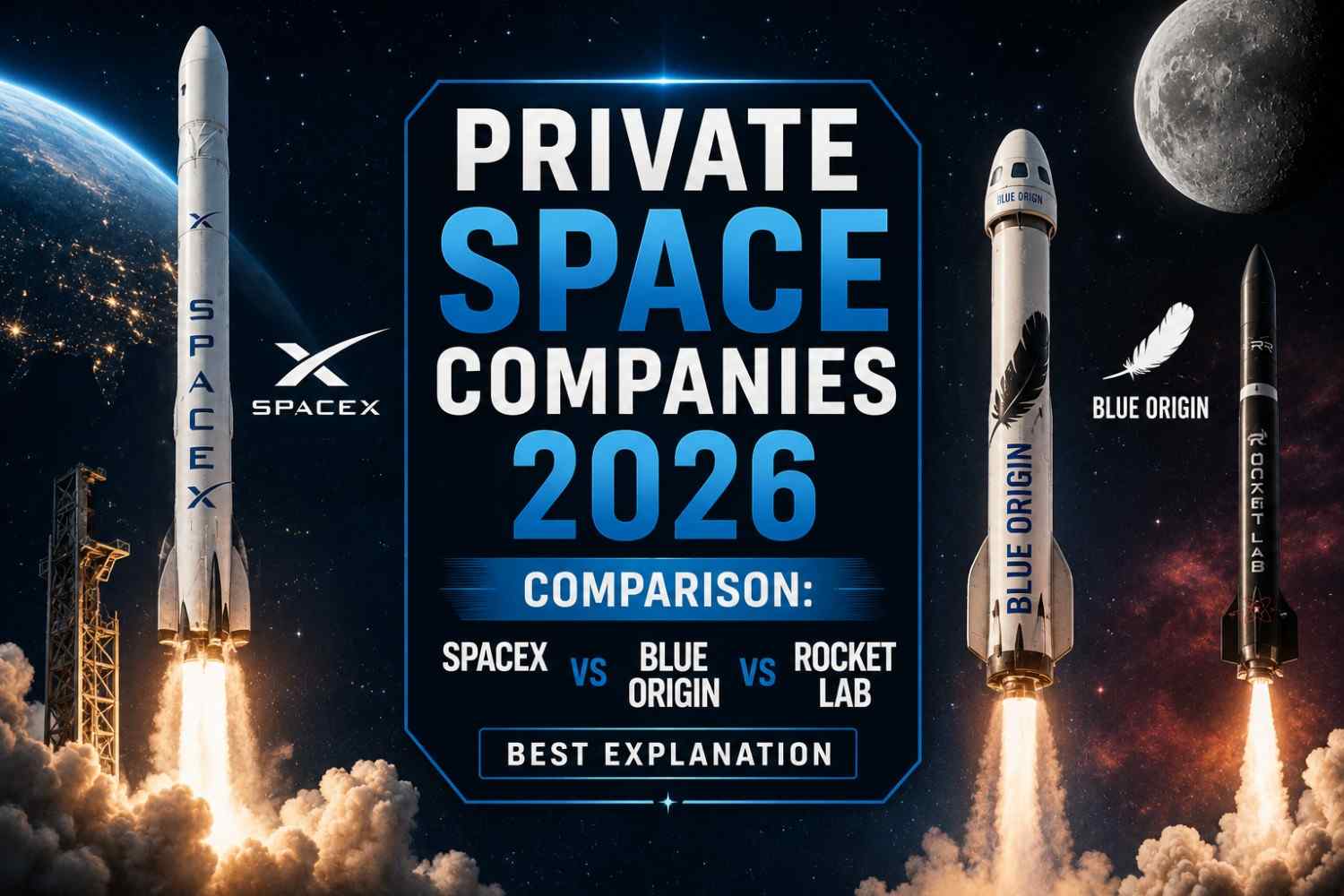
Introduction
The private space companies 2026 comparison reveals an industry that has evolved beyond all expectations in just 15 years.
SpaceX effectively created the commercial launch industry. Blue Origin has spent billions building toward a different vision. Rocket Lab carved out the small satellite niche and is now going medium.
This private space companies 2026 comparison breaks down rockets, revenue, ambitions, and which company is actually winning — by each metric that matters.
Why This Comparison Matters in 2026
In 2010, there were almost no private launch companies. Today, in this private space companies 2026 comparison, we’re looking at:
- SpaceX completing the 200th Falcon 9 mission milestone
- Blue Origin achieving first human orbital flights on New Glenn
- Rocket Lab targeting medium-lift with Neutron while operating Electron globally
The stakes are enormous. Launch contracts, military satellites, commercial stations, and Moon missions all flow through these companies. The private space companies 2026 comparison determines who gets those contracts.
SpaceX — The Undisputed Market Leader
Rockets and Launch Cadence
SpaceX’s position in any private space companies 2026 comparison is dominant almost to the point of unfair.
Active rockets in 2026:
- Falcon 9: ~100 launches per year; ~$67M per launch; 96%+ success rate
- Falcon Heavy: ~6 launches per year; ~$97M per launch
- Starship (V3): First operational missions; cost target <$10M per launch
For context, Falcon 9 alone has launched more rockets than any nation’s entire fleet for the last several years running.
Revenue
SpaceX revenue in 2025 exceeded $15 billion, driven primarily by:
- Starlink subscription revenue (~$8B+)
- Commercial and government launch contracts (~$4B)
- NASA contracts (Crew Dragon, HLS, CRS) (~$3B)
Starlink — with ~6 million subscribers globally and expanding — transforms SpaceX from a launch company into an internet utility with a rocket hobby.
Key Strengths
- Most reliable rocket in history (Falcon 9)
- Only company with full vertical integration from engine to satellite constellation
- Starship’s cost revolution, if it delivers, makes all competition irrelevant in heavy lift
Key Weaknesses
- Regulatory friction with FAA (launch license delays)
- Starship’s complexity means any failure is high-stakes
- Political dependencies on government contracts (NASA, DOD) create risk if relationships shift
Blue Origin — The Resurgent Challenger
Rockets and Launch Cadence
Blue Origin spent years as the “tortoise” to SpaceX’s “hare.” In this private space companies 2026 comparison, New Glenn’s operational debut changes that narrative significantly.
Active rockets in 2026:
- New Shepard: ~8–10 suborbital tourism/research flights per year
- New Glenn: First orbital flights operational; ~$70–100M per launch; competing directly with Falcon 9
New Glenn is a genuinely impressive rocket:
- Two-stage, fully reusable first stage
- 45 tonnes to LEO (expendable); ~13t reusable
- 7-meter fairing — largest in the industry
- First flight (January 2024) reached orbit on debut — a remarkable achievement
Revenue
Blue Origin remains privately funded by Jeff Bezos ($1B+ per year injected). Revenue from launches is nascent — they have US Space Force and commercial contracts for New Glenn, but the customer base is still being established.
The company is not publicly profitable, and Bezos’s personal funding is what keeps the comparison competitive in 2026.
Key Strengths
- New Glenn’s large fairing (7m) captures payloads no Falcon 9 can fit
- Orbital Reef space station partnership positions them for post-ISS commercial station market
- Deep pockets: Bezos’s $200B net worth insulates against short-term losses
Key Weaknesses
- A decade behind SpaceX in operational experience
- No equivalent to Starlink for revenue diversification
- New Glenn launch cadence is still ramping — reliability record is thin
Rocket Lab — The Clever Specialist
Rockets and Launch Cadence
Rocket Lab’s inclusion in this private space companies 2026 comparison is about specialization and execution — not volume.
Active rockets in 2026:
- Electron: ~15–20 launches per year; ~$7.5M per launch; 40+ successful flights
- Neutron (development): Medium-lift (8 tonnes to LEO); targeting first launch 2026–2027
Electron is the world’s most frequently launched small dedicated launch vehicle. It has captured the dedicated small satellite launch market that Falcon 9’s rideshare program can’t fully serve (dedicated schedule, dedicated orbit, on your timeline).
Revenue
Rocket Lab is publicly traded (RKLB) and reported ~$400M in 2024 revenue. This breaks down as:
- Launch services (~40%)
- Space systems (spacecraft manufacture, components) (~60%)
This private space companies 2026 comparison point is critical: Rocket Lab is not just a launch company. They build spacecraft buses, solar panels, reaction wheels, and complete satellites for customers. It’s a vertically integrated space services business.
Key Strengths
- Profitability path is clearer than Blue Origin (public company, actual customers)
- Neutron, if successful, moves them into head-to-head competition with Falcon 9 reusability
- Space systems diversification reduces launch-only revenue risk
- Recovered Electron boosters (helicopter catch) demonstrate reusability R&D
Key Weaknesses
- Electron is too small for the largest contracts
- Neutron must succeed or Rocket Lab remains a niche player permanently
- Limited ability to self-fund at SpaceX/Blue Origin scale
The Head-to-Head Comparison
Launch Cost Per Kilogram to LEO (2026)
| Company | Vehicle | Cost/kg to LEO (approx.) |
|---|---|---|
| SpaceX | Falcon 9 (reusable) | ~$1,500 |
| SpaceX | Starship (target) | <$100 |
| Blue Origin | New Glenn | ~$2,000–3,000 |
| Rocket Lab | Electron | ~$25,000 |
| Rocket Lab | Neutron (projected) | ~$3,000–5,000 |
SpaceX wins on cost, and Starship makes that advantage absurd if it reaches full cadence.
Reliability Record
| Company | Vehicle | Success Rate |
|---|---|---|
| SpaceX | Falcon 9 | ~97.5% |
| SpaceX | Falcon Heavy | ~100% |
| Blue Origin | New Shepard | ~100% (suborbital) |
| Blue Origin | New Glenn | Early missions — too few for statistical comparison |
| Rocket Lab | Electron | ~90%+ |
Crewed Spaceflight Capability
| Company | Status |
|---|---|
| SpaceX | Operational (Dragon); crew of 4; ISS missions ongoing |
| Blue Origin | Crewed orbital capability in development (New Glenn with capsule planned) |
| Rocket Lab | No crewed capability; not in roadmap |
For government human spaceflight contracts, SpaceX is the only game in town domestically in 2026.
Who’s Winning This Private Space Companies 2026 Comparison?
By market share: SpaceX — no contest. By growth trajectory: Blue Origin is closing ground, but slowly. By profitability: Rocket Lab is the most financially disciplined. By vision scale: SpaceX (Mars civilization) vs Blue Origin (orbital colonies) are both playing long games that dwarf Rocket Lab’s near-term focus.
The most interesting private space companies 2026 comparison dynamic: Neutron, if Rocket Lab delivers a reusable medium-lift vehicle, gives them a seat at the real table. And Blue Origin’s space station ambitions (Orbital Reef) could become a billion-dollar business entirely independent of launch.
Related: Commercial Space Stations After ISS 2030 — Who Will Replace the Space Station?
Beyond the Big Three: Other Companies Worth Watching
This private space companies 2026 comparison focuses on the top three, but the broader ecosystem includes:
- United Launch Alliance (ULA): Vulcan Centaur is operational; legacy defense contracts; no reusability roadmap
- Relativity Space: Abandoned Terran 1 for Terran R — a reusable medium-lift rocket targeting 2026 debut
- Stoke Space: Developing a fully reusable rocket with upper stage propulsive landing — the most technically ambitious new entrant
- ABL Space Systems: Small lift; operational; primarily military and government customers
Related: Future of Space Exploration 2026 to 2040 — Moon Bases, Mars Colonies & Beyond
5 Frequently Asked Questions
Q1: Is SpaceX publicly traded? No. SpaceX remains private as of 2026, though Starlink has been discussed as a potential IPO candidate. Rocket Lab (RKLB) is publicly traded; Blue Origin is private (Bezos-funded).
Q2: Can Blue Origin catch SpaceX in this private space companies 2026 comparison? In launch volume: unlikely in the near term. In specific markets like heavy-lift with large fairings, and commercial space stations — yes, genuinely competitive.
Q3: Why is Rocket Lab’s Electron so expensive per kg if it’s a modern rocket? Small rockets have poor economies of scale — fixed costs of a launch (range fees, operations, recovery) are similar whether you carry 300kg or 30,000kg. Electron’s value is dedicated schedule and orbit, not cost per kg.
Q4: Who launches more satellites — SpaceX or everyone else combined? SpaceX. Their own Starlink constellation alone accounts for more satellite mass launched than all other operators globally combined in most years since 2020.
Q5: Which private space company has the best safety record? SpaceX Falcon 9 has never had a crew fatality and has the highest flight cadence with the highest reliability rate (97.5%+). Rocket Lab Electron has an excellent record too. Blue Origin New Glenn’s record is too new for meaningful statistical comparison.
Conclusion
The private space companies 2026 comparison reveals an industry that is genuinely competitive at the top, even if SpaceX’s lead seems insurmountable on pure metrics today.
SpaceX is winning the present. Blue Origin is building for a different future. Rocket Lab is executing the most disciplined business strategy.
And the truth is — we need all of them. Competition drives innovation, reduces prices, and ensures that no single point of failure can ground humanity’s access to space.
The private space companies 2026 comparison will look very different by 2030. Keep watching.
Follow our complete commercial space coverage for company updates, launch results, and contract announcements throughout 2026.
External sources: SpaceX Launch Manifest | Rocket Lab Investor Relations