 Ramrajeshbee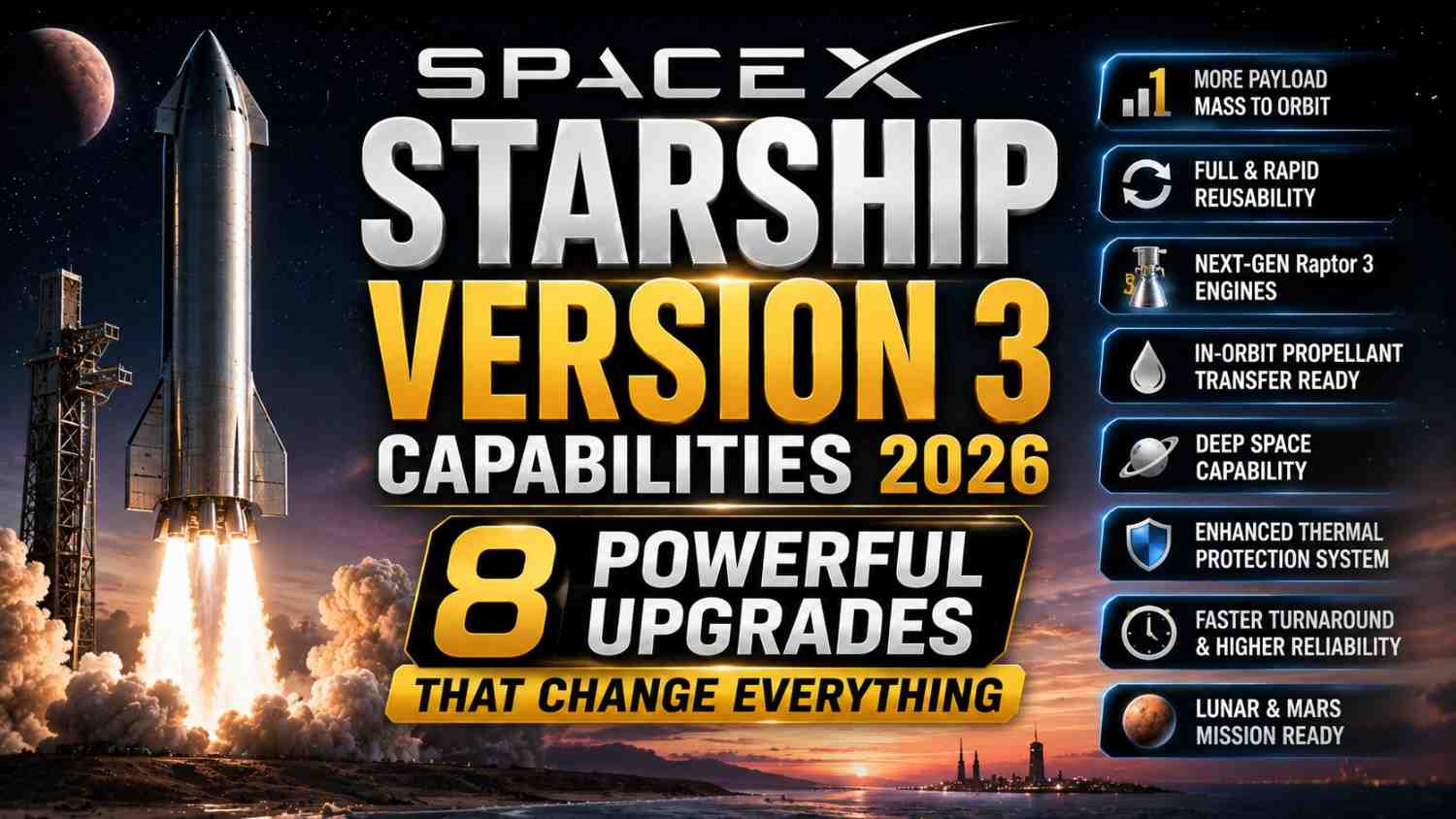
Introduction
SpaceX Starship Version 3 capabilities in 2026 represent the most significant leap in rocket engineering since the Saturn V took humans to the Moon.
Version 2 proved the concept. Version 3 delivers the performance. And in 2026, the world will watch this vehicle attempt its most ambitious missions yet—including lunar landing demonstrations for NASA’s Artemis program.
This article breaks down exactly what SpaceX Starship Version 3 capabilities in 2026 mean for spaceflight, and why this rocket changes the economics of everything.
What Is Starship Version 3?
Starship is a two-stage fully reusable rocket system. The Super Heavy booster is stage one; the Starship upper stage carries crew and cargo.
SpaceX Starship Version 3 capabilities 2026 represent the third major iteration after:
- Version 1 (2023): First integrated flight tests; multiple anomalies
- Version 2 (2024–2025): Successful booster catch with mechazilla arms; upper stage reentry
- Version 3 (2026): Full rapid reusability; upgraded engines; increased payload
The key word in SpaceX Starship Version 3 capabilities 2026 is reusability. Version 3 is designed to fly multiple times per week.
8 Powerful Upgrades in Starship Version 3
1. Raptor 3 Engines — More Thrust, Less Weight
Version 3 uses the Raptor 3 engine, SpaceX’s most efficient full-flow staged combustion engine to date.
Key improvements over Raptor 2:
- Thrust: ~280 metric tonnes per engine (up from ~230)
- Specific impulse: Higher, meaning more efficient fuel use
- External plumbing eliminated: Raptor 3 integrates all lines internally — fewer failure points, less weight
Super Heavy booster carries 33 Raptor 3 engines. Total liftoff thrust: approximately 9,000 tonnes — nearly twice the Saturn V.
2. Payload to Orbit: 150+ Tonnes
The defining SpaceX Starship Version 3 capability in 2026 is payload capacity.
- Expendable mode: Over 150 metric tonnes to low Earth orbit (LEO)
- Reusable mode: ~100 metric tonnes to LEO
- To the Moon (with refueling): ~100 tonnes of cargo
- To Mars (with refueling): ~100 tonnes
For comparison: the Saturn V could lift 130 tonnes to LEO and was never reused. Starship does 150 tonnes and lands itself back on the pad.
3. Rapid Reusability — Turnaround in Hours
SpaceX Starship Version 3 capabilities 2026 include a target turnaround time measured in hours, not months.
SpaceX’s ambition:
- Catch the booster with mechazilla arms at launch pad
- Refuel and relaunch the booster within 1 hour
- Turn around the upper stage within 24 hours
If achieved, this single capability reduces the cost per kilogram to orbit from ~$2,000 (Falcon 9) to potentially under $100.
4. In-Space Propellant Transfer
One of the most critical SpaceX Starship Version 3 capabilities in 2026 is orbital refueling.
NASA’s Human Landing System (HLS) contract requires SpaceX to demonstrate propellant transfer in orbit before a Moon landing can happen. Version 3 is the vehicle that performs these transfers.
Multiple Starship tanker flights top off the HLS vehicle before it departs for the Moon. This is how Starship reaches the Moon despite Earth’s gravity — refuel in orbit, then leave.
5. Lunar Starship (HLS) — NASA’s Moon Lander
The Starship HLS variant is specifically designed to land on the Moon for Artemis III, targeting 2026.
SpaceX Starship Version 3 capabilities 2026 include:
- Landing legs optimized for lunar regolith
- Airlock for EVA operations on the Moon
- Internal cargo configuration for lunar surface equipment
- Ability to remain on the Moon for weeks to months
6. Heat Shield Tiles — Generation 3
Starship’s thermal protection system has been dramatically improved.
Version 3 features:
- New tile geometry that interlock more reliably
- Improved bonding adhesive reducing tile loss on reentry
- Windward tile density reduced by weight-optimizing high-heat zones
- Active water-cooled sections on the highest-heat flap areas
Surviving reentry reliably is what makes SpaceX Starship Version 3 capabilities 2026 commercially viable.
7. Expanded Payload Bay
Version 3 features a larger payload bay than earlier designs:
- Diameter: 9 meters internal
- Length: ~17 meters usable
- Volume: Largest ever on any operational spacecraft
This fits satellites too large for any other rocket, entire space station modules, large telescope assemblies, or hundreds of Starlink satellites per launch.
8. Point-to-Point Earth Transport (Experimental)
SpaceX Starship Version 3 capabilities 2026 include early testing of Earth-to-Earth transport — flying passengers from one city to another in under 45 minutes.
This remains experimental in 2026, with regulatory and safety hurdles far ahead of the technical ones. But demonstration flights over oceans may begin this year.
Related: Private Space Companies 2026 Comparison — SpaceX vs Blue Origin vs Rocket Lab
Starship Version 3 vs. Previous Heavy Rockets
| Metric | Saturn V | Space Shuttle | Falcon Heavy | Starship V3 |
|---|---|---|---|---|
| LEO Payload | 130t | 24t | 64t | 150t+ |
| Reusable? | No | Partial | Partial | Fully |
| Cost per kg | ~$54,000 | ~$65,000 | ~$1,500 | <$100 target |
| Turnaround | N/A | Months | Days | Hours |
The numbers in the SpaceX Starship Version 3 capabilities 2026 column are not incremental improvements — they’re a category change.
What Starship Version 3 Makes Possible in 2026
NASA Artemis III Lunar Landing
This is the mission that defines SpaceX Starship Version 3 capabilities in 2026 for the general public. Two NASA astronauts, one of whom will be the first woman to walk on the Moon, using Starship HLS as their lander.
Starlink Gen 3 Mega-Constellation
SpaceX plans to launch Starlink Version 3 satellites using Starship, each far larger and more capable than current Starlink dishes. One Starship can deploy satellites that previously required 20 Falcon 9 flights.
First Commercial Lunar Missions
Payload customers including scientific instruments, resource prospecting rovers, and commercial cargo will fly to the Moon aboard Starship in 2026.
Related: Moon Base Construction Plan 2026–2035 — NASA Gateway Explained
Risks and Challenges
SpaceX Starship Version 3 capabilities 2026 are impressive on paper — but space is unforgiving.
Key risks:
- In-orbit refueling has never been demonstrated at this scale
- Regulatory approvals from the FAA have historically delayed SpaceX launches by months
- Mechazilla booster catch has succeeded in testing but must prove reliability for crewed missions
- Heat shield performance must be 100% reliable for astronaut return from the Moon
SpaceX’s philosophy is “test to failure, fix, test again.” That philosophy works. But it means delays are baked in.
5 Frequently Asked Questions
Q1: When will Starship Version 3 first fly? Starship Version 3 test flights are planned for early 2026, with the first fully operational mission (NASA HLS demonstration) targeting mid-to-late 2026.
Q2: How much does a Starship launch cost? SpaceX’s target is under $10 million per launch at high flight rates — compared to $150 million+ for traditional heavy rockets. As of 2026, actual prices for early missions are higher.
Q3: Can Starship Version 3 reach Mars? Yes, with orbital refueling. SpaceX Starship Version 3 capabilities 2026 include propellant transfer tech that enables Mars transit once fully operational.
Q4: What happens to the Super Heavy booster after launch? It is caught by the launch tower’s mechanical arms (“mechazilla”), refueled, and relaunched — all within hours at the target cadence.
Q5: How does Starship Version 3 compare to SLS? Starship V3 carries more payload (150t vs 95t), costs far less, and is fully reusable. SLS is expendable at ~$2.2 billion per launch. The comparison is not favorable for SLS on any metric except existing contract obligations.
Conclusion
SpaceX Starship Version 3 capabilities 2026 don’t just advance the state of the art — they obliterate the old economic model of space access entirely.
A rocket that can carry 150 tonnes, land itself, refuel, and fly again within hours transforms every mission from Moon bases to Mars colonies to Starlink mega-constellations.
Whether Version 3 delivers on every promise in 2026 or faces delays, the direction is clear. The most capable rocket ever built is operational — and it’s changing everything.
Follow our space coverage for live updates on every Starship mission in 2026.
External sources: SpaceX Starship page | NASA HLS Contract Details