 Ramrajeshbee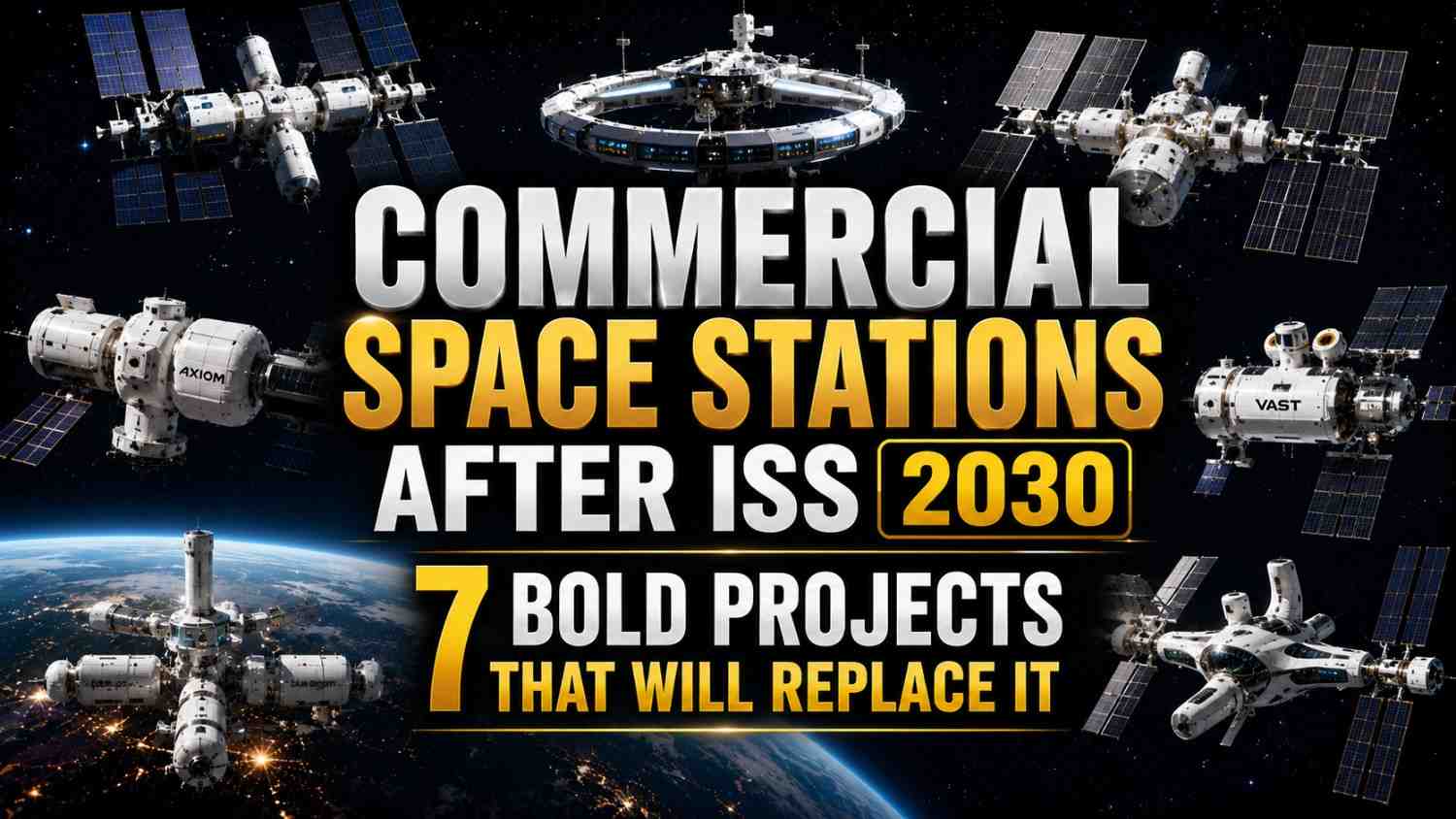
Introduction
The International Space Station has served humanity for over 25 years. But it retires in 2030 — and the question of commercial space stations after ISS 2030 is now one of the most consequential debates in modern spaceflight.
Who fills that gap? What happens to continuous human presence in low Earth orbit (LEO)? And will private companies actually deliver?
The answer, surprisingly, is optimistic. Commercial space stations after ISS 2030 are not a backup plan — they are the plan. Here’s everything you need to know.
Why the ISS Is Being Retired
The ISS launched its first module in 1998. By 2030, it will be over 30 years old — ancient by aerospace standards.
Structural fatigue, increasing maintenance costs, and aging systems make operating the ISS beyond 2030 unsustainable. NASA has estimated it would cost $1 billion per year just to maintain it.
The decision: retire the ISS, deorbit it safely over the Pacific Ocean, and hand LEO to commercial operators. This frees NASA to focus its budget on deep space — the Moon and Mars.
NASA’s CLD Program: The Bridge to Commercial
NASA’s Commercial Low Earth Orbit Destinations (CLD) program is the mechanism funding commercial space stations after ISS 2030.
NASA awarded development contracts to four companies:
- Axiom Space — $130 million
- Voyager Space / Starlab — $160 million
- Blue Origin / Orbital Reef — $130 million
- Northrop Grumman — $125.6 million
These aren’t handouts. They’re investments in future customers. NASA plans to buy crew time aboard commercial space stations after ISS 2030, just as it bought Soyuz seats from Russia for years.
The 7 Most Serious Commercial Space Station Projects
1. Axiom Space Station — The First Commercial Module in History
Axiom Space is the closest to reality among all commercial space stations after ISS 2030 contenders.
Their plan is elegant:
- Phase 1 (2026–2028): Attach commercial modules to the ISS while it’s still operational
- Phase 2 (2030): When ISS retires, detach those modules and operate independently
Axiom already sent private astronaut missions to the ISS in 2022, 2023, and 2024. They know what they’re doing.
The Axiom Station will feature:
- Research labs available for commercial lease
- Premium crew quarters (designed by Philippe Starck)
- An Earth observation module with panoramic windows
2. Starlab — The All-in-One Commercial Station
Starlab is a joint venture between Voyager Space and Airbus. It’s designed as a single large inflatable module — easier and cheaper to launch than multi-module stations.
Key specs:
- Launched on a single Starship flight (planned)
- Holds 4 crew members permanently
- Purpose-built for pharmaceutical and materials research in microgravity
Starlab targets 2028 for launch, making it potentially the first independent commercial space station after ISS 2030 to operate.
3. Orbital Reef — Blue Origin’s Space Business Park
Blue Origin calls Orbital Reef a “mixed-use business park in space.” That framing is deliberate — they’re selling it to researchers, manufacturers, filmmakers, and tourists.
Built with Sierra Space and Boeing as partners, Orbital Reef features:
- Modular design for expansion
- Sierra Space’s LIFE habitat (large inflatable module)
- Boeing’s science module
Blue Origin’s New Glenn rocket will provide the heavy-lift access.
4. Northrop Grumman Commercial Space Station
Northrop Grumman’s design leverages their Cygnus resupply spacecraft heritage. Their station is modular, scalable, and designed for robotic servicing — reducing maintenance costs significantly.
It targets a more conservative launch date of 2030–2032, positioning it as a complementary option to earlier commercial space stations after ISS 2030.
What Services Will These Stations Offer?
Commercial space stations after ISS 2030 are businesses, not just science labs. Revenue streams include:
| Service | Customers |
|---|---|
| Microgravity research | Pharma, biotech, materials science |
| Manufacturing | Fiber optics, alloys, semiconductors |
| Tourism & hospitality | Ultra-wealthy individuals, nations |
| Film & media production | Studios, streaming platforms |
| Government crew time | NASA, ESA, JAXA |
| Technology testing | Defense, communications companies |
The global market for in-space services is projected to reach $60 billion annually by 2035, according to McKinsey & Company’s Space Report.
Key Challenges Facing Commercial Space Stations After ISS 2030
Technical Risks
Building and operating a space station is extraordinarily complex. The ISS required 136 space flights and over a decade to assemble. Commercial space stations after ISS 2030 must do this faster and cheaper.
Main technical challenges:
- Life support system reliability without NASA’s 30-year ISS institutional knowledge
- Micrometeor and orbital debris shielding
- Long-duration radiation management for crew
Financial Risks
These stations are expensive. Axiom, Starlab, and Orbital Reef each require an estimated $2–5 billion in total investment before reaching operational status.
NASA’s CLD contracts cover only a fraction of that. Private capital, research contracts, and tourism revenues must fill the gap.
The Gap Risk
The ISS retires in 2030. Most commercial space stations after ISS 2030 target operational dates between 2028 and 2032. Any slippage could mean a gap in continuous human presence in LEO — the first since 2000.
NASA considers this a serious risk and is pushing contractors for earlier delivery dates.
Related: Future of Space Exploration 2026 to 2040 — Moon Bases, Mars Colonies & Beyond
International Players: China and Russia’s Plans
Commercial space stations after ISS 2030 is primarily a US-led story — but not exclusively.
China’s Tiangong Space Station is already operational, having completed its three-module configuration in 2022. It runs independently and plans to add modules through the 2030s.
Russia has announced plans for ROSS (Russian Orbital Service Station), targeting 2027 for its first module. However, funding and sanctions since 2022 have severely complicated those plans.
The global picture of commercial space stations after ISS 2030 will likely include American, Chinese, and possibly European-operated platforms in orbit simultaneously.
Why This Matters for Science and Medicine
Microgravity is a unique environment that cannot be replicated on Earth. Commercial space stations after ISS 2030 unlock:
- Drug crystal growth at higher purity than possible on Earth — potentially improving treatments for cancer, Alzheimer’s, and diabetes
- Fiber optic manufacturing with lower attenuation than ground-produced ZBLAN fiber
- Cell biology research in 3D environments that mimic how cells behave in the human body
Companies like Eli Lilly, Merck, and Bayer have already conducted pharmaceutical research on the ISS. They’re waiting for commercial space stations after ISS 2030 to expand those programs significantly.
Related: Private Space Companies 2026 Comparison — SpaceX vs Blue Origin vs Rocket Lab
5 Frequently Asked Questions
Q1: When exactly does the ISS retire? The ISS is officially planned for deorbit in January 2030. NASA will use a SpaceX Dragon spacecraft to guide it into a controlled reentry over the Pacific Ocean.
Q2: Will there be a gap in human spaceflight after ISS retirement? Possibly. NASA is working to avoid it, but delays in commercial space stations after ISS 2030 programs could create a brief gap. China’s Tiangong would remain operational regardless.
Q3: Can private citizens visit commercial space stations? Yes — that’s part of the business model. Axiom has already proven the market with private astronaut missions to the ISS costing roughly $55 million per seat.
Q4: Which commercial space station will launch first? Axiom Space is most likely to be first, with their initial modules planned to attach to the ISS by 2026 before operating independently post-2030.
Q5: Will commercial space stations after ISS 2030 be safer than the ISS? They’ll use modern designs with improved redundancy. However, they’ll lack the ISS’s decades of operational experience — a real risk that engineers are actively addressing.
Conclusion
The era of commercial space stations after ISS 2030 is not a gamble — it’s an inevitability backed by billions in investment and years of engineering work.
The ISS showed the world what humans can do in space. The next generation of commercial space stations after ISS 2030 will show what humans can build, manufacture, and discover there.
The companies that succeed will reshape industries from medicine to manufacturing. The ones that fail will teach the survivors invaluable lessons.
Either way, humanity stays in space. And that’s what matters most.
Explore our full coverage of the new space economy and bookmark this guide for updates as launch dates approach.
External sources: NASA CLD Program | McKinsey Space Economy Report