 Ramrajeshbee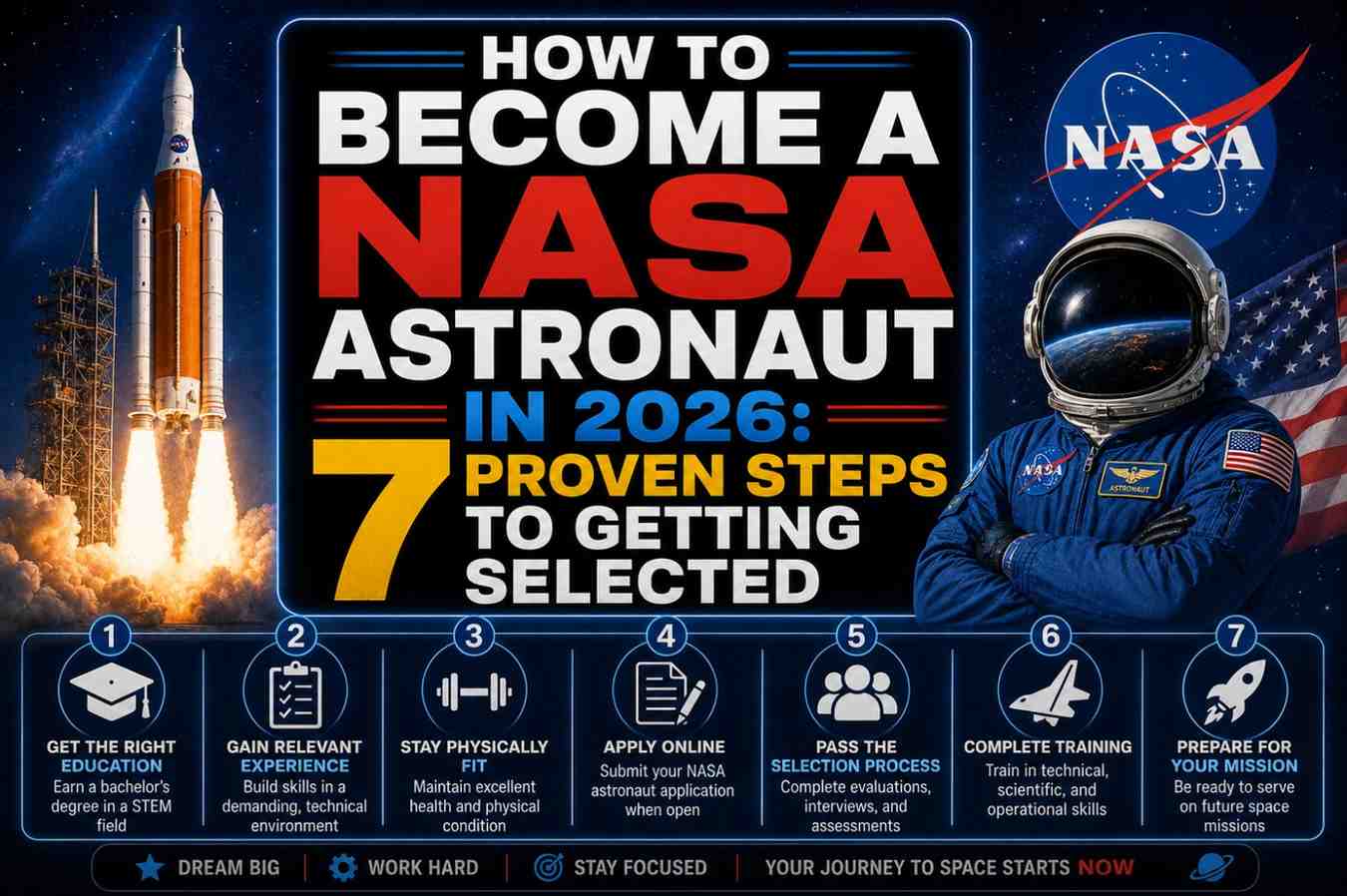
Introduction
How to become a NASA astronaut in 2026 is a question millions of people ask—but very few know the real, detailed answer. The process is longer, more demanding, and more nuanced than most people realize.
NASA doesn’t just want people with PhDs and pilot licenses. They want extraordinary humans with exceptional adaptability, teamwork, and judgment under pressure.
This step-by-step guide covers everything you need to know about how to become a NASA astronaut in 2026.
Step 1: Meet the Basic Eligibility Requirements
The first step in understanding how to become a NASA astronaut in 2026 is checking the baseline eligibility criteria. As of the most recent selection cycle, candidates must:
- Be a U.S. citizen
- Hold a master’s degree in a STEM field (engineering, biological science, physical science, computer science, or mathematics)
- Have at least 2 years of relevant professional experience OR 1,000 hours of pilot-in-command time on jet aircraft
- Pass a NASA flight physical
Note that a master’s degree requirement can also be met by a medical degree, doctoral degree, or two years of progress toward a STEM PhD.
Military experience with test pilot school graduation is highly valued but no longer strictly required.
Step 2: Build the Right Educational Foundation
If you’re planning how to become a NASA astronaut in 2026 from scratch, your education pathway matters enormously.
Top fields of study for astronaut candidates include:
- Aerospace engineering
- Electrical engineering
- Physics
- Biology or medicine
- Computer science
- Geology (especially relevant for planetary science missions)
A bachelor’s degree alone is no longer sufficient. The 2026 candidate pool is extraordinarily competitive — most applicants hold master’s or doctoral degrees from top-tier research institutions.
Recommended Universities for Aspiring Astronauts
Many successful astronauts attended military academies or top engineering schools. However, NASA evaluates candidates on experience and capability, not prestige alone.
Step 3: Gain the Right Professional Experience
Knowing how to become a NASA astronaut in 2026 requires understanding that paper qualifications alone won’t get you selected. Real-world experience is essential.
High-value professional paths include:
- Military test pilot — historically the most common background
- Research scientist or engineer at NASA, NOAA, or equivalent agency
- Medical doctor with research background
- Field scientist with remote or extreme environment experience (Antarctica, underwater habitats, etc.)
The 2017 class included a water-bear researcher, a cave diver, and a climate scientist alongside military pilots. NASA values diverse expertise.
Step 4: Apply During an Open Selection
NASA opens astronaut applications roughly every 2–4 years. During the application window:
- Submit your application through USAJobs.gov
- Provide academic transcripts, professional references, and a detailed work history
- Complete an extensive medical questionnaire
Thousands to tens of thousands of people apply in each cycle. In the 2017 cycle, over 18,300 applications were received. Only 12 were selected.
Knowing how to become a NASA astronaut in 2026 means accepting that the odds are extraordinary—but not impossible.
Step 5: Survive the Selection Process
If your application advances, you’ll face multiple rounds of evaluation:
Round 1: Paper Screening
NASA staff review all applications and narrow the pool to roughly 500–1,000 qualified candidates.
Round 2: Reference Checks and Background Review
Extensive background investigations, including security clearance review.
Round 3: First-Round Interviews
Selected candidates come to Johnson Space Center in Houston for interviews and initial medical screening.
Round 4: Final Interviews
The top ~50 candidates return for final interviews, comprehensive medical evaluations, and psychological testing.
Selection
The final class — typically 10–20 candidates — is announced publicly. They then begin a 2-year training program called TFNG (Astronaut Candidate Training).
Step 6: Complete ASCAN Training
Making it through selection is only half the battle when figuring out how to become a NASA astronaut in 2026. Astronaut Candidate (ASCAN) training is rigorous and two years long.
Training includes:
- Russian language (required for Soyuz operations)
- T-38 jet aircraft proficiency
- Spacewalk (EVA) training in the Neutral Buoyancy Lab
- Robotics and Canadarm2 operations
- ISS systems — every system aboard the station
- Survival training in wilderness, water, and desert environments
- Medical training as a crew medical officer
Only upon completing ASCAN training does a candidate officially become a NASA astronaut.
Step 7: Wait for a Mission Assignment
Even after becoming an astronaut, mission assignment is not guaranteed. Some astronauts wait years between selection and their first spaceflight.
Mission assignments depend on mission needs, spacecraft availability (Dragon, Starliner, Orion), and candidate specialties.
Patience and continued readiness are essential parts of how to become a NASA astronaut in 2026 and beyond.
Related Article: Artemis II Astronaut Crew 2026 — Meet the Four Pioneers
External Resources
FAQ: How to Become a NASA Astronaut 2026
Q1: What degree do I need to become a NASA astronaut in 2026? A master’s degree in a STEM field is required, though a medical doctorate or doctoral degree also qualifies.
Q2: Do you have to be a pilot to become a NASA astronaut? No — while pilot experience is valued, mission specialists with science or medical backgrounds are also selected without pilot qualifications.
Q3: How long does NASA astronaut training take? Initial ASCAN training lasts two years, followed by mission-specific preparation that can take additional years.
Q4: How old is too old to become a NASA astronaut 2026? There is no official age limit. Applicants must be able to pass the physical, but candidates in their 40s have been selected.
Q5: How often does NASA accept astronaut applications? Typically every 2–4 years. Monitor NASA.gov and USAJobs.gov for the next open application window.
Conclusion
How to become a NASA astronaut in 2026 comes down to a long game: the right education, the right experience, exceptional health, and the mental toughness to compete against the best humanity has to offer.
It’s one of the most difficult career paths on Earth—and one of the most rewarding.
Start building your foundation now. The next astronaut class will be announced, and when it is, you want to be ready to apply.