 Ramrajeshbee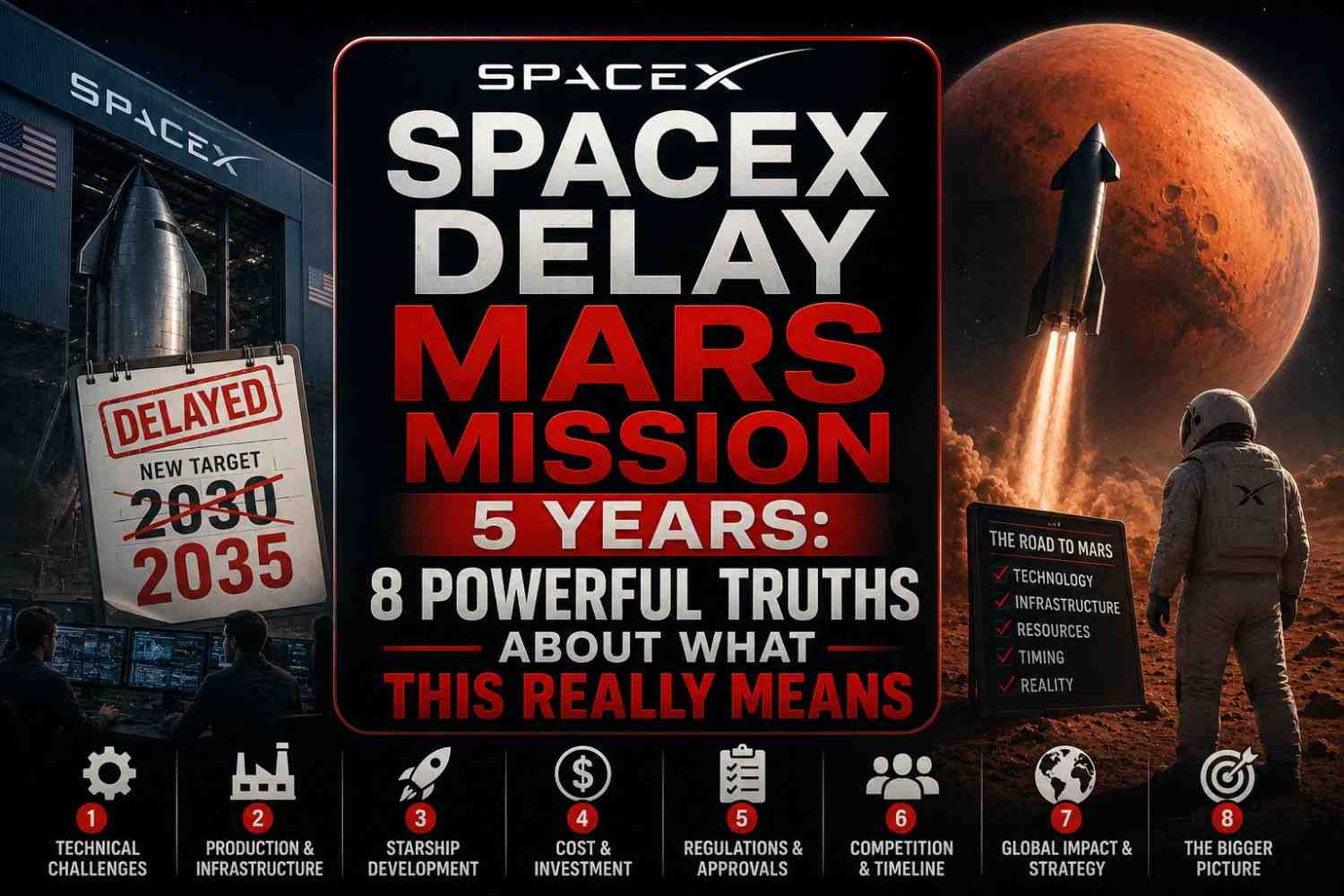
Introduction
When news broke that SpaceX delay Mars mission 5 years was a real possibility, space enthusiasts around the world felt the weight of that announcement. Elon Musk’s original timeline promised humans on Mars before 2030. Now, those projections look significantly more stretched.
But delays in space exploration aren’t always failures. Sometimes they’re signs of seriousness.
Here are 8 powerful truths about what this delay actually means — and why it may ultimately lead to a safer, more successful mission.
Why Did SpaceX Delay Mars Mission 5 Years?
The SpaceX delay Mars mission 5 years reality stems from a combination of engineering challenges, regulatory hurdles, and the sheer complexity of what’s being attempted.
This isn’t a story of failure. It’s a story of the hardest engineering problem in human history running on schedule — which is already ahead of any government program.
Truth 1 — Starship Development Took Longer Than Expected
The Starship rocket — the vehicle designed to carry humans to Mars — experienced multiple explosive test failures before achieving stable orbital flight.
Each failure, while dramatic, produced critical data. SpaceX’s rapid iteration approach meant setbacks were learning events.
The Starship Development Milestones
- SN8 through SN15 prototypes: 2020–2021, multiple pad explosions
- Orbital flight test (IFT-1): April 2023, explosive disassembly after launch
- IFT-4 (June 2024): First successful splashdown
- IFT-7 (2025): Full reusability test with booster catch
Each test pushed the timeline. The SpaceX delay Mars mission 5 years is largely a consequence of learning what no one had tried before.
Truth 2 — FAA Regulatory Approvals Created Bottlenecks
SpaceX operates under Federal Aviation Administration licensing for every Starship launch from Boca Chica, Texas.
Each explosive test triggered FAA investigations, environmental reviews, and license modifications — each taking months.
The Regulatory Reality
SpaceX and the FAA have had a complicated relationship. After IFT-1, the FAA required 63 corrective actions before the next launch.
These aren’t bureaucratic obstacles for their own sake. Starship launches 400 feet above a fragile coastal ecosystem, and FAA oversight protects both public safety and environmental integrity.
But the cumulative effect contributed significantly to the SpaceX delay Mars mission 5 years situation. Regulatory reform in the commercial space sector is now a major policy conversation in Washington.
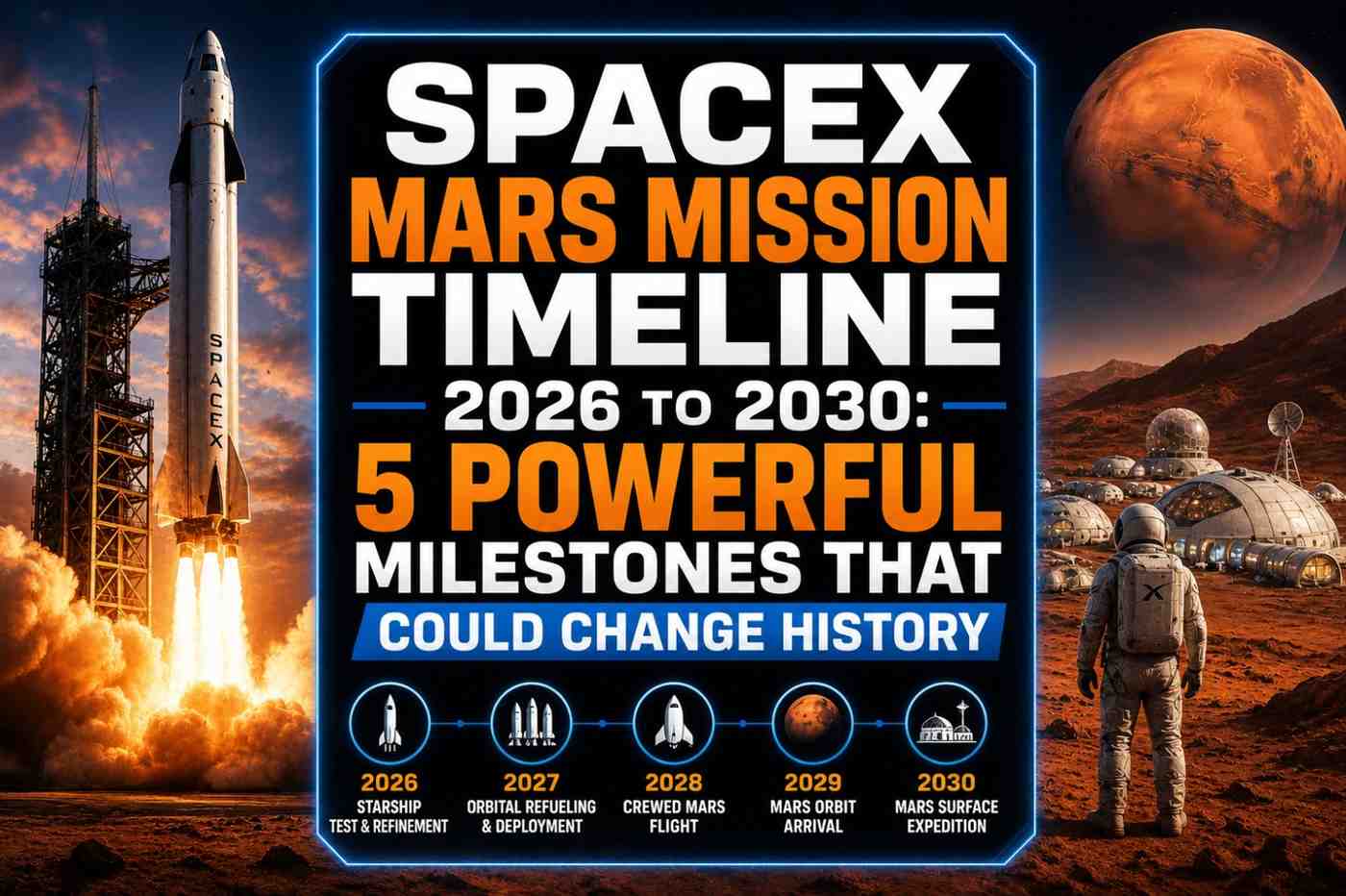
Related Article: SpaceX Mars Mission Timeline 2026 to 2030
Truth 3 — In-Situ Resource Utilization Technology Isn’t Ready
Sending humans to Mars and bringing them back requires making rocket fuel on Mars itself. This technology — called ISRU — is still in the laboratory phase.
The SpaceX delay Mars mission 5 years buys time to mature the methane production technology that is literally life-or-death for any crewed Mars mission.
What ISRU Must Achieve
To produce enough methane and liquid oxygen for a return trip from Mars, the ISRU plant must:
- Extract water ice from Mars’s subsurface
- Electrolyze water into hydrogen and oxygen
- React hydrogen with atmospheric CO₂ to produce methane
- Liquefy and store the methane for months before crew arrival
Demonstrating this at scale, reliably, on a planet 200 million kilometers away — that requires the kind of time this delay provides.
Truth 4 — Radiation Shielding Solutions Are Still Being Developed
The trip to Mars exposes astronauts to approximately 300 millisieverts of radiation — nearly the career limit recommended for NASA astronauts in Earth orbit.
Solving this problem is not optional. It’s existential.
Current Research Directions
Scientists are investigating:
- Polyethylene-composite hull linings
- Water wall shielding (storing water in double-hull structures)
- Active magnetic shielding (technically complex but highly effective)
- Biological countermeasures including specific medications
The SpaceX delay Mars mission 5 years allows radiation protection research to mature before risking human lives on a 9-month transit.
For the latest on space radiation health research, see NASA Human Research Program and ESA’s Space Medicine Office.
Truth 5 — Life Support Systems Require Extensive Testing
Keeping humans alive on Mars for 18 months without resupply is vastly more complex than anything done on the International Space Station.
Closed-loop life support systems — recycling air, water, and waste — must operate at near-100% efficiency with no option for parts delivery.
What Must Work Perfectly on Mars
- CO₂ scrubbing (produces oxygen, removes exhaled carbon dioxide)
- Water reclamation (99%+ efficiency required)
- Food production (hydroponic and aeroponic systems)
- Waste processing (thermal, chemical, and biological)
- Medical care without immediate Earth support
Each of these systems needs years of additional testing before a crew stakes their lives on them. The delay is a gift, not a setback.
Truth 6 — Funding and Resource Competition Caused Delays
SpaceX isn’t operating in a vacuum. The company simultaneously manages Starlink satellite production, Falcon 9 launches, NASA Artemis contracts, and Starship development.
Resource allocation — engineering talent, manufacturing capacity, test facilities — is a real constraint.
The Business Reality
The SpaceX delay Mars mission 5 years also reflects commercial realities. Starlink revenue funds Mars development. Maintaining Starlink’s competitive edge is essential to keeping the Mars program financially viable.
Truth 7 — International Competition Changed the Timeline Calculus
China’s space program has announced its own crewed Mars mission goals for the 2040s. NASA has Mars exploration objectives with different timelines.
Interestingly, the SpaceX delay Mars mission 5 years may actually accelerate international cooperation rather than competition — as partner organizations now have more time to align their missions.
Related Article: Mars vs Moon Colonization Comparison
Truth 8 — A Delayed But Safe Mission Is Better Than a Rushed Tragedy
The Apollo 1 fire killed three astronauts due to schedule pressure. The Challenger and Columbia disasters each had roots in deadline-driven decision-making.
The SpaceX delay Mars mission 5 years may be the most important safety decision of the entire program.
What Mars Demands
A failed crewed Mars mission — whether from propulsion failure, life support collapse, or launch vehicle issues — would set back human Mars exploration by decades.
One catastrophic failure could end public and political support for crewed interplanetary travel for a generation.
Getting it right is worth every extra day.
Frequently Asked Questions (FAQs)
Q1: How long is SpaceX’s Mars mission actually delayed now? Current estimates suggest the first crewed landing has shifted from the originally stated “late 2020s” to a more realistic early-to-mid 2030s timeframe, representing roughly a 5-year slip.
Q2: Is SpaceX still planning to go to Mars? Absolutely. The Mars mission remains the stated north star of SpaceX and Elon Musk’s vision. Starship development continues, and uncrewed precursor missions remain on the schedule.
Q3: What was SpaceX’s original Mars mission date? Elon Musk first proposed sending humans to Mars by 2024, later revised to 2026, then to the late 2020s. Each revision reflected engineering and technological realities.
Q4: Will the SpaceX delay Mars mission affect NASA’s plans? NASA’s own Mars exploration roadmap has different timelines and is less directly affected. However, SpaceX is a key contractor for NASA’s Artemis lunar program, and any technology cross-pollination helps both programs.
Q5: Could private companies other than SpaceX send humans to Mars first? Currently, no other private company has demonstrated technology anywhere close to what SpaceX has built with Starship. Blue Origin is developing New Glenn for orbital missions, but Mars remains in SpaceX’s domain for the foreseeable future.
Conclusion
The SpaceX delay Mars mission 5 years is a story of ambition meeting reality — and reality winning, for now. Every delay has been driven by genuine engineering, regulatory, and safety considerations.
The destination hasn’t changed. Only the timeline has.
The most important thing is that the mission happens safely. Follow our coverage of every SpaceX Mars development to stay ahead of the most significant journey in human history.