 Ramrajeshbee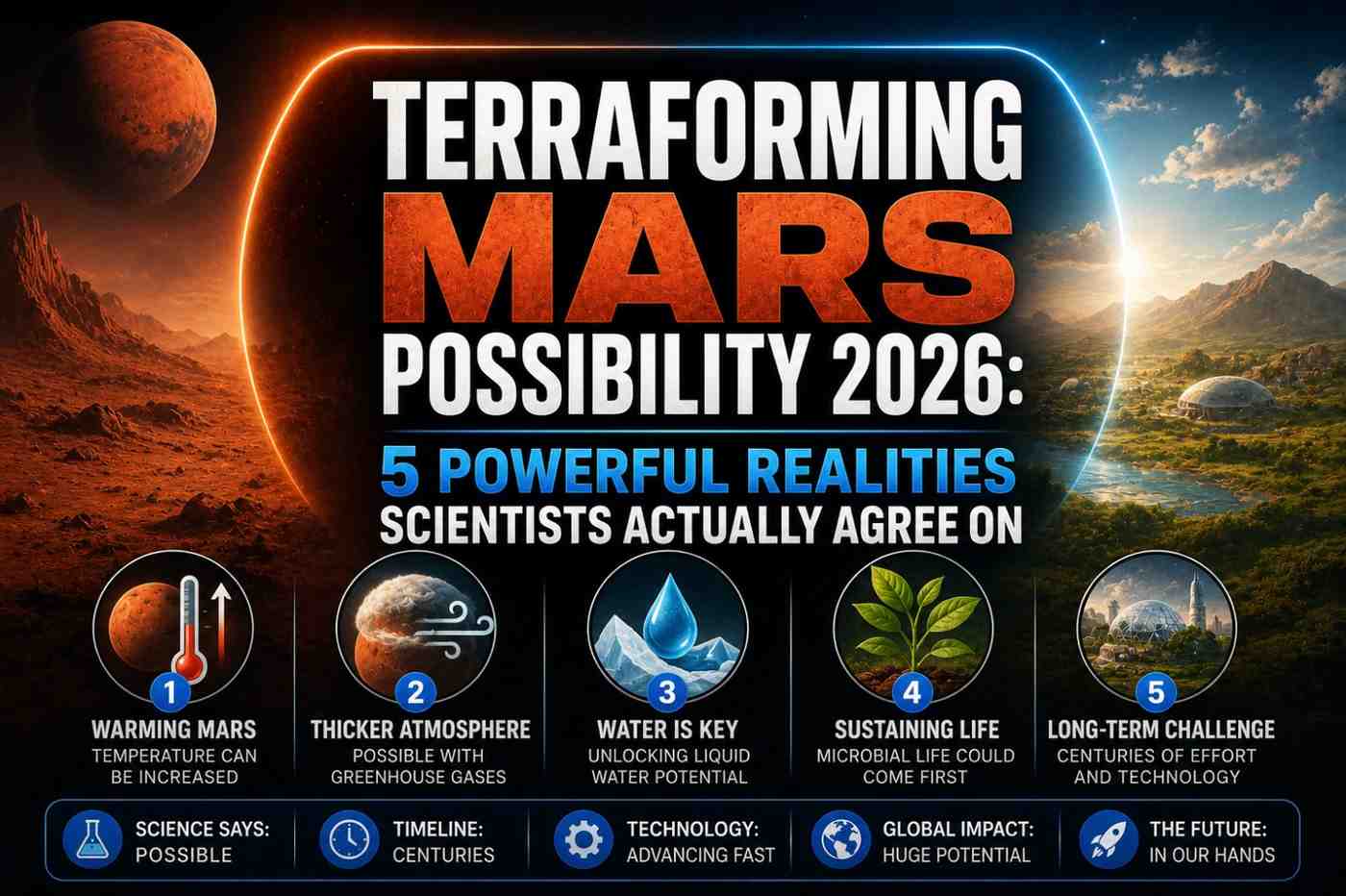
Introduction
Terraforming Mars possibility in 2026 sits at a fascinating intersection of science, engineering, ethics, and ambition. The concept — transforming Mars into an Earth-like planet habitable for humans without spacesuits — has captivated scientists, engineers, and philosophers for decades.
But is it actually possible? And if so, over what timescale?
Here are 5 powerful realities about terraforming Mars that scientists actually agree on — and the fierce debates they’re still having.
What Does “Terraforming Mars” Actually Mean?
Before assessing terraforming Mars possibility 2026, we need to define the goal precisely.
Full terraforming means:
- Raising average surface temperature from -60°C to above 0°C
- Thickening the atmosphere to Earth-like pressure (~101 kPa vs Mars’s current 0.6 kPa)
- Converting the atmosphere from CO₂-dominated to nitrogen-oxygen breathable
- Creating liquid surface water
- Building a protective magnetic field or equivalent
Each of these challenges is individually massive. Combined, they represent a planetary engineering project on a multi-thousand-year timescale.
Reality 1 — Full Terraforming Mars Is Not Feasible Within Any Human Lifetime
The honest scientific assessment of terraforming Mars possibility 2026 is that full terraforming — creating breathable, shirtsleeve conditions on the Martian surface — is a project measured in centuries to millennia, not decades.
A landmark 2018 paper in Nature Astronomy, authored by Bruce Jakosky and Christopher Edwards of the University of Colorado, analyzed Mars’s available CO₂ reserves and concluded that even releasing all accessible CO₂ would only double atmospheric pressure — still less than 2% of Earth’s sea level.
What This Means in Practice
You cannot terraform Mars with present-day technology or any technology foreseeable in 2026 and beyond.
The terraforming Mars possibility 2026 debate isn’t about whether we can fully terraform Mars soon. It’s about whether partial terraforming — making Mars more hospitable — is achievable on a human timescale.
Reality 2 — Partial Terraforming (Warming Mars) Is Theoretically Possible
While full terraforming is off the table for centuries, warming Mars meaningfully is a different question.
The terraforming Mars possibility 2026 most seriously considered by scientists involves:
- Releasing stored CO₂ and other greenhouse gases to warm the planet
- Melting polar ice caps to release additional CO₂ and water vapor
- Introducing super-greenhouse gases manufactured on Mars
The Super-Greenhouse Gas Approach
Scientists including Robert Zubrin and Christopher McKay have proposed manufacturing perfluorocarbons (PFCs) on Mars. These synthetic gases have tens of thousands of times the warming power of CO₂.
Producing enough PFCs to meaningfully warm Mars would take an estimated 100 years at industrial scale — requiring a self-sustaining Martian civilization to manufacture them.
It’s circular: you need a colony to terraform, but terraforming is meant to make colonization easier.
Related Article: SpaceX Mars Mission Timeline 2026 to 2030
Reality 3 — Mars Has a Magnetic Field Problem No One Has Solved
Earth’s magnetic field deflects the solar wind — high-energy particles that would strip away a terraformed Martian atmosphere within thousands of years.
Mars lost its global magnetic field approximately 4 billion years ago. Without it, any thickened atmosphere would be gradually eroded.
Proposed Solutions and Their Limitations
L1 Magnetic Shield: NASA researchers proposed placing a large magnetic dipole at Mars’s L1 Lagrange point (between Mars and the Sun) to deflect solar wind before it reaches the planet. It’s theoretically possible but would require an artificial magnet of extraordinary scale.
Atmospheric replenishment: Continuous release of new atmosphere faster than it’s stripped away — essentially running to stay in place.
Underground habitats: Abandon surface terraforming entirely and build underground, using rock and regolith as natural radiation and pressure shields.
The magnetic field challenge is the most fundamental obstacle to any long-term terraforming Mars possibility 2026 scenario. For the technical analysis, see NASA’s Mars terraforming research.
Reality 4 — Biological Terraforming (Ecopoiesis) May Come First
Long before any atmosphere engineering begins, terraforming Mars possibility 2026 researchers are seriously studying biological approaches.
Ecopoiesis — seeding Mars with specially engineered microorganisms to begin modifying the environment — is the most near-term terraforming approach.
How Engineered Microbes Could Begin Mars Transformation
Scientists are working on synthetic biology approaches including:
- Cyanobacteria variants capable of producing oxygen from CO₂ and water ice at sub-zero temperatures
- Nitrogen-fixing organisms to begin building soil chemistry
- Extremophile fungi capable of breaking down Martian regolith into proto-soil
- CRISPR-engineered photosynthetic organisms with tolerance for high radiation and low pressure
These microbes wouldn’t breathe for humans anytime soon. But they could begin a biological chain reaction that, over thousands of years, progressively enriches the Martian environment.
Reality 5 — The Ethics of Terraforming Mars Are Deeply Contested
Any serious discussion of terraforming Mars possibility 2026 must confront the ethical dimensions — and they are profound.
If Ancient Life Exists on Mars, Do We Have the Right to Terraform?
If the signs of ancient life on Mars discovered in 2026 are confirmed, or if extant microbial life exists today deep underground, terraforming Mars raises an extraordinary moral question.
Do we have the right to potentially destroy an independent biosphere — however microbial — to make the planet convenient for us?
Arguments For Terraforming
- Human survival insurance — a second biosphere guarantees species continuity
- Mars’s current environment is sterile enough to make colonization justified
- Even microbial Martian life could potentially be preserved in protected zones
Arguments Against Terraforming
- Scientific value of pristine Mars would be permanently destroyed
- The energy and resources required could solve Earth’s problems instead
- Hubris: we would be reshaping a planet without fully understanding the consequences
This ethical debate is ongoing in both scientific and philosophical circles, and is a critical component of any honest assessment of terraforming Mars possibility 2026.
For comprehensive ethical analysis, see The Planetary Society’s terraforming discussion and peer-reviewed work from the International Journal of Astrobiology.
Related Article: Mars vs Moon Colonization Comparison
What Is Actually Possible by 2026 — And by 2100?
To be precise about terraforming Mars possibility 2026:
By 2026: No terraforming. First robotic and possibly crewed missions demonstrating basic surface survival in pressurized habitats.
By 2100: Potentially, local greenhouse warming using manufactured gases; early-stage biological soil engineering experiments; possibly a small but functional colony under pressurized domes.
By 2500+: With continued investment, meaningful atmospheric thickening and warming might be achievable. Full terraforming remains speculative beyond this horizon.
Frequently Asked Questions (FAQs)
Q1: Is terraforming Mars actually possible according to scientists? Full terraforming to Earth-like breathable conditions is not considered feasible within any foreseeable human timescale. Partial terraforming — warming and thickening the atmosphere meaningfully — is theoretically possible over centuries with sufficient industrial capacity on Mars.
Q2: How long would terraforming Mars take? Estimates range from several hundred years for minimal warming to 100,000 years or more for full Earth-like conditions. Most scientists consider full terraforming a multi-millennial project.
Q3: Why does Mars need terraforming at all? Mars has a thin, unbreathable atmosphere, no liquid water on the surface, intense radiation from the lack of a magnetic field, and average temperatures of -60°C. None of these conditions are survivable without life support.
Q4: Could genetically engineered organisms help terraform Mars? Yes — this is called ecopoiesis and is one of the more seriously studied near-term terraforming approaches. Engineered extremophile organisms could theoretically begin modifying Martian soil and atmosphere over long timescales.
Q5: Would terraforming Mars destroy any existing life? If microbial life exists on Mars today (unconfirmed), terraforming could threaten it. This is a major ethical consideration that many scientists argue must be resolved before any terraforming begins.
Conclusion
Terraforming Mars possibility 2026 is a question with a precise scientific answer: full terraforming is not currently feasible and won’t be for centuries at minimum. But partial terraforming — warming, biological seeding, and incremental atmosphere enhancement — is a serious long-term scientific and engineering goal.
What’s certain is that any path to a terraformed Mars begins with a colony on Mars — and that is the challenge of the next 20 years.
Fascinated by humanity’s Martian future? Follow our complete coverage of Mars colonization science, mission timelines, and the extraordinary technologies being developed to make the Red Planet a second home for humanity.