 Ramrajeshbee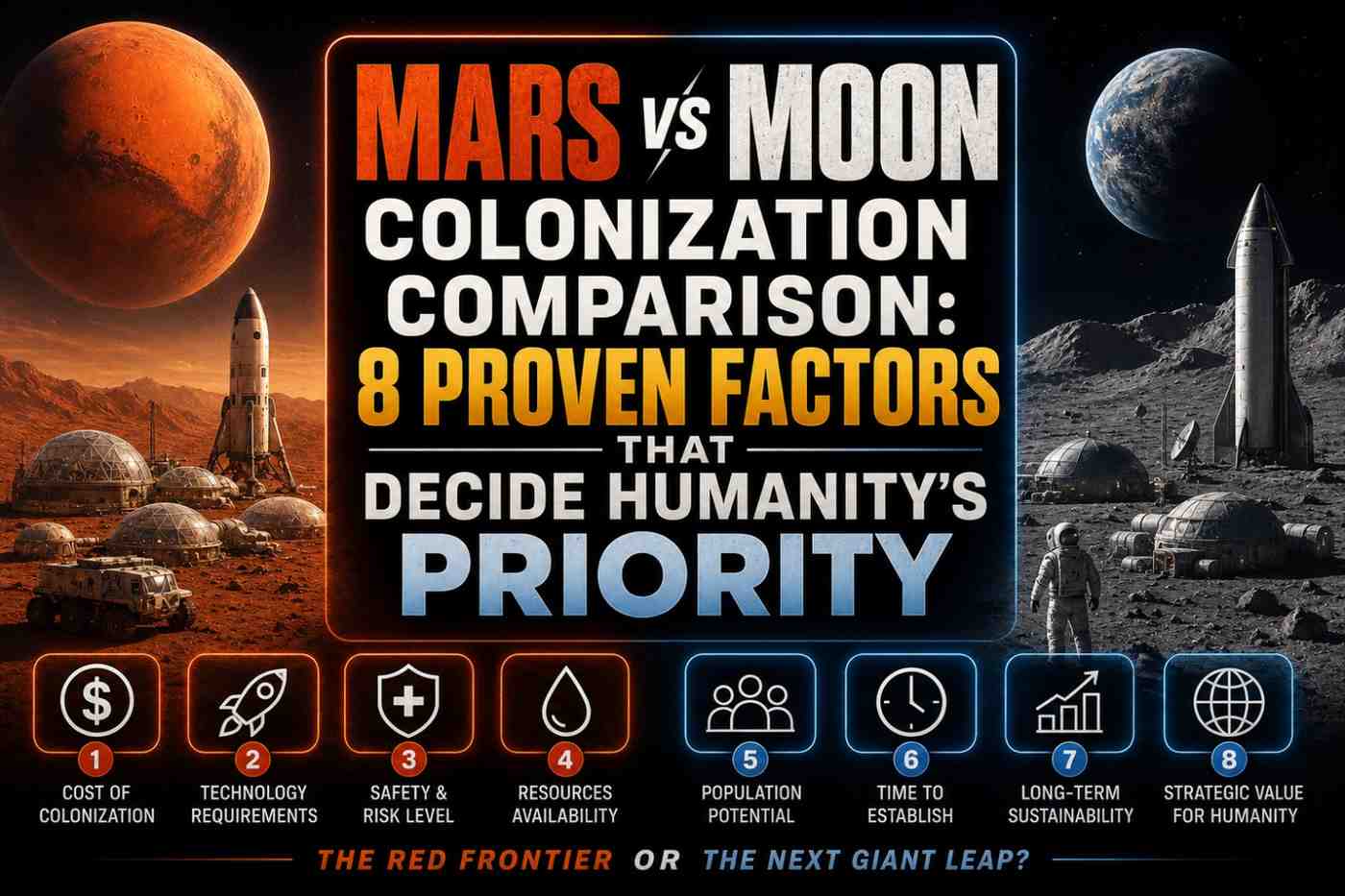
Introduction
The Mars vs Moon colonization comparison is arguably the most important strategic question in 21st-century space exploration. Both worlds offer extraordinary scientific and long-term survival value. Both present enormous challenges. And humanity may not have the resources to fully pursue both simultaneously.
So which should come first?
This comparison examines 8 proven factors — distance, resources, cost, timeline, scientific value, survival utility, political will, and technology readiness — to give you the most complete answer available.
Why the Mars vs Moon Colonization Comparison Matters Now
This isn’t an abstract debate. Real decisions with trillion-dollar implications are being made right now.
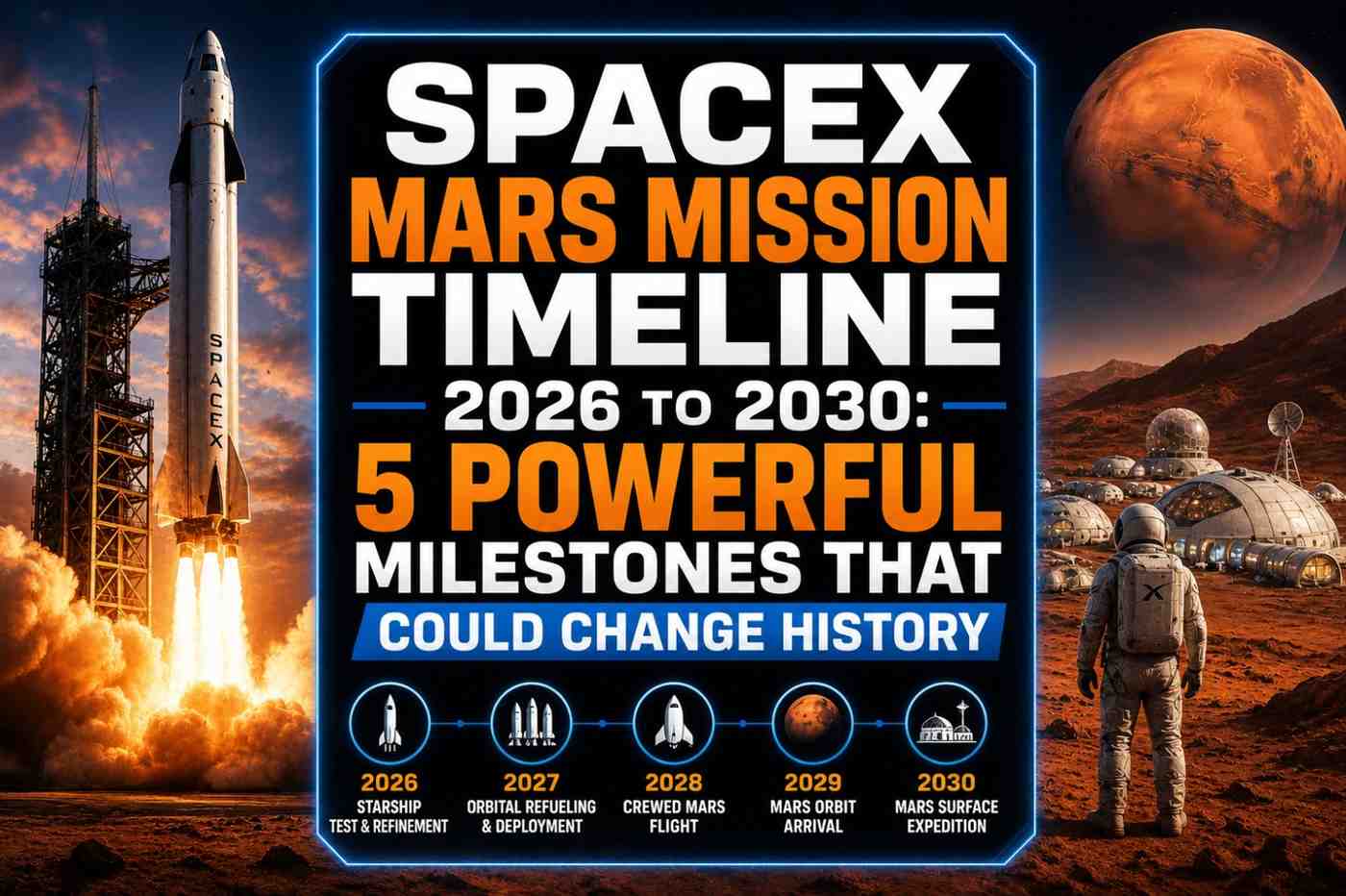
NASA’s Artemis program is building a lunar gateway and targeting crewed lunar landings. SpaceX is targeting Mars missions starting in 2026. International agencies — ESA, JAXA, China’s CNSA — are developing their own lunar and Martian programs.
The Mars vs Moon colonization comparison shapes funding priorities, technology development, international partnerships, and ultimately which humans first call another world home.
Factor 1 — Distance: Moon Wins Decisively
In the Mars vs Moon colonization comparison, distance is the Moon’s most powerful advantage.
- Moon: ~384,000 km from Earth. 3-day journey. 1.3-second communication delay.
- Mars: ~225 million km (average). 6–9-month journey. 3–24-minute communication delay.
What This Means for Colonization
The Moon’s proximity enables:
- Emergency resupply within days
- Near-real-time communication with Earth
- Easier medical evacuation
- Lower initial infrastructure investment
- Iterative learning — try, fail, fix, repeat — on a human timescale
Mars’s distance means any failure is catastrophic and irreversible in a way the Moon’s proximity prevents. For early colonization, proximity is an enormous safety advantage.
Advantage: Moon
Factor 2 — Resources: Mars Wins
The Mars vs Moon colonization comparison flips dramatically when we look at available resources.
Mars Resources
- Water ice: Abundant, accessible shallow deposits across mid-latitudes
- Atmosphere: CO₂-rich — usable for propellant production and eventually plant growth
- Day length: 24.6 hours — nearly identical to Earth
- Seasons: Mars has seasons similar to Earth’s
- Temperature: -60°C average (harsh, but insulated habitats are manageable)
- Gravity: 38% of Earth’s — enough for long-term human health (uncertain, but better than Moon’s 16%)
Moon Resources
- Water ice: Present at the poles but sparse and deep
- No atmosphere: No CO₂ for propellant production without importing ingredients
- 14-Earth-day night: Requires massive battery storage for solar power
- Gravity: 16% of Earth’s — long-term health effects unknown but concerning
- Regolith: Contains titanium, aluminum, silicon, and oxygen in mineral form
Mars is dramatically more resource-rich than the Moon for sustained human habitation.
Advantage: Mars
Related Article: Mars Water Ice Discovery 2026
Factor 3 — Radiation: Moon and Mars Both Lose (But Differently)
Neither world in the Mars vs Moon colonization comparison has Earth-equivalent radiation protection — but the challenges differ.
Moon Radiation
- No atmosphere, no magnetic field
- Continuous galactic cosmic ray bombardment
- Intense solar particle events
- Mitigation: underground habitats using regolith shielding
Mars Radiation
- Thin atmosphere provides minimal but measurable protection (~10 mSv/year surface)
- No global magnetic field
- Transit radiation is the biggest challenge (300 mSv in 6 months of travel)
- Mitigation: underground habitats, storm shelters, regolith shielding
Both worlds require robust radiation protection. The Moon’s harsher surface environment is offset by the transit radiation challenge of reaching Mars.
Advantage: Tie — both require underground habitats
Factor 4 — Scientific Value: Mars Wins
In the Mars vs Moon colonization comparison, Mars offers far greater near-term scientific return — particularly for the most profound question in science: are we alone?
Mars Scientific Priorities
- Biosignature investigation and potential confirmation of ancient life
- Understanding Mars’s climate history and what happened to its water
- Geological diversity across continents, polar caps, volcanoes, and canyons
- Potential extant life in deep subsurface environments
Moon Scientific Priorities
- Lunar geology and the Moon’s formation history
- Cosmic ray and solar wind research (no atmosphere)
- Astronomical observations from the lunar far side
- Resource extraction technology development
The potential to find evidence of ancient — or even living — Martian life makes Mars the most scientifically significant destination in the solar system.
Advantage: Mars
Related Article: Signs of Ancient Life on Mars 2026
Factor 5 — Cost: Moon Wins
The financial reality of the Mars vs Moon colonization comparison strongly favors the Moon in the near term.
NASA’s Artemis program costs are estimated at $93 billion through 2025. Expensive — but orders of magnitude less than a full Mars colonization program.
Why Moon Colonization Is Cheaper
- Shorter missions mean smaller life support systems
- 3-day transit requires far less food, water, and oxygen
- Emergency return in days vs 8+ months for Mars
- Existing launch infrastructure is sufficient for lunar missions
- Test failures are correctable; Mars failures are catastrophic
SpaceX’s Mars program requires developing entirely new propellant production technology, years-long life support systems, and radiation protection for 9-month transits.
For an analysis of comparative costs, see The Planetary Society’s exploration budget analysis and NASA’s Artemis program overview.
Advantage: Moon
Factor 6 — Long-Term Survival Value: Mars Wins
The philosophical foundation of the Mars vs Moon colonization comparison ultimately rests on a question: which world better ensures humanity’s long-term survival?
Here, Mars wins clearly.
Why Mars Is the Better Insurance Policy
- The Moon is within Earth’s “gravitational sphere of influence” — a large asteroid or nearby supernova affects both
- Mars is 225 million km away — far enough to be independently insulated from most Earth-scale catastrophes
- Mars has the resources to become genuinely self-sufficient in a way the Moon cannot
- A fully independent Martian civilization is theoretically achievable; a fully independent lunar civilization is not
If the goal is ensuring humans exist even if Earth becomes uninhabitable, Mars is the only serious candidate in our solar system.
Advantage: Mars
Factor 7 — Technology Readiness: Moon Wins
The Mars vs Moon colonization comparison on technology readiness tilts strongly toward the Moon — particularly right now.
What We Can Do at the Moon Today
- Proven crewed lunar landing technology (Apollo; Artemis building on it)
- SpaceX Starship being certified as lunar lander
- NASA Lunar Gateway station under development
- Multiple nations with active lunar rover programs
- Water ice mining technology being developed and tested
What Mars Still Requires
- Long-duration deep space life support (not yet proven for 6+ months)
- Mars entry, descent, and landing for large payloads (technically unsolved at scale)
- ISRU propellant production (demonstration only)
- Deep space medical care (incomplete)
- Long-duration radiation mitigation (under development)
The Moon is achievable with current and near-term technology. Mars requires 5–10 more years of critical development.
Advantage: Moon
Factor 8 — Political Will and International Support: Tie
The final factor in our Mars vs Moon colonization comparison is practical: which mission has the political and international support to actually happen?
Lunar Program Support
- NASA’s Artemis has bipartisan U.S. Congressional support
- ESA, JAXA, CSA, and multiple other agencies are Artemis partners
- China has its own independent crewed lunar program targeting the 2030s
- Multiple commercial players (SpaceX, Blue Origin, Astrobotic) targeting the Moon
Mars Program Support
- SpaceX is the primary driver of near-term Mars ambition
- NASA’s long-term exploration roadmap includes crewed Mars in the 2040s
- No established international framework for Mars colonization exists yet
- Political support is more diffuse and private-sector dependent
Advantage: Tie — both have significant but different support bases
The Verdict: Moon First, But Mars Is the Goal
The Mars vs Moon colonization comparison doesn’t produce a simple winner — it produces a strategic sequence.
The Moon first. Mars always.
The Moon is:
- Closer and safer for first colonization attempts
- Essential for proving life support, radiation protection, and resource extraction technology
- A commercially viable destination that funds the deeper space program
But Mars is:
- The ultimate destination with resources to build a genuinely independent civilization
- The scientific priority for questions about life in the universe
- The long-term survival insurance for the human species
The Moon is the training ground. Mars is the destination. Both are necessary.
For more on the strategic debate, see The Mars Society’s position papers and NASA’s Moon to Mars strategy.
Related Article: Terraforming Mars Possibility 2026
Frequently Asked Questions (FAQs)
Q1: Should humanity colonize the Moon or Mars first? Most space agencies and strategic planners favor a “Moon first” approach — using the Moon to develop and test the technology, medical knowledge, and operational experience needed for the much harder Mars mission.
Q2: Is it cheaper to colonize the Moon or Mars? Significantly cheaper to begin with the Moon. Proximity reduces mission duration, life support requirements, and emergency response challenges. Mars colonization requires decades of additional technology development that Moon programs will help enable.
Q3: Which world has more water — Moon or Mars? Mars has dramatically more accessible water ice, particularly in mid-latitude shallow deposits. The Moon’s water ice is largely confined to permanently shadowed polar craters and is harder to access.
Q4: Could humans live permanently on the Moon without returning to Earth? Theoretically possible but much harder than Mars. The Moon’s 16% gravity is a long-term health concern, and the 14-Earth-day night cycle creates severe power challenges. Underground habitats are likely required for permanent residence.
Q5: Will Mars colonization happen in our lifetime? For people alive today who are in their 20s–50s: yes, almost certainly. The first human Mars landing is most likely in the 2030s. Permanent colonization — a self-sustaining settlement — is likely in the 2050s–2070s according to current roadmaps.
Conclusion
The Mars vs Moon colonization comparison reveals a nuanced strategic picture: the Moon wins on proximity, cost, and technology readiness; Mars wins on resources, science, and long-term survival value.
The wisest path combines both — using the Moon as humanity’s proving ground while keeping Mars as the ultimate horizon.
The greatest adventure in human history is unfolding right now. Follow our complete coverage of both lunar and Martian missions, discoveries, and milestones as humanity takes its first steps toward becoming a multi-planetary species.