 Ramrajeshbee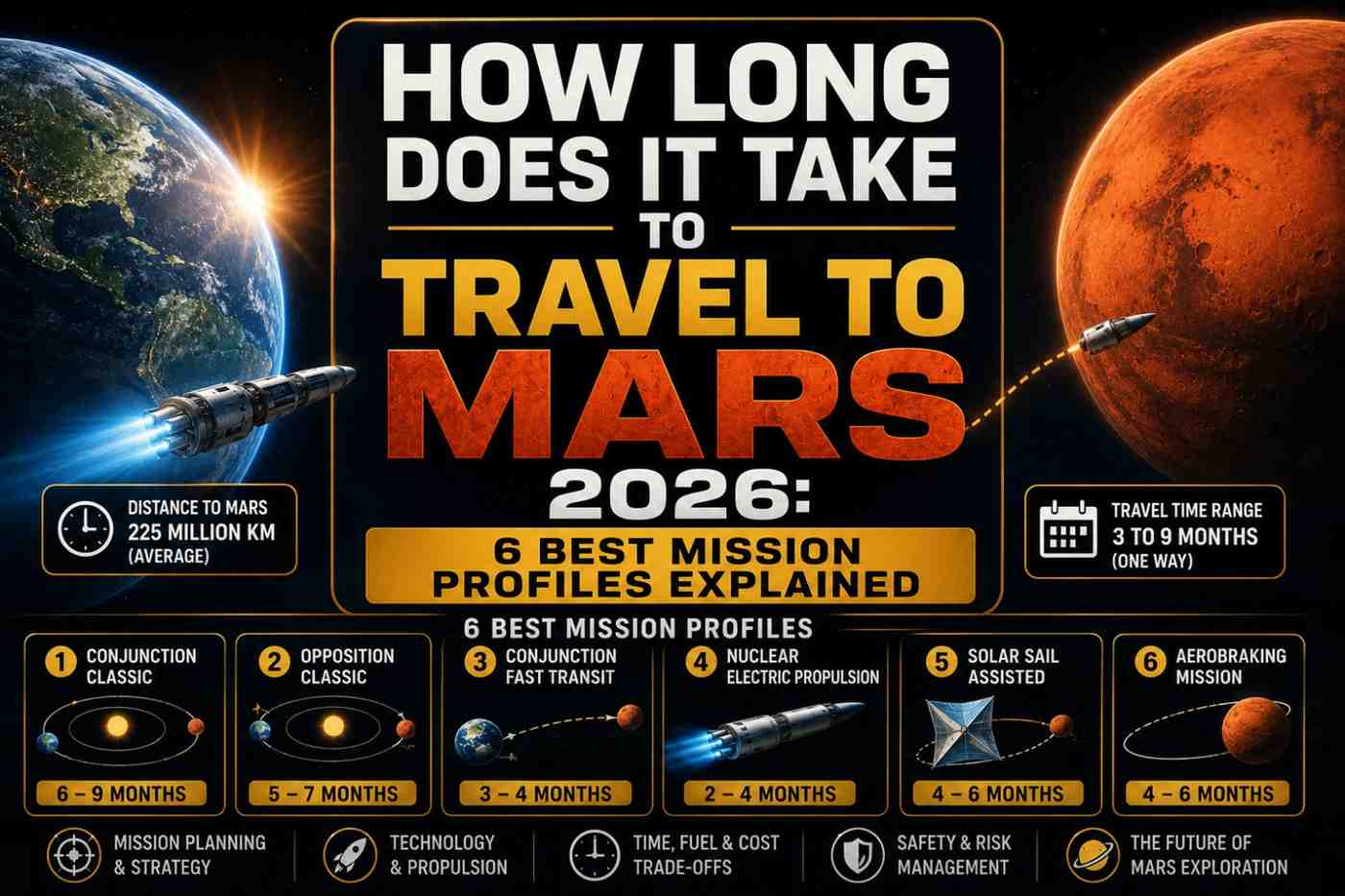
Introduction
How long does it take to travel to Mars in 2026? It’s one of the most asked questions in space exploration — and the answer is more nuanced than a single number.
Distance, spacecraft speed, orbital mechanics, and mission design all play a role. The journey to Mars is not a straight line. It’s a carefully calculated arc through the solar system that takes months, not days.
Here’s everything you need to know — from the physics to the human experience.
The Basics: Why Does the Answer to How Long Does It Take to Travel to Mars 2026 Change?
Mars and Earth are both orbiting the Sun — but at different speeds and at different distances.
The distance between Earth and Mars varies dramatically:
- Closest approach (opposition): ~54.6 million kilometers
- Average distance: ~225 million kilometers
- Farthest distance: ~401 million kilometers
Understanding how long does it take to travel to Mars 2026 requires knowing where both planets are in their orbits when you launch — and where Mars will be when you arrive.
Mission Profile 1 — The Hohmann Transfer Orbit (Standard Approach)
The most fuel-efficient path to Mars is called the Hohmann transfer orbit. Spacecraft follow an elliptical path that “falls” from Earth’s orbit toward Mars’s orbit in a giant arc.
Key Numbers for 2026
- Transit time: 6 to 9 months
- Delta-v (velocity change required): ~3.6 km/s
- Launch window: Every 26 months when Earth-Mars alignment is optimal
This is the approach used by every Mars mission to date — from Mariner 4 in 1965 to Perseverance in 2020. It’s slow but achievable with existing technology.
The answer to how long does it take to travel to Mars 2026 using this method: approximately 7 months for the 2026 launch window.
Mission Profile 2 — Fast Transit Options (Shorter but Costly)
Could we go faster? Yes — but it costs dramatically more fuel.
Venus Gravity Assist
Some mission designers propose a trajectory that swings past Venus to gain speed. This reduces transit time to approximately 5 months but adds mission complexity.
High-Energy Direct Transfer
Using more propellant to take a more direct path cuts transit time to as little as 3–4 months. But the fuel mass required makes this impractical for most missions with current technology.
Nuclear Thermal Propulsion
NASA is developing nuclear thermal rocket engines that could reduce Mars transit time to 3–4 months with manageable fuel loads. These engines are not yet operational but represent the most realistic path to faster Mars travel.
Related Article: SpaceX Mars Mission Timeline 2026 to 2030
Mission Profile 3 — SpaceX Starship’s 2026 Trajectory
For SpaceX’s planned 2026 Mars missions, how long does it take to travel to Mars 2026 comes down to the specific launch window and trajectory selected.
SpaceX has stated transit times of approximately 6 months for the 2026 window. Starship’s methane engines are optimized for a modified Hohmann-type trajectory.
Why Starship’s Journey Time Matters for Human Missions
Six months in deep space is a significant physiological challenge:
- Muscle atrophy without resistance exercise
- Bone density loss (up to 1–2% per month)
- Radiation exposure
- Psychological stress from isolation
SpaceX’s habitat designs include centrifuge sections for artificial gravity in later mission iterations, though early missions may operate in microgravity throughout.
Mission Profile 4 — The 2026 Launch Window Specifics
Understanding how long does it take to travel to Mars 2026 requires looking at the specific orbital geometry.
The 2026 launch window opens approximately in November 2026. During this window:
- Earth-Mars distance at launch: ~180 million km
- Earth-Mars distance at arrival: ~250 million km (Mars moves outward during transit)
- Optimal transit time: ~6.5 months
- Arrival: ~May to June 2027
This is why launch windows are critical — miss the 2026 window and the next opportunity isn’t until early 2029.
Mission Profile 5 — How Distance and Speed Compare to Previous Missions
To answer how long does it take to travel to Mars 2026 in context, here’s a comparison with historical missions:
| Mission | Launch Year | Transit Time | Spacecraft |
|---|---|---|---|
| Mariner 4 | 1964 | 7.5 months | NASA flyby probe |
| Viking 1 | 1975 | 10 months | NASA lander |
| Mars Pathfinder | 1996 | 7 months | NASA rover |
| Mars Odyssey | 2001 | 6.5 months | NASA orbiter |
| Perseverance | 2020 | 6.5 months | NASA rover |
| Starship (planned) | 2026 | ~6 months | SpaceX crewed |
The transit time for the 2026 SpaceX missions aligns closely with modern uncrewed missions — but with humans on board, the experience is categorically different.
For technical orbital mechanics information, see NASA’s Jet Propulsion Laboratory and ESA’s mission design resources.
Mission Profile 6 — The Return Trip: How Long Is the Full Mission?
When people ask how long does it take to travel to Mars 2026, they’re often thinking about the round trip.
A full crewed mission includes:
- Earth to Mars transit: ~6–7 months
- Surface stay on Mars: ~18 months (waiting for next launch window)
- Mars to Earth transit: ~6–7 months
- Total mission duration: ~30–32 months (2.5 to 3 years)
The 18-month surface stay isn’t optional. If crew arrives during the 2026 window, the next Earth-Mars alignment allowing a return launch isn’t until approximately late 2028.
Why the Surface Stay Is So Long
Mars and Earth only align for efficient transit every 26 months. Leaving at the wrong time wastes enormous amounts of fuel.
The 18-month wait actually serves science too — it gives the crew extended time to conduct research, establish the habitat, and test long-duration surface operations.
Related Article: Terraforming Mars Possibility 2026
What the Journey Actually Feels Like
Answering how long does it take to travel to Mars 2026 in human terms means understanding what six months in deep space is like.
The spacecraft would be:
- Moving at an average speed of ~24,000 km/h
- Experiencing no sensation of speed (no atmospheric drag in space)
- Gradually losing Earth’s communication signal delay — up to 24 minutes one way at maximum distance
- Entirely self-sufficient — no resupply possible
Crew routines would include:
- 2–3 hours of daily exercise to combat muscle and bone loss
- Scheduled work shifts for spacecraft maintenance and science operations
- Regular psychological support sessions
- Entertainment, education, and social activities
It would be humanity’s most isolated journey — and its most historic.
Frequently Asked Questions (FAQs)
Q1: How long does it take to travel to Mars in 2026 specifically? For the 2026 launch window, the planned Hohmann transfer trajectory would take approximately 6 to 7 months one-way, arriving on Mars in approximately May to June 2027.
Q2: Why can’t we travel to Mars faster? Faster trajectories require dramatically more fuel — which adds mass, which requires even more fuel to accelerate. Nuclear thermal propulsion (not yet operational) is the most promising technology for significantly shorter transit times.
Q3: Could humans survive 6 months in deep space without a centrifuge? Yes, though with health consequences. ISS astronauts routinely spend 6 months in microgravity. Intensive exercise protocols mitigate but don’t eliminate bone and muscle loss. Future Starship designs may include artificial gravity systems.
Q4: How fast would a Starship travel to Mars? A Starship on a 2026 Mars mission would travel at varying speeds — reaching peak velocity of approximately 30,000 km/h during the initial burn, then coasting at around 24,000 km/h for most of the transit.
Q5: How does communication work during the 6-month journey? Radio signals travel at the speed of light. At average Earth-Mars distance, signals take 12–20 minutes one way, meaning a conversation has a 24–40 minute round-trip delay. Real-time communication is impossible; crews operate largely autonomously.
Conclusion
How long does it take to travel to Mars in 2026? Approximately 6 to 7 months one-way — and about 2.5 years for a complete round-trip mission including the mandatory 18-month surface stay.
It’s not a short trip. But it is a finite, achievable one with technology that either exists today or is in advanced development.
The journey of a lifetime is closer than you think. Follow our complete Mars exploration coverage to track every mission update, technology breakthrough, and scientific discovery on the road to humanity’s greatest adventure.