 Ramrajeshbee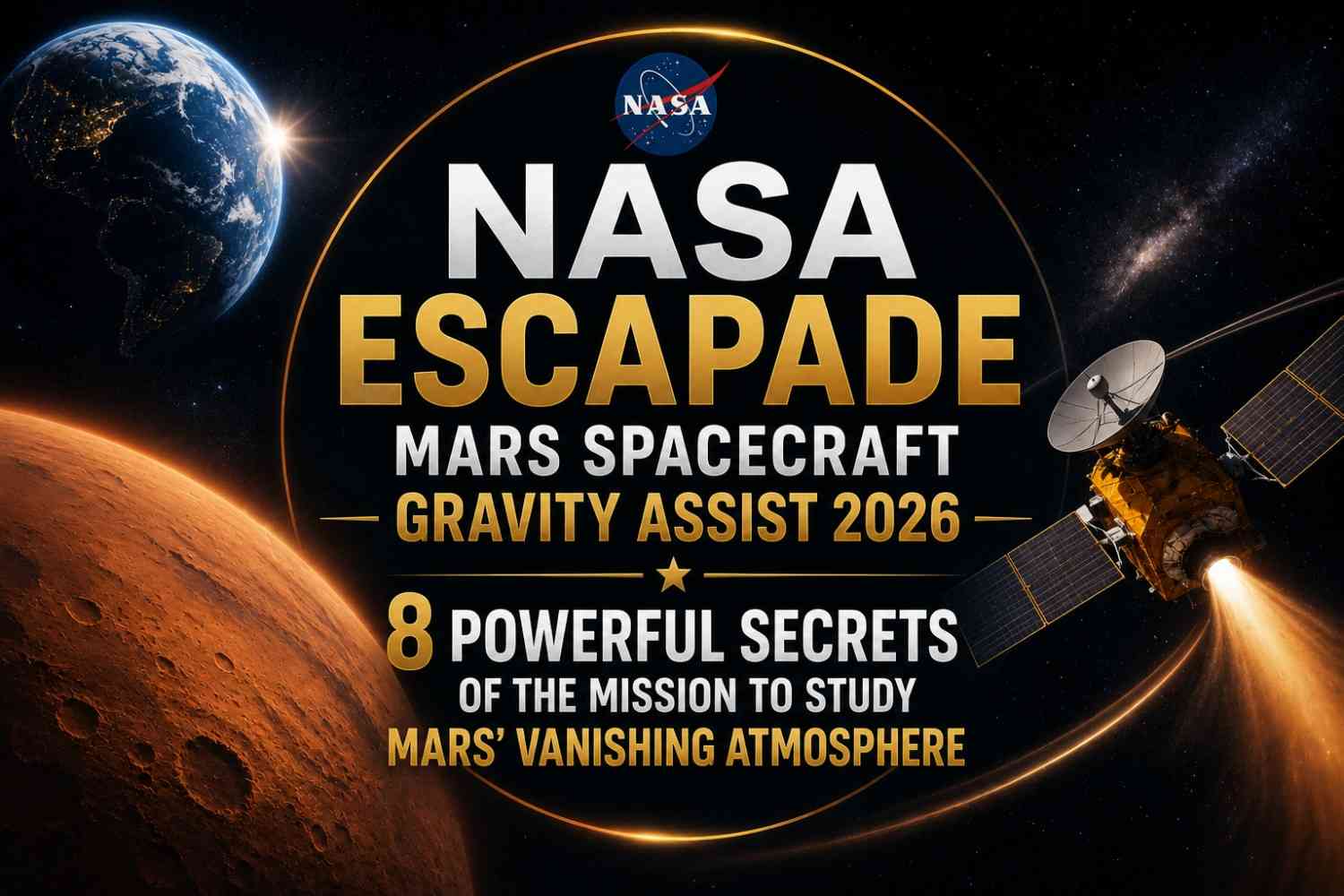
Introduction
The NASA ESCAPADE Mars spacecraft gravity assist 2026 event is one of the most fascinating and technically innovative moments in planetary science happening this year. In November 2026, two small spacecraft named Blue and Gold — already circling a point in space a million miles from Earth — will swoop back toward our planet and use Earth’s gravity as a slingshot to hurl themselves toward Mars.
This maneuver, called a gravity assist, is the centerpiece of one of the most creative mission designs in NASA history. And it is just one of many reasons scientists are intensely excited about ESCAPADE.
The full name is almost as remarkable as the mission itself: Escape and Plasma Acceleration and Dynamics Explorers — a pair of twin spacecraft designed to answer one of the most profound questions in planetary science: how did Mars lose its atmosphere?
This guide explains everything you need to know about the NASA ESCAPADE Mars spacecraft gravity assist 2026 and why this mission could reshape our understanding of the Red Planet — and what it means for the future of human exploration.
What Is the ESCAPADE Mission?
ESCAPADE is a NASA twin-spacecraft mission to Mars, led by the University of California, Berkeley’s Space Sciences Laboratory, with principal investigator Dr. Robert Lillis. It is part of NASA’s Small Innovative Missions for Planetary Exploration (SIMPLEx) program — a series of low-cost, high-risk science missions designed to punch above their weight class scientifically.
The mission consists of two identical spacecraft, each the size of a large refrigerator:
- Blue (named after UC Berkeley’s colors)
- Gold (named after UC Berkeley’s colors)
Each spacecraft weighs approximately 535 kg (1,179 lbs) fully fueled, carries four science instruments, and is built on Rocket Lab’s Explorer spacecraft bus. They were built by Rocket Lab USA and launched together on November 13, 2025, aboard Blue Origin’s New Glenn rocket from Cape Canaveral Space Force Station, Florida.
The spacecraft commissioning was completed in February 2026, with all science instruments confirmed operational. Rocket Lab handed operational control to UC Berkeley’s Space Sciences Laboratory, which now manages the mission.
The NASA ESCAPADE Mars Spacecraft Gravity Assist 2026: Why Not Fly Directly to Mars?
This is the question at the heart of the mission’s genius — and it is directly tied to the NASA ESCAPADE Mars spacecraft gravity assist 2026 maneuver.
Most Mars missions must launch during a narrow two-week window that occurs approximately every 26 months, when Earth and Mars are aligned in their orbits in just the right way for a direct trajectory. Miss that window, and you wait two more years.
ESCAPADE is testing a fundamentally different approach. Instead of waiting for the planets to align and then flying directly to Mars, ESCAPADE launched into a “loiter” orbit around Earth’s Sun-Earth Lagrange Point 2 (L2) — the same stable gravitational location used by the James Webb Space Telescope and the Roman Space Telescope, about one million miles from Earth.
From there, the two spacecraft have been orbiting in a large kidney-bean-shaped path stretching up to 2 million miles from Earth — patiently waiting. They have been using this time to test their science instruments and collect early heliophysics data in a previously unexplored region of Earth’s distant magnetotail (the part of Earth’s magnetic environment that streams away from the Sun like a comet’s tail).
Then, in November 2026, when Earth and Mars finally reach a favorable alignment, the two spacecraft will swoop back toward Earth. Flying within 600 km of Earth’s surface, they will use our planet’s gravitational field to dramatically accelerate and redirect themselves onto a trajectory toward Mars.
This is the NASA ESCAPADE Mars spacecraft gravity assist 2026 — and it is one of the most elegant navigation solutions in the history of robotic space exploration.
After this gravity assist, ESCAPADE will cruise for 11 months, making small course corrections, before arriving at Mars in September 2027.
Why Is This Approach Revolutionary?
The traditional approach to Mars missions is rigid: you must launch during the Mars launch window, or you wait two years. ESCAPADE proves that this constraint can be broken.
“Can we launch to Mars when the planets are not aligned? ESCAPADE is paving the way for that,” said Jeffrey Parker of Advanced Space LLC, NASA’s trajectory design partner for the mission.
According to NASA’s official ESCAPADE science page, this innovative trajectory design could enable future missions to Mars to launch outside the traditional narrow windows — dramatically increasing the flexibility of Mars exploration and potentially making it much easier to send cargo and eventually humans to the Red Planet on demand, rather than waiting for rare planetary alignments.
NASA ESCAPADE Mars Spacecraft Gravity Assist 2026: 8 Powerful Secrets of the Mission
1. Mars Once Had an Atmosphere — ESCAPADE Will Tell Us Where It Went
The fundamental scientific question ESCAPADE is asking is one of the most important in planetary science: why is Mars the cold, dry, nearly airless world we see today — when billions of years ago, it was likely warm, wet, and covered with flowing rivers and potentially oceans?
The leading answer is atmospheric escape — the gradual stripping of Mars’ atmosphere by the solar wind. Unlike Earth, Mars lost its global magnetic field billions of years ago. Without that protective magnetic shield, the Sun’s stream of charged particles (the solar wind) could directly interact with Mars’ upper atmosphere — accelerating ions to escape velocity and carrying them away into space.
Over billions of years, this process peeled away most of Mars’ air. ESCAPADE is designed to watch this process happening in real time and measure exactly how the solar wind drives atmospheric loss today.
2. Two Spacecraft Where One Has Never Been Enough
Every previous Mars mission that studied the planet’s atmosphere and magnetic environment used a single spacecraft. The problem with one spacecraft is fundamental: you can only be in one place at a time.
When a single Mars orbiter detects a change in the magnetic environment — say, a burst of solar wind energy — it cannot tell whether the change happened because the solar wind just became more active, or because the spacecraft moved into a different region of the magnetosphere. You can’t separate spatial changes from temporal changes with only one measurement point.
ESCAPADE solves this with two spacecraft flying in coordinated formation. With Blue and Gold simultaneously measuring different locations around Mars, scientists can finally separate cause from effect.
“Having two spacecraft is going to help us understand cause and effect — how the solar wind, when it comes to Mars, interacts with the magnetic field,” said Michele Cash, ESCAPADE program scientist at NASA Headquarters.
“When we have two spacecraft crossing those regions in quick succession, we can monitor how those regions vary on timescales as short as two minutes,” added principal investigator Robert Lillis. “This will allow us to make measurements we could never make before.”
3. Mars Has a Unique “Hybrid” Magnetosphere
Earth has a global magnetic field generated by its molten iron core — a planetary-scale invisible shield that deflects the solar wind. Mars has no such global field.
But Mars is not completely unprotected. Large regions of its ancient crust are heavily magnetized — remnants of an era when Mars did have a global magnetic field, billions of years ago. These magnetized crustal patches create a bizarre patchwork of local magnetic fields that interact with the solar wind in chaotic, complex ways.
Scientists call this a “hybrid” magnetosphere — partly shielded in some places by crustal magnetism, completely exposed in others. This hybrid system is far more complex than Earth’s magnetosphere, and understanding it is critical to understanding how Mars’ atmosphere escapes.
ESCAPADE’s coordinated twin-spacecraft observations will produce the most detailed map of this hybrid magnetosphere ever assembled — revealing exactly which parts of Mars are exposed to the solar wind and how quickly the atmosphere escapes from each region.
4. The Mission Will Catch Both Calm and Stormy Days
The solar wind is not constant. The Sun goes through cycles of activity, occasionally launching powerful solar storms — coronal mass ejections — that supercharge the solar wind and dramatically accelerate atmospheric escape at Mars.
ESCAPADE is designed to observe Mars during both calm periods and solar storms, comparing the rate of atmospheric escape under different conditions. This comparison will allow scientists to calculate how much atmosphere Mars has lost to the solar wind over its entire history.
This data will also reveal which types of solar events are most destructive to Mars’ atmosphere — information that is directly relevant to designing radiation shielding for future human missions to the Red Planet.
5. Science Has Already Begun — in Earth’s Magnetotail
The NASA ESCAPADE Mars spacecraft gravity assist 2026 isn’t just a navigation maneuver. The time the spacecraft are spending in the loiter orbit around L2 is scientifically valuable in its own right.
ESCAPADE is the first mission to fly through the distant magnetotail of Earth — the elongated, comet-like tail of Earth’s magnetic environment that extends millions of miles away from the Sun. Scientists have never had direct measurements from this region before.
With all four science instruments on both spacecraft confirmed operational as of February 2026, Blue and Gold are already collecting heliophysics data from this unexplored region — data that will be scientifically valuable independent of the Mars mission.
Internal Link: NASA SunRISE CubeSat Mission 2026 — 6 Powerful Ways These Tiny Satellites Will Protect Earth from Solar Storms
6. The Four Science Instruments on Each Spacecraft
Each ESCAPADE spacecraft carries four instruments, built by leading institutions:
EMAG (Magnetometer) — Built by NASA’s Goddard Space Flight Center. Measures DC magnetic fields up to 1,000 nT, mounted on a boom to minimize interference from the spacecraft’s own electronics. Will map Mars’ complex crustal magnetic fields and track how they interact with the solar wind.
EESA (Electrostatic Analyzer) — Built by UC Berkeley. Measures the energies, fluxes, and masses of suprathermal ions and electrons — the particles being accelerated out of Mars’ atmosphere by solar wind interaction.
ELP (Extreme Low Frequency Plasma wave instrument) — Measures electromagnetic plasma waves that drive particle acceleration and atmospheric escape.
VISIONS (Visible Imaging System for Ion and Neutral Source) — An ultraviolet camera that will image the global distribution of escaping atoms from Mars’ atmosphere, producing full-disk images of atmospheric escape for the first time.
7. The Mission Will Directly Inform Human Mars Exploration
The science of ESCAPADE is not purely abstract. Understanding the Martian radiation environment — how solar wind energy penetrates Mars’ hybrid magnetosphere and reaches the surface — has direct practical implications for human missions.
Astronauts on Mars will be exposed to significantly more radiation than on Earth or even the Moon, because Mars has no global magnetic field and only a thin atmosphere to block energetic particles. Understanding where on Mars the radiation is worst, and when solar events pose the greatest danger, will help mission planners choose safer landing sites and develop more effective warning systems.
ESCAPADE’s data will feed directly into this radiation hazard modeling — making it one of the most practically relevant planetary science missions of the decade for the long-term goal of sending humans to Mars.
Internal Link: NASA Artemis II Mission Results 2026 — 10 Proven Breakthroughs That Changed Space Exploration
8. A Low-Cost Mission That Punches Far Above Its Weight
ESCAPADE cost approximately $80 million — a fraction of the cost of flagship planetary science missions like the Mars Reconnaissance Orbiter ($720 million) or the Curiosity rover ($2.5 billion). This is by design: ESCAPADE is part of NASA’s SIMPLEx program, which explicitly accepts higher risk in exchange for lower cost and faster access to science.
The mission’s affordable price tag did not come at the expense of scientific ambition. By building on Rocket Lab’s commercial Explorer spacecraft bus, by leveraging Blue Origin’s New Glenn as a commercial launch vehicle, and by designing an innovative trajectory that exploited the Earth gravity assist, the mission team achieved planetary science goals that would normally cost many times more.
According to NASA’s SIMPLEx program information, ESCAPADE demonstrates that NASA can pursue bold, multi-spacecraft planetary science missions at a fraction of traditional costs — a model that is increasingly important as NASA’s science budget faces headwinds.
ESCAPADE Mission Timeline: What Happens Next?
| Phase | Date | Event |
|---|---|---|
| Launch | November 13, 2025 | Launched on Blue Origin New Glenn |
| Commissioning | February 26, 2026 | All instruments confirmed operational |
| L2 Loiter | Nov 2025 – Nov 2026 | Science in Earth’s magnetotail |
| Gravity Assist | November 2026 | Earth flyby within 600 km — slingshot to Mars |
| Interplanetary Cruise | Nov 2026 – Sep 2027 | 11-month journey to Mars |
| Mars Orbit Insertion | September 2027 | Engines fire for ~11 minutes each to enter orbit |
| Orbit Adjustment | Sep 2027 – early 2028 | Science orbit configuration |
| Science Campaign A | 2028 | String-of-pearls formation — temporal changes |
| Science Campaign B | 2028 | Separated orbits — spatial changes |
Conclusion
The NASA ESCAPADE Mars spacecraft gravity assist 2026 is a beautiful example of what modern planetary science can accomplish with creativity, commercial partnerships, and smart mission design. Two small, affordable spacecraft — orbiting patiently near Earth for a year — will use our planet’s gravity in November 2026 to launch themselves on an 11-month journey to Mars.
When they arrive in September 2027, they will become the first twin spacecraft ever to orbit Mars together, watching the solar wind strip away the last remnants of an atmosphere that once may have supported liquid water — and possibly life.
Every observation Blue and Gold make will deepen our understanding of Mars’ past and prepare the way for humans to explore its surface in the future.
Want to follow every phase of the ESCAPADE journey from gravity assist to Mars orbit? Bookmark NASA’s official ESCAPADE mission page and follow the journey of two remarkable little spacecraft on their way to the Red Planet.