 Ramrajeshbee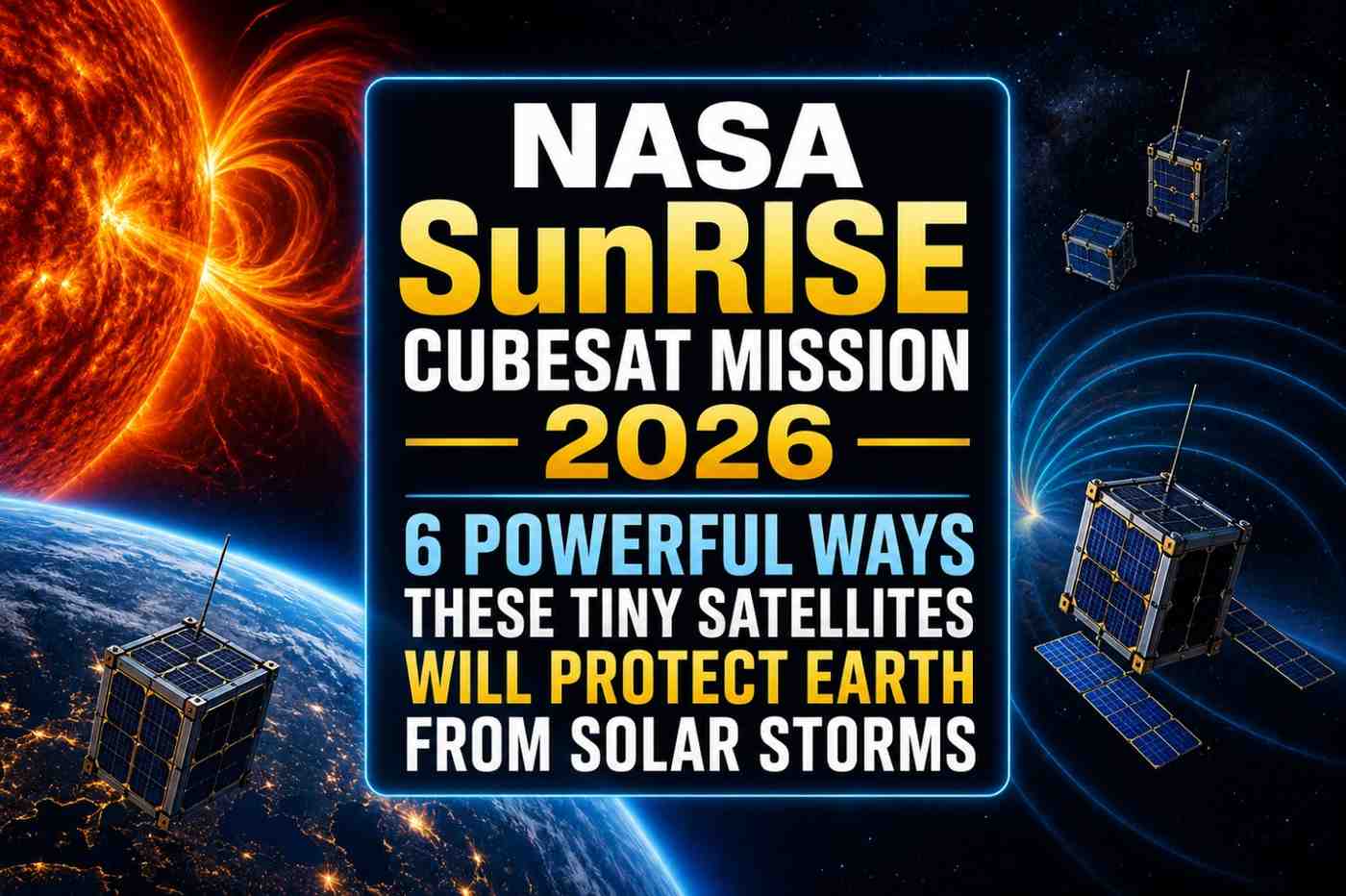
Introduction
The NASA SunRISE CubeSat mission 2026 may be one of the smallest missions NASA has ever flown — but its scientific impact could be enormous. Launching in summer 2026, SunRISE consists of just six satellites, each roughly the size of a toaster oven. Together, they will function as a single giant radio telescope stretching 6 miles across — watching the Sun in a way that has never been done before from space.
Scientists are excited about the NASA SunRISE CubeSat mission 2026 because it targets one of the most dangerous and least understood phenomena in space science: solar particle storms. These powerful events, driven by eruptions on the Sun, can irradiate unprotected astronauts, disable satellites, and disrupt GPS and communications systems on Earth.
SunRISE is here to help us predict them.
What Does SunRISE Stand For?
SunRISE stands for Sun Radio Interferometer Space Experiment. The name perfectly describes what the mission does: it uses radio interferometry — the same technique used by Earth-based radio telescope arrays — but applied from space, where Earth’s atmosphere can no longer block the specific low radio frequencies the Sun produces during solar particle events.
The NASA SunRISE CubeSat mission 2026 was selected in March 2020 as a NASA Heliophysics Explorer Mission of Opportunity. It is managed by NASA’s Jet Propulsion Laboratory (JPL) in Southern California, with science led by the University of Michigan in Ann Arbor.
NASA SunRISE CubeSat Mission 2026: Key Facts
| Detail | Information |
|---|---|
| Full Name | Sun Radio Interferometer Space Experiment |
| Launch Target | Summer 2026 |
| Launch Vehicle | United Launch Alliance Vulcan Centaur |
| Launch Site | Cape Canaveral Space Force Station, Florida |
| Number of Satellites | 6 CubeSats (6U each) |
| Satellite Size | Toaster-oven sized |
| Orbit | Supersynchronous geosynchronous (~22,000 miles altitude) |
| Virtual Telescope Size | ~6 miles (10 kilometers) wide |
| Mission Duration | 12 months (prime mission) |
| Science Lead | University of Michigan |
| Project Manager | NASA Jet Propulsion Laboratory |
Why Scientists Are Excited About NASA SunRISE CubeSat Mission 2026
1. It Will See What No Telescope Can See from Earth
This is the single most important reason the NASA SunRISE CubeSat mission 2026 exists.
The Sun produces powerful bursts of low-frequency radio waves during solar particle events — specifically in the frequency range of 0.1 MHz to 25 MHz. These radio signals contain critical information about where and how solar particle storms are generated in the Sun’s corona (outer atmosphere).
The problem? Earth’s upper atmosphere — called the ionosphere — completely absorbs and reflects these low frequencies. No ground-based telescope can detect them. Even orbiting satellites in low Earth orbit are below the ionosphere and face the same limitation.
SunRISE solves this by flying its six satellites high above the ionosphere, in a supersynchronous geosynchronous orbit at about 22,000 miles altitude. From up there, the Sun’s low-frequency radio emissions arrive completely unblocked.
According to NASA’s official SunRISE science page, this makes SunRISE the first low radio frequency interferometer in space — a pioneering instrument with no predecessor.
2. Six Small Satellites That Act Like One Giant Telescope
The technical genius of the NASA SunRISE CubeSat mission 2026 is the way six tiny satellites combine into a single, powerful observatory.
Each of the six CubeSats will carry a software-defined radio receiver and four telescoping antenna booms, each about 10 feet (2.5 meters) long, that deploy in an “X” pattern. By flying within 6 miles (10 kilometers) of one another and sharing their data, the six satellites collectively function as a single virtual radio telescope 6 miles wide.
This technique — called interferometry — is the same principle behind Earth-based radio telescope arrays like the Very Large Array (VLA) in New Mexico. The larger the effective diameter of a telescope, the finer the detail it can resolve. SunRISE’s 6-mile virtual aperture lets it pinpoint the location of solar radio bursts with a precision impossible for any single small satellite.
The satellites will transmit their data to Earth using NASA’s Deep Space Network, using an efficient simultaneous multi-spacecraft downlink mode.
3. It Will Map Solar Particle Storms Before They Strike
Solar energetic particle (SEP) events are one of the primary hazards facing astronauts in deep space. When the Sun launches a blast of high-energy particles — often following a coronal mass ejection (CME) — those particles can reach Earth in as little as 20 to 30 minutes after the initial radio burst.
That is not much warning time. And currently, scientists do not have a reliable way to tell where those particles are headed before they arrive.
The NASA SunRISE CubeSat mission 2026 changes this. By imaging the approximate location of a solar radio burst and tracking the direction in which energetic particles are streaming, SunRISE will give space weather forecasters a crucial new tool: the ability to predict not just that a radiation event is coming, but where it is going.
For astronauts on the Moon — which NASA is sending humans to as part of the Artemis program — that advance warning could be life-saving.
Internal Link: NASA Artemis II Mission Results 2026 — 10 Proven Breakthroughs
4. SunRISE Will Answer Fundamental Questions About the Sun
Beyond space weather prediction, the NASA SunRISE CubeSat mission 2026 is aimed at one of the most fundamental unsolved problems in solar science: how does the Sun accelerate particles to nearly the speed of light?
Solar flares, coronal mass ejections, and solar energetic particle events all involve particle acceleration on a scale that dwarfs anything achievable in a particle accelerator on Earth. Understanding the mechanism behind this acceleration is not just relevant to the Sun — it applies to stars, black holes, and other high-energy environments throughout the universe.
By measuring the radio signatures of particle acceleration in the Sun’s corona and tracking how those particles propagate into interplanetary space, SunRISE will generate the first direct observational map of this process, shedding light on a mystery that has puzzled heliophysicists for decades.
5. The Satellites Have Already Passed All Their Tests
The NASA SunRISE CubeSat mission 2026 is not just a future plan — the hardware is ready.
All six CubeSats were built at Utah State University’s Space Dynamics Laboratory (SDL) and have completed a rigorous testing campaign, including:
- Thermal vacuum testing — simulating the extreme temperature swings of orbit
- Electromagnetic compatibility testing — ensuring the satellites’ electronics won’t interfere with their sensitive science instruments
- Vibration testing — simulating the intense shaking of launch in all three axes, loaded with propellant to match true launch mass
The results? All six spacecraft passed every test. Jim Lux, SunRISE project manager at JPL, reported that “pre- and post-test functional checks were performed, and all six spacecraft aced them.”
As of January 2026, the satellites completed this full test campaign and are ready for launch — waiting only for their Vulcan Centaur ride to space.
6. SunRISE Will Join and Strengthen NASA’s Entire Heliophysics Fleet
The NASA SunRISE CubeSat mission 2026 is not operating in isolation. It is joining a remarkable fleet of solar observatories that together paint the most detailed picture of the Sun ever assembled.
SunRISE will directly complement:
- Parker Solar Probe — which flies closer to the Sun than any spacecraft in history, measuring solar wind and magnetic fields up close
- Solar Orbiter — a joint ESA/NASA mission imaging the Sun in unprecedented detail, including the never-before-seen polar regions
- STEREO (Solar TErrestrial RElations Observatory) — NASA’s twin-satellite mission studying the 3D structure of the Sun and solar wind
Together, these missions address what current heliophysics cannot do alone. Parker Solar Probe flies within 10 solar radii (10 RS) of the Sun’s surface — but it does not observe the moment particles are first accelerated at around 3 RS. SunRISE’s radio imaging fills this gap by mapping where and how radio bursts originate in the corona.
According to ESA’s Solar Orbiter mission page, the combined data from SunRISE and Solar Orbiter will create an unprecedented multi-wavelength, multi-point picture of the solar environment.
Internal Link: NASA Nancy Grace Roman Space Telescope Launch 2026 — Everything You Need to Know
How SunRISE Will Launch: The Vulcan Centaur Rideshare
The NASA SunRISE CubeSat mission 2026 will launch as a rideshare aboard a United Launch Alliance Vulcan Centaur rocket, sponsored by the United States Space Force’s Space Systems Command. The launch will take place from Cape Canaveral Space Force Station in Florida.
Flying as a rideshare keeps costs low — a key feature of the Mission of Opportunity program that funded SunRISE. This cost-efficiency model allows NASA to conduct high-value science missions at a fraction of the cost of dedicated launches, and SunRISE exemplifies how much cutting-edge science can be packed into a small, affordable package.
After launch, the six satellites will be delivered to a supersynchronous geosynchronous orbit and begin deploying their antenna booms. Once all six are in position and within 10 kilometers of each other, the mission’s one-year prime science phase will begin.
What SunRISE Data Will Look Like
When the NASA SunRISE CubeSat mission 2026 begins generating science, here is what it will produce:
Radio images of the Sun’s corona at frequencies between 0.1 and 25 MHz — a window on the universe that has never been opened from space before.
Maps of solar particle storm origins showing where in the corona energetic particles are first accelerated and in which direction they stream.
Real-time space weather data that will feed into forecasting models operated by NOAA’s Space Weather Prediction Center and NASA’s space weather team.
Fundamental physics data on particle acceleration in magnetized plasma — information applicable to understanding cosmic ray sources, pulsar wind nebulae, and other high-energy environments throughout the universe.
Why the Timing of the NASA SunRISE CubeSat Mission 2026 Is Perfect
The Sun operates on an approximately 11-year cycle of activity. Right now, in 2026, the Sun is in or near the peak of Solar Cycle 25 — the most active period of the current solar cycle. This means more solar flares, more coronal mass ejections, and more solar particle events than at any other time in the past decade.
Launching SunRISE during this peak period of solar activity is a deliberate and scientifically fortunate choice. The mission will have more solar events to study in its first year than it would at solar minimum — maximizing the science return on every dollar spent.
Conclusion
The NASA SunRISE CubeSat mission 2026 proves that you don’t need to be big to do great science. Six satellites, each the size of a toaster, flying in a precise formation 22,000 miles above Earth — together forming a radio telescope the size of a small city. Together, they will answer questions about the Sun that no previous instrument could touch, and give scientists the data they need to protect astronauts, satellites, and even power grids on Earth from the Sun’s most violent outbursts.
This summer, the Sun gets a new set of eyes. And they’re very, very small.
Want to follow the SunRISE mission from launch to first science? Bookmark NASA’s official SunRISE mission page and stay updated as these remarkable little satellites get to work.