
 Ramrajeshbee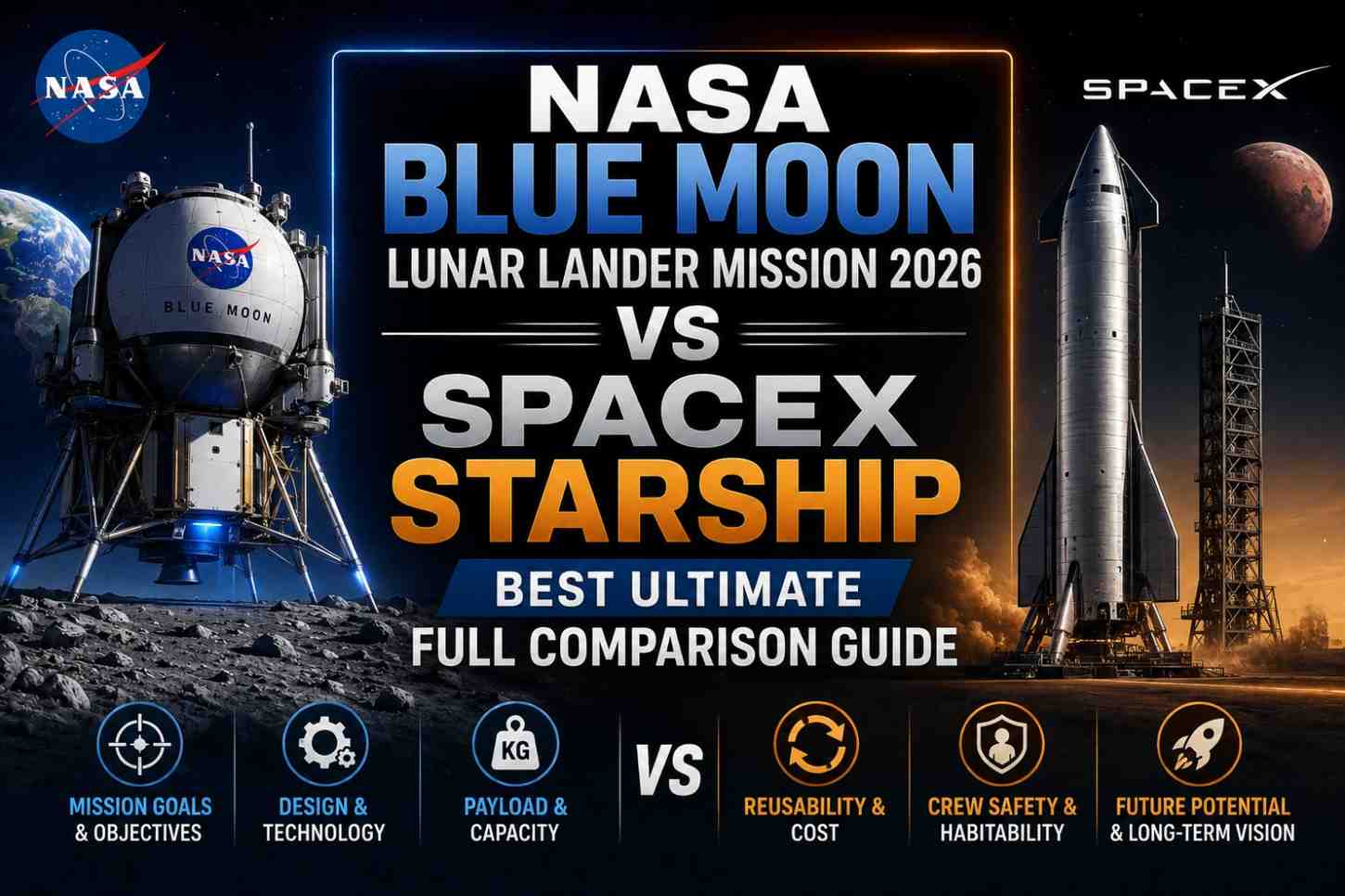
Introduction
The NASA Blue Moon lunar lander mission 2026 has become one of the most compelling stories in the new space race — a David-and-Goliath contest that nobody expected, pitting Blue Origin’s relatively compact Blue Moon lander against SpaceX’s gargantuan Starship.
Both vehicles are under development to land astronauts on the Moon. Both are backed by billions in NASA contracts. And both are racing toward a crucial test in late 2027 that will determine which one — or whether both — get to carry humans to the lunar surface for the first time since 1972.
This guide breaks down the NASA Blue Moon lunar lander mission 2026 and gives you a complete, honest comparison with SpaceX’s Starship Human Landing System. By the end, you’ll understand exactly how these two remarkable vehicles differ, what challenges each faces, and what the stakes are for NASA’s Artemis Moon landing program.
Background: Why NASA Has Two Lunar Landers
Before comparing the vehicles, it helps to understand why NASA is funding two competing lunar landers at the same time.
For years, NASA had only one contracted lunar lander: SpaceX’s Starship HLS, selected in April 2021 for a $2.89 billion contract. But delays in Starship’s development — particularly around orbital refueling — caused repeated slips in the Artemis III lunar landing timeline.
In May 2023, NASA awarded Blue Origin a second Human Landing System (HLS) contract — officially to “increase competition, reduce costs to taxpayers, support a regular cadence of lunar landings, and further invest in the lunar economy.” In reality, it also gave NASA a backup option if Starship couldn’t be ready in time.
The result is a genuine, high-stakes competition. The NASA Blue Moon lunar lander mission 2026 program represents a second path to the Moon — and possibly the faster one.
NASA Blue Moon Lunar Lander Mission 2026: What Is Blue Moon?
Blue Moon is a family of lunar landers under development by Blue Origin — the space company founded by Amazon’s Jeff Bezos. It comes in two variants with very different roles:
Blue Moon Mark 1 (Mk1) — The Uncrewed Pathfinder
The Blue Moon Mark 1 is a robotic cargo lander approximately 26 feet (8 meters) tall. It can deliver up to 3.3 tons (3 metric tons) of payload to the lunar surface.
The Mk1’s primary role is demonstration — proving that Blue Origin’s hardware, propulsion, avionics, and precision landing technology works on the Moon before any astronaut trusts their life to it. Its first uncrewed test flight, known as Blue Moon Pathfinder, was targeting launch in early 2026 and aims to land near the Shackleton crater at the Moon’s south pole.
The Pathfinder mission is partially funded by NASA’s Commercial Lunar Payload Services (CLPS) program, under which Blue Origin was awarded $6.1 million to transport NASA’s SCALPSS (Stereo Cameras for Lunar Plume Surface Studies) instrument — a camera system that will study how rocket plumes interact with the lunar surface during landing.
Blue Moon Mark 2 (Mk2) — The Crewed Artemis Lander
The Blue Moon Mark 2 is a significantly larger and more capable human lander designed for NASA’s Artemis program. Key specifications:
- Carries up to 4 astronauts to the lunar surface
- Supports stays of up to 30 days on the Moon
- Fully reusable design
- Powered by three BE-7 engines burning liquid hydrogen and liquid oxygen
- Paired with a Cislunar Transporter space tug (built by Lockheed Martin) for propulsion from Earth orbit to lunar orbit
Blue Moon Mk2 is officially contracted for the Artemis V mission and beyond — but the revised Artemis timeline has opened the door to an earlier role if it can be made ready.
There is also discussion of a Blue Moon Mark 1.5 — a crewed variant of the Mk1 that could potentially be ready sooner than the full Mk2, though Blue Origin has not officially confirmed this designation.
Internal Link: Complete Guide to NASA Artemis III Moon Landing Mission 2026
SpaceX Starship HLS — The Original Choice
SpaceX’s Human Landing System is a crewed variant of the company’s Starship upper stage — a stainless steel, reusable spacecraft that is part of the most powerful rocket ever built.
Key specifications:
- Height: Just over 50 meters (164 feet)
- Cargo capacity to the Moon: potentially 100 tons
- Propellant: liquid methane and liquid oxygen (cryogenic)
- Crew access: via a side-mounted elevator platform
- Reusable: designed for full reusability
Starship HLS has been in development since 2021 and has completed 11 full test flights of the broader Starship system. SpaceX has demonstrated the successful catch and reuse of the Super Heavy booster and has produced more than three dozen Starship ships and over 600 Raptor engines.
However, the most critical unproven capability — orbital propellant transfer — remains ahead. Because Starship HLS is too large to carry enough fuel to reach the Moon from Earth on its own, it requires refueling at an orbital propellant depot using a chain of tanker flights. This has never been done at scale in space and is the single biggest technical challenge standing between Starship HLS and a Moon landing.
NASA Blue Moon Lunar Lander Mission 2026 vs SpaceX Starship — Full Comparison
| Feature | Blue Moon Mk2 | SpaceX Starship HLS |
|---|---|---|
| Height | ~15 meters | ~50+ meters |
| Crew Capacity | 4 astronauts | 4 astronauts |
| Max Surface Stay | 30 days | ~7 days (Artemis IV) |
| Propellant | Liquid hydrogen / Liquid oxygen | Liquid methane / Liquid oxygen |
| Refueling Required | Yes (Cislunar Transporter) | Yes (multiple tanker flights) |
| Reusability | Fully reusable | Fully reusable (planned) |
| Cargo to Moon | 3+ tons (Mk1) | Up to 100 tons |
| Test Flights | 1 (New Glenn), Mk1 uncrewed in 2026 | 11+ Starship system tests |
| Assigned Artemis Mission | Artemis V | Artemis III/IV |
| Contract Value | Not publicly disclosed | $3.4 billion+ |
| Launch Vehicle | Blue Origin New Glenn | SpaceX Super Heavy / Starship |
The Key Challenge Both Landers Share: Cryogenic Fuel Transfer
This is the challenge that unites both contenders in the NASA Blue Moon lunar lander mission 2026 race — and both face it.
Both Starship HLS and Blue Moon Mk2 run on cryogenically cooled propellants that slowly boil off in space if not kept refrigerated. To reach the Moon and back, both vehicles must be refueled in Earth orbit using multiple tanker missions before heading to lunar orbit.
This cryogenic fuel transfer between spacecraft in orbit has never been accomplished at the scale required for a lunar mission. SpaceX internally transferred about 5 metric tons of cryogenic liquid oxygen between tanks during Starship’s third test flight — a promising first step, but a tiny fraction of what is needed for an actual lunar mission.
NASA has stated clearly that both landers must demonstrate this capability before astronauts can board them for a Moon landing. The results of these tests — whether on Artemis III or in dedicated uncrewed demonstrations — will be a major factor in determining which lander flies astronauts first.
The Race to Be Ready: Who Has the Edge?
SpaceX’s Advantages
SpaceX has the most flight experience, the most engines produced, and the most ambitious performance targets. Starship’s sheer size means it can carry unprecedented amounts of crew, cargo, and equipment to the lunar surface — potentially making it the backbone of a long-term lunar base.
SpaceX is also backed by an enormous engineering team and has demonstrated a willingness to test rapidly and iterate aggressively. The first flight of the improved Starship Version 3 is a critical upcoming milestone.
Blue Origin’s Advantages
Blue Origin’s advantage is simplicity and focus. The Blue Moon Mk1 is smaller, uses a more flight-proven propellant combination (liquid hydrogen and liquid oxygen, which NASA has used since the Apollo era), and does not require the same scale of on-orbit refueling operations as Starship.
The fact that Blue Moon Pathfinder is targeting an uncrewed lunar landing in 2026 — before any crewed Artemis mission — gives Blue Origin a chance to prove its hardware on the actual Moon ahead of SpaceX.
NASA has also signaled clearly that it values having two different landers as a safety measure. “Whichever lander is ready to go, we’ll go with,” said Lori Glaze, acting associate administrator for NASA’s Exploration Systems Development Mission Directorate.
NASA’s Position
NASA is not picking sides — it wants both. According to NASA’s official Human Landing Systems page, the agency views the two-lander approach as essential for maintaining a regular cadence of lunar missions and ensuring safe, redundant capabilities for astronauts.
NASA Administrator Jared Isaacman confirmed in April 2026 that both SpaceX and Blue Origin had committed to meeting NASA’s needs for the late 2027 Artemis III rendezvous and docking test — a critical milestone before any Moon landing attempt.
What Happens If Only One Lander Is Ready?
This is the scenario that has driven much of the discussion around the NASA Blue Moon lunar lander mission 2026 and the broader Artemis program.
Under the revised Artemis timeline confirmed in April 2026, the Artemis III mission in late 2027 will test one or both landers in Earth orbit. If only one is ready, that lander gets tested. If both are ready, both get tested.
For the Artemis IV Moon landing in early 2028, NASA will select whichever vehicle has successfully completed Earth orbit testing and received human-rating certification. The selection will be based on results, not on prior contracts.
The competition is real. The stakes are enormous. And the Moon landing clock is ticking.
Internal Link: NASA Artemis II Mission Results 2026 — 10 Proven Breakthroughs
Blue Moon Pathfinder: The 2026 Test That Changes Everything
The most immediate milestone in the NASA Blue Moon lunar lander mission 2026 story is the Blue Moon Pathfinder uncrewed lunar landing attempt.
Targeting launch no earlier than early 2026, the Pathfinder will attempt to land the Blue Moon Mk1 near the Moon’s Shackleton crater — at the lunar south pole — aboard a New Glenn rocket. If successful, it will validate:
- The BE-7 engine — Blue Origin’s powerful, throttleable cryogenic engine
- Cryogenic fluid power and propulsion systems
- Avionics and navigation software
- Continuous downlink communications
- Precision landing within a 100-meter radius
A successful Pathfinder landing would dramatically strengthen Blue Origin’s case for an expanded role in Artemis — possibly accelerating the Blue Moon’s assignment from Artemis V to Artemis IV.
According to Blue Origin’s official mission page, the Pathfinder is “the first step in establishing a sustained human presence on the Moon.”
Conclusion
The NASA Blue Moon lunar lander mission 2026 represents a genuine, high-stakes alternative to SpaceX Starship as humanity prepares for its first Moon landing since 1972. Blue Origin’s compact, heritage-design lander may lack Starship’s raw power — but it also lacks Starship’s complexity, and in spaceflight, simplicity is sometimes the safer bet.
What is certain is that NASA has made a wise choice in backing both. Two lunar landers mean two chances for success, more safety redundancy for astronauts, and the kind of competitive pressure that historically drives aerospace innovation to its fastest pace.
The Moon is the destination. Both roads lead there. The only question is which one gets paved first.
Want to follow both landers as they race toward the Moon? Bookmark NASA’s official HLS program page for the latest updates on Blue Moon and Starship HLS.