 Ramrajeshbee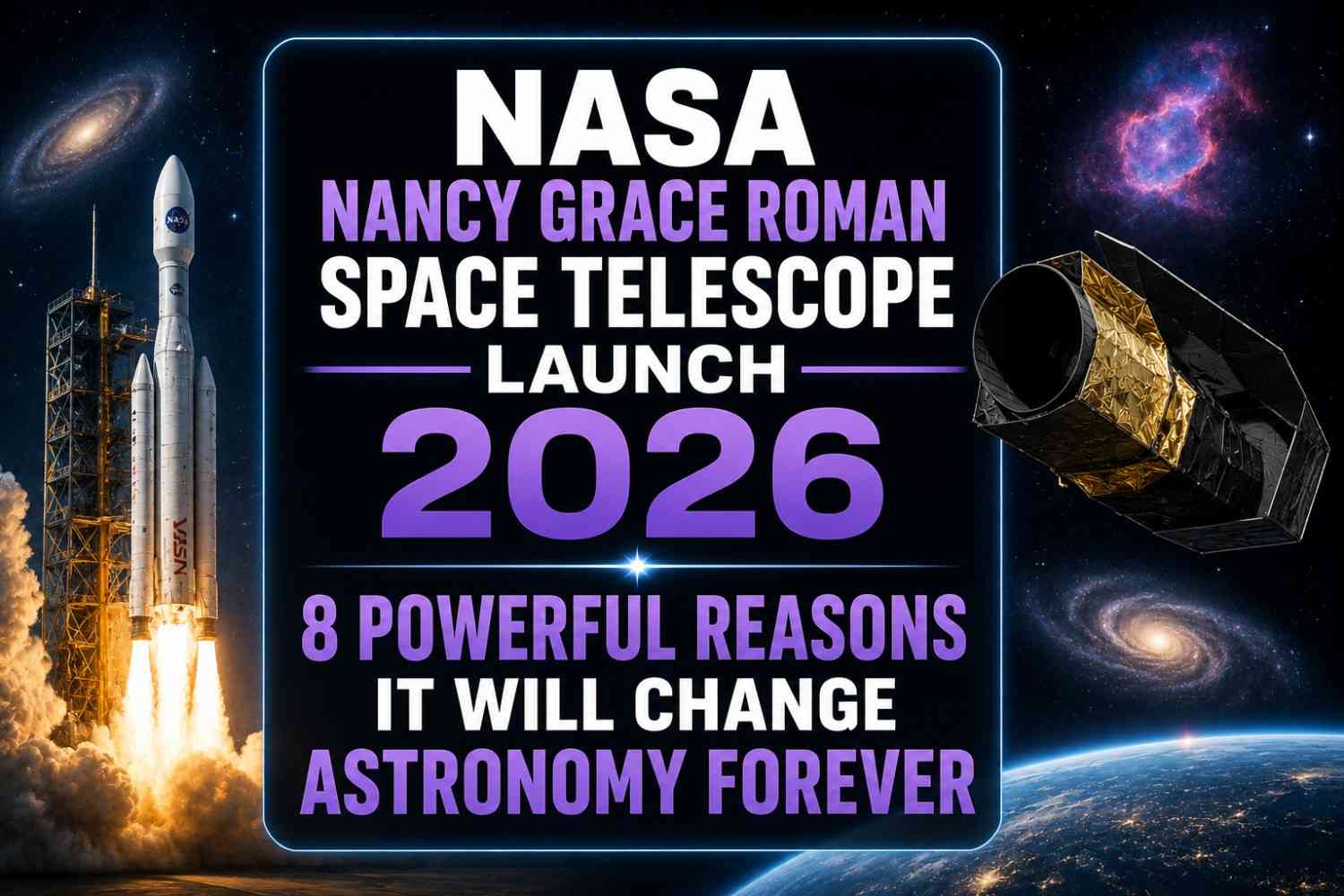
Introduction
The NASA Nancy Grace Roman Space Telescope launch 2026 is one of the most exciting events in the history of modern astronomy — and it’s happening sooner than anyone expected.
Originally scheduled for no later than May 2027, NASA shocked the science world in April 2026 by announcing that the Roman Space Telescope is now targeting early September 2026 for launch — a full eight months ahead of schedule and under budget.
This is not just another space telescope. Roman is a next-generation observatory that will survey the universe with a field of view 100 times wider than the Hubble Space Telescope and survey the sky more than 1,000 times faster. It is poised to rewrite textbooks on dark energy, dark matter, and the search for planets beyond our solar system.
Whether you’re a seasoned astronomer or simply someone who looks up at the stars and wonders, this guide explains everything you need to know about the NASA Nancy Grace Roman Space Telescope launch 2026.
Who Was Nancy Grace Roman?
Before diving into the telescope itself, it’s worth understanding the remarkable woman it honors.
Dr. Nancy Grace Roman was NASA’s first Chief of Astronomy — the first woman to hold an executive position at the agency. She joined NASA in 1959 and spent her career fighting to make cosmic exploration accessible to the entire scientific community. Most importantly, she was a driving force behind the creation of the Hubble Space Telescope.
Named in her honor on May 20, 2020, the NASA Nancy Grace Roman Space Telescope launch 2026 is a fitting tribute — because Roman is, in many ways, Hubble’s most powerful successor.
NASA Nancy Grace Roman Space Telescope Launch 2026: Key Facts at a Glance
| Detail | Information |
|---|---|
| Launch Target | Early September 2026 |
| Launch Vehicle | SpaceX Falcon Heavy |
| Destination | Sun-Earth L2 point (1.5 million km from Earth) |
| Mirror Size | 2.4 meters (same as Hubble) |
| Camera Resolution | 300.8 megapixels |
| Field of View | 100x wider than Hubble |
| Survey Speed | 1,000x faster than Hubble |
| Primary Mission | 5 years |
| Data Generated | 20,000 terabytes |
| Construction Complete | November 25, 2025 |
8 Powerful Reasons the NASA Nancy Grace Roman Space Telescope Launch 2026 Matters
1. It’s Launching 8 Months Ahead of Schedule — and Under Budget
In a space industry where delays are practically expected, the NASA Nancy Grace Roman Space Telescope launch 2026 stands as a genuine exception.
Construction was completed on November 25, 2025, at NASA’s Goddard Space Flight Center in Greenbelt, Maryland. Following successful environmental testing — including acoustic, vibration, and thermal vacuum tests — NASA Administrator Jared Isaacman announced on April 21, 2026, that the telescope is ready for launch in early September 2026.
“Roman’s accelerated development is a true success story of what we can achieve when public investment, institutional expertise, and private enterprise come together to take on the near-impossible missions that change the world,” Isaacman said.
This ahead-of-schedule milestone is especially significant given that multiple Trump administration budget proposals sought to cancel or defund the telescope. Roman survived every attempt — and is now set to reach space before another funding fight can reach it.
2. Its Field of View Is 100 Times Larger Than Hubble’s
The single most impressive specification of the NASA Nancy Grace Roman Space Telescope launch 2026 mission is its extraordinary field of view.
While the Hubble Space Telescope takes crisp, detailed images of small patches of the sky, Roman takes equally sharp images of a patch 100 times larger in a single shot. Each image captures an area of sky 0.28 square degrees — equivalent to the apparent size of multiple full moons side by side.
NASA’s Chief Scientist Julie McEnery described it simply: “The images it captures will be so large there is not a screen in existence large enough to show them.”
This wide-field capability is not just visually spectacular. It fundamentally changes what kind of science is possible. Surveys that would take Hubble decades to complete will take Roman just a few years.
3. NASA Nancy Grace Roman Space Telescope Launch 2026 Will Crack the Mystery of Dark Energy
Dark energy is the most mysterious force in the universe. It makes up approximately 68% of the total energy content of the cosmos and is responsible for the accelerating expansion of the universe — yet we have almost no idea what it actually is.
Roman was specifically designed to attack this problem. By generating detailed 3D maps of billions of galaxies across vast stretches of cosmic time, the telescope will track how the universe’s large-scale structure has evolved. This data will allow scientists to measure the effects of dark energy with unprecedented precision and test competing theories about its nature.
According to NASA’s official Roman mission page, this survey alone could reshape our understanding of fundamental physics.
4. It Will Map Dark Matter Across the Cosmos
Alongside dark energy, Roman will tackle the equally baffling mystery of dark matter — the invisible substance that makes up approximately 27% of the universe’s total mass-energy content.
Dark matter cannot be seen directly. Its presence is only detectable through the gravitational effects it has on visible matter — bending light from distant galaxies in a phenomenon called gravitational lensing. Roman’s wide-field infrared camera is perfectly engineered to detect these tiny distortions in the shapes of billions of distant galaxies.
By measuring gravitational lensing on an unprecedented scale, the telescope will map the distribution of dark matter across the cosmos — something no previous instrument has been able to do with this level of accuracy.
5. Roman Will Discover Thousands of New Exoplanets
The search for planets beyond our solar system is one of the most popular and fastest-growing fields in astronomy. The NASA Nancy Grace Roman Space Telescope launch 2026 will accelerate this search dramatically.
Using a technique called gravitational microlensing, Roman will detect planets that are nearly impossible to find with other methods — including free-floating planets that drift through space without orbiting any star. Scientists estimate that Roman will discover tens of thousands of exoplanets during its five-year primary mission, including many in the outer regions of their solar systems.
Additionally, Roman carries a Coronagraph Instrument (CGI) — a specialized device that blocks the light from a star so that orbiting planets can be photographed directly. While this coronagraph will serve primarily as a technology demonstration, it could open entirely new avenues for directly imaging giant exoplanets and studying their atmospheres.
Internal Link: NASA Artemis II Mission Results 2026 — 10 Proven Breakthroughs
6. It Will Generate 20,000 Terabytes of Data — More Than Hubble’s Entire Lifetime
The sheer volume of scientific data Roman will produce is almost impossible to comprehend.
During its five-year primary mission, Roman is expected to generate approximately 20,000 terabytes of astronomical data. For comparison, that is more data than the Hubble Space Telescope has produced in its entire 30+ year operational lifetime.
Roman will generate roughly 500 terabytes per year — data that will be made publicly available to astronomers around the world. Scientists expect this open archive to fuel astronomical discoveries for decades, long after the primary mission ends.
Crucially, AI-assisted analysis tools are already being developed to help researchers process and make sense of this flood of data — a partnership between space telescope technology and artificial intelligence that could itself become a model for future missions.
7. NASA Nancy Grace Roman Space Telescope Launch 2026 Will Work Alongside Webb and Hubble
Roman is not replacing the James Webb Space Telescope or the aging Hubble. It is joining them — and the combination is extraordinary.
Think of it this way: the James Webb Space Telescope is like a powerful microscope, looking at small areas of the sky in extraordinary detail and at extreme distances. Hubble is a legendary instrument that does the same, though less powerfully than Webb. Roman is like a wide-angle lens — scanning vast swaths of the universe rapidly to find the most interesting targets for Webb and Hubble to examine in detail.
Roman will operate from the Sun-Earth L2 Lagrange point, about 1.5 million kilometers from Earth — the same gravitationally stable location as the James Webb Space Telescope. From there, it will share the cold, dark vantage point that makes infrared observations of the universe so precise.
According to ESA’s overview of space observatories, combining observations from Roman and Webb will give astronomers a view of the universe that is both vast and incredibly deep.
8. Roman Is the Last of Its Kind — and One of the Most Significant
The NASA Nancy Grace Roman Space Telescope launch 2026 may represent the last of NASA’s great flagship science observatories for a generation.
Budget pressures under multiple recent administrations have made long-term science mission planning increasingly difficult. While the Habitable Worlds Observatory — a future flagship telescope capable of directly imaging Earth-like planets — has been proposed, its funding remains deeply uncertain.
Roman’s completion on time and under budget is therefore not just scientifically significant. It is a statement about what NASA can achieve — and perhaps a last chapter in an era of transformational flagship space science missions that began with Hubble in 1990.
Senior project scientist Julie McEnery captured the moment: “In the mission’s first five years, it’s expected to unveil more than 100,000 distant worlds, hundreds of millions of stars, and billions of galaxies. We stand to learn a tremendous amount of new information about the universe very rapidly after Roman launches.”
Internal Link: Complete Guide to NASA Artemis III Moon Landing Mission 2026
What Will Roman’s Three Core Surveys Study?
The NASA Nancy Grace Roman Space Telescope launch 2026 mission is built around three core surveys that will account for 75% of its primary mission time:
1. The High-Latitude Wide-Area Survey This survey will image billions of galaxies across vast stretches of cosmic time. Scientists will use this data to trace the evolution of the universe — mapping dark matter distribution and measuring the effects of dark energy on the large-scale structure of the cosmos.
2. The High-Latitude Time-Domain Survey Roman will observe the same regions of sky repeatedly over time, capturing transient events like exploding stars (supernovae), colliding neutron stars, and other rapidly changing phenomena. This survey is critical for measuring cosmic expansion rates with extreme precision.
3. The Galactic Bulge Time-Domain Survey By staring at the crowded central region of our own Milky Way galaxy, Roman will detect thousands of planets — including free-floating rogue planets — through gravitational microlensing events that last as little as a few hours.
Final Preparations Before the September 2026 Launch
With the NASA Nancy Grace Roman Space Telescope launch 2026 now just months away, the remaining steps are:
- Final environmental testing at Goddard Space Flight Center
- Shipping to Kennedy Space Center in Florida (planned for summer 2026)
- Integration with SpaceX Falcon Heavy at the launch pad
- Final sensor checkouts before liftoff
- Launch — early September 2026
The SpaceX Falcon Heavy was selected for this mission in July 2022, with a contract specifying readiness by October 2026. Its proven reliability — a 100% success rate for its 70-meter variant — makes it an ideal launch vehicle for this once-in-a-generation observatory.
Conclusion
The NASA Nancy Grace Roman Space Telescope launch 2026 is arguably the most significant astronomical event of this decade. A telescope that surveys 100 times more sky than Hubble, generates 20,000 terabytes of data, maps dark energy and dark matter across billions of galaxies, and discovers thousands of new worlds — arriving eight months ahead of schedule and under budget.
This is science at its best. And this September, a new eye on the universe will open.
Want to follow every milestone of the Roman mission from now through launch day? Bookmark NASA’s official Roman Space Telescope page and never miss an update.