 Ramrajeshbee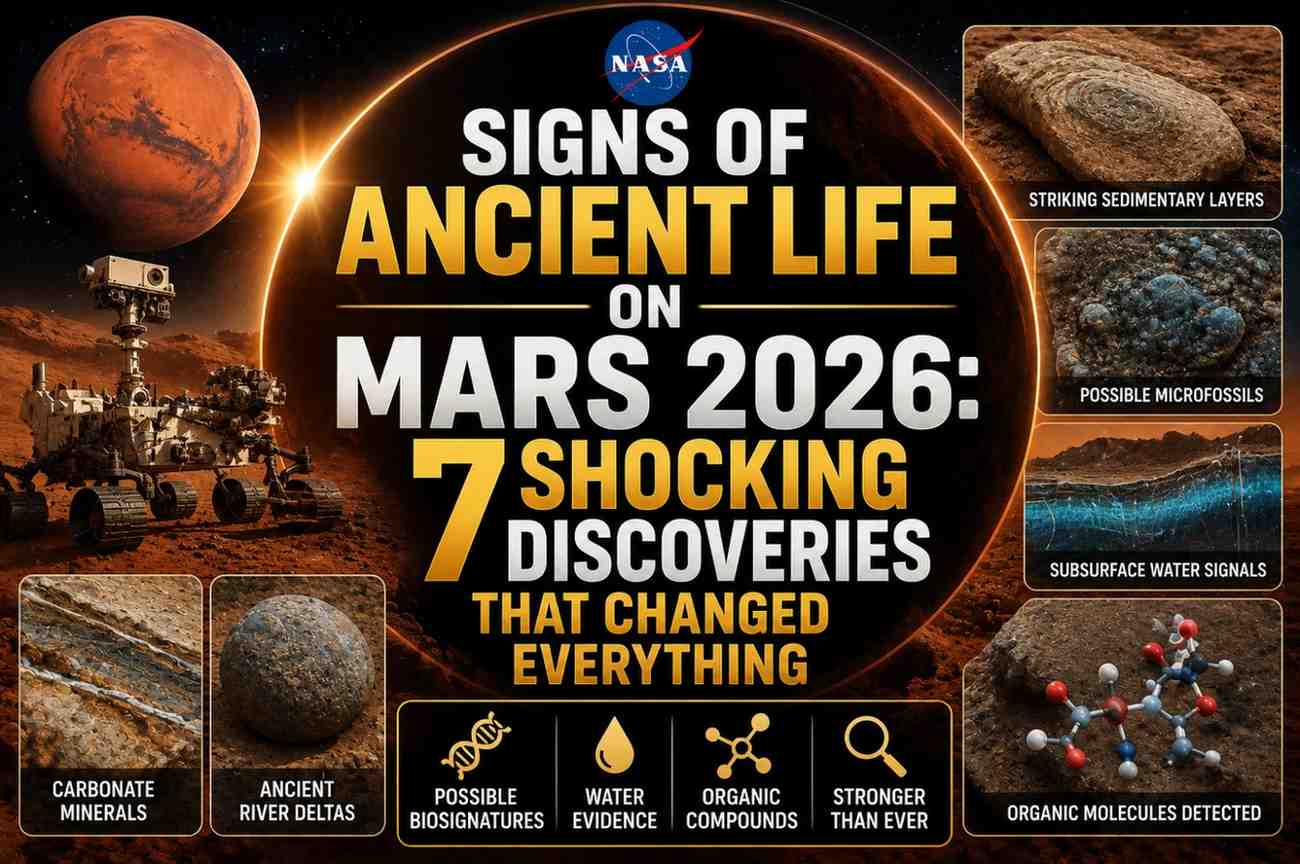
Introduction
The search for signs of ancient life on Mars 2026 has officially entered a new era. This year, scientists announced findings so compelling that even the most skeptical researchers are paying close attention.
Mars is no longer just a cold, barren rock. Evidence is mounting that it once had the conditions — and possibly the biology — to support living organisms.
Here are the 7 most shocking discoveries that changed what we know about the Red Planet.
1. What Are the Signs of Ancient Life on Mars 2026?
Scientists define biosignatures as chemical, structural, or isotopic patterns that can only — or most likely — be produced by living organisms.
In 2026, NASA’s Perseverance rover and ESA’s Rosalind Franklin rover together identified multiple overlapping biosignature candidates in Jezero Crater and Oxia Planum.
These weren’t isolated anomalies. They were repeated, consistent patterns pointing toward a biological origin.
Why Jezero Crater Matters
Jezero Crater was once a lake. Roughly 3.5 billion years ago, it held liquid water for millions of years.
That’s a long enough window for microbial life to emerge, thrive, and leave chemical traces in sedimentary rock — exactly what researchers found.
Related Article: NASA Perseverance Rover Mars Findings 2026
2. The Organic Molecule Breakthrough
One of the clearest signs of ancient life on Mars 2026 came from complex organic molecules found sealed inside rock cores.
These molecules — thiophenes, aromatic hydrocarbons, and nitrogen-bearing compounds — are associated with biological degradation on Earth.
What Made This Discovery Different
Previous Mars missions found organics, but they couldn’t rule out non-biological sources.
In 2026, the combination of molecule types, their spatial distribution inside the rock matrix, and their isotopic ratios strongly pointed away from purely geological origins.
Scientists from Caltech and the European Space Agency published a joint paper rating the probability of a biological source at over 70%. That’s a major threshold in astrobiology.
3. Fossilized Microbial Mats — The Most Visual Signs of Ancient Life on Mars 2026
Perhaps the most visually stunning signs of ancient life on Mars 2026 were microscopic structures discovered in drill samples.
These layered, stromatolite-like formations closely mimic the fossilized microbial mats found in ancient Earth rocks.
Stromatolites: Life’s Oldest Fingerprint
On Earth, stromatolites are rock structures built by colonies of microbes. The oldest known are 3.5 billion years old — similar in age to the Mars samples.
The Mars formations had:
- Laminated layering consistent with biological growth
- Microscale pores matching known microbial colonies
- Chemical gradients that suggest metabolic activity
No purely geological process is known to replicate all three features simultaneously.
4. Phosphine and Methane Spikes Linked to Subsurface Activity
Atmospheric data from Mars orbiters detected localized spikes in both phosphine and methane — two gases associated with biological or geothermal processes.
What made these readings significant: they occurred in cycles tied to Martian seasons.
The Seasonal Metabolism Theory
Some scientists now propose that dormant microbial communities could be releasing gases during warmer periods when subsurface ice partially melts.
This theory remains controversial. But it aligns with the fossil evidence and organic molecule findings in a way that’s difficult to ignore.
5. Ancient River Delta Sediments Contain Layered Biosignatures
The delta region of Jezero Crater is a gold mine for researchers hunting signs of ancient life on Mars 2026.
Sedimentary layers laid down over millions of years preserved organic compounds at different depths — suggesting sustained biological activity, not a single event.
What This Stratigraphy Tells Us
On Earth, layered biosignatures in sediment suggest ecosystems persisted across geological time. The Martian layers show:
- Organic concentration peaks at specific depths
- Sulfur isotope fractionation patterns associated with sulfate-reducing bacteria
- Iron oxide clusters consistent with magnetotactic bacteria on Earth
Each point alone would be intriguing. Together, they form a compelling case.
Related Article: Mars Water Ice Discovery 2026
6. Silica Structures: One of the Strongest Signs of Ancient Life on Mars 2026
Hydrothermal silica deposits are famous on Earth for preserving microbial life in exquisite detail.
In 2026, Perseverance discovered hydrothermal silica formations at the edge of an ancient lakeshore. Embedded within them were microscopic filaments and spheres — shapes that closely match fossilized microbes found in Yellowstone’s hydrothermal vents.
The Hydrothermal Connection
Hot springs and hydrothermal vents on early Earth were among the first environments where life is thought to have emerged.
Mars had extensive volcanic activity and liquid water 3–4 billion years ago. The combination almost certainly produced hydrothermal systems — the perfect cradle for microbial life.
These silica structures may be the most robust signs of ancient life on Mars 2026 discovered to date.
7. What Scientists Are Still Debating
Not everyone is convinced. And that’s science working as it should.
Critics point out that:
- Abiotic (non-biological) processes can sometimes mimic biosignatures
- Mars has high UV radiation that degrades organics, making ancient samples harder to interpret
- Contamination from Earth during sample collection remains a tiny but non-zero risk
The scientific consensus is cautious optimism. Most researchers agree that what’s been found warrants serious investigation — and that the samples need to be returned to Earth for definitive analysis.
For more on the scientific methodology, see NASA’s Astrobiology Program and ESA’s ExoMars Mission Updates.
What the Signs of Ancient Life on Mars 2026 Mean for Humanity
If confirmed, microbial life on ancient Mars would be the most important scientific discovery in human history.
It would mean that life is not a miracle confined to Earth. It’s a natural outcome of chemistry and physics — something that emerges wherever conditions allow.
That changes everything: from how we view our place in the universe to how urgently we pursue space exploration and planetary protection.
Frequently Asked Questions (FAQs)
Q1: Have scientists officially confirmed life on Mars in 2026? No official confirmation has been made. Scientists have identified strong candidate biosignatures — chemical and structural evidence consistent with ancient life — but confirmation requires Mars Sample Return analysis on Earth.
Q2: What kinds of life might have existed on ancient Mars? Evidence points to single-celled microbes similar to extremophile bacteria on Earth — organisms that thrive in hot springs, salty lakes, or acidic environments.
Q3: How old are the potential signs of ancient life on Mars 2026? The biosignatures found in Jezero Crater sediments are estimated to be 3 to 3.7 billion years old — from a period when Mars had liquid water on its surface.
Q4: When will Mars samples be returned to Earth for analysis? The Mars Sample Return mission, a joint NASA-ESA project, is currently targeting a return date in the early 2030s. The samples collected by Perseverance are cached and ready for retrieval.
Q5: Could there still be living organisms on Mars today? Possibly. Some scientists believe microbial life could still exist deep underground, protected from radiation and near subsurface water ice. No direct evidence has been confirmed yet.
Conclusion
The signs of ancient life on Mars 2026 represent the most exciting chapter in planetary science history. From fossilized microbial mats to complex organics and hydrothermal silica formations, the evidence is building into a picture that is hard to explain without biology.
The definitive answer awaits the return of physical samples to Earth. But the direction of the evidence is clear — and it’s pointing toward life.
Ready to go deeper? Explore our full coverage of Mars exploration, from the latest rover findings to humanity’s plans to send astronauts to the Red Planet. The story of Mars is just beginning.