 Ramrajeshbee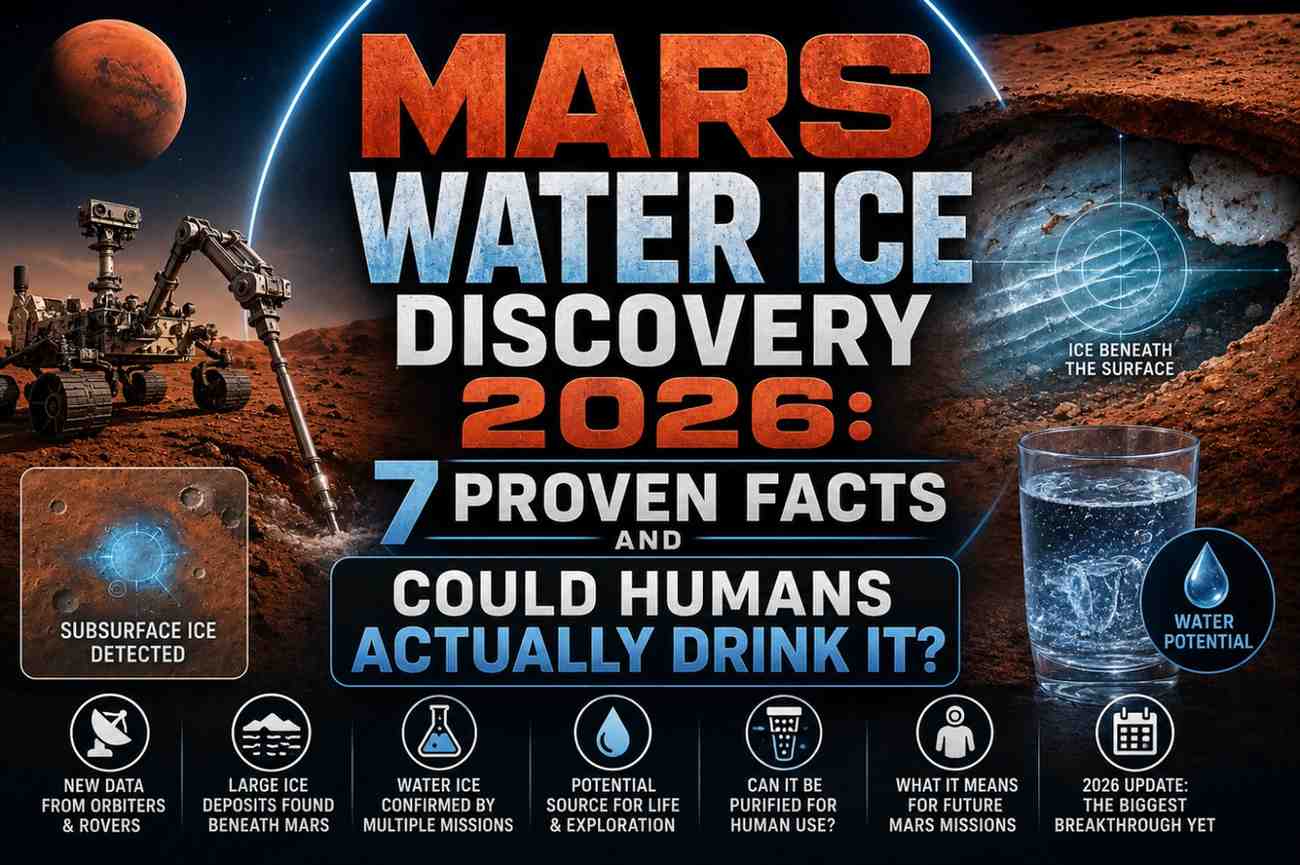
Introduction
The Mars water ice discovery has fundamentally changed humanity’s prospects for living on the Red Planet. Scientists have known for years that Mars harbors water ice at its poles and in permafrost beneath its surface — but 2026 brought something new: accessible, shallow deposits located in equatorial regions where future human missions would actually land.
Could future colonists drink this water? The answer is more complicated — and more promising — than you might think.
What Is the Mars Water Ice Discovery 2026?
The Mars water ice discovery 2026 refers to the confirmed detection and mapping of shallow water ice deposits in Mars’s mid-latitude and near-equatorial regions.
Using data from NASA’s Mars Reconnaissance Orbiter, the ESA Mars Express, and ground-penetrating radar from the InSight lander’s seismology network, scientists identified ice-rich layers less than 1 meter below the surface in multiple locations.
This is significant because:
- Previous accessible ice was mostly at the poles (cold, distant, hard to reach)
- Mid-latitude ice is accessible for surface missions
- Shallow deposits can be mined without deep drilling
Fact 1 — Where Was the Ice Found?
The Mars water ice discovery 2026 identified major shallow deposits in:
- Utopia Planitia (northern lowlands): One of the largest known ice reservoirs
- Arcadia Planitia: Shallow ice confirmed at less than 0.5 meters depth
- Hellas Basin edges: Ice-rich regolith in a warmer depression
- Mid-latitude craters: Multiple fresh craters exposing ice in their walls
The Arcadia Planitia deposit alone is estimated to contain water equivalent to Lake Superior — enough to supply a colony for thousands of years.
Why Location Matters for Human Missions
SpaceX’s preferred Mars landing zones overlap with regions near the Mars water ice discovery 2026 deposits. This wasn’t accidental — mission planners prioritized landing sites near accessible resources.
Fact 2 — How Much Water Ice Is There?
Estimates based on SHARAD (Shallow Radar) and MARSIS data suggest Mars holds water ice equivalent to a global ocean 1.5 to 2 meters deep — if spread evenly over the entire surface.
In practical terms: enough fresh water for millions of people for millions of years.
The Mars water ice discovery 2026 mid-latitude deposits alone represent thousands of cubic kilometers of frozen water — far more than any colony would need.
Related Article: NASA Perseverance Rover Mars Findings 2026
Fact 3 — Could Humans Actually Drink It?
This is the question everyone is asking. The answer: yes, but with processing.
What Mars Ice Water Contains
Martian water ice is not pure H₂O. Analysis suggests it likely contains:
- Perchlorate salts (toxic to humans in high concentrations)
- Heavy metals from volcanic activity
- Dust and regolith particles
- Possible trace organics
Perchlorates are the biggest concern. Mars’s surface has perchlorate concentrations roughly 100 times higher than Earth’s worst contaminated sites.
How It Would Be Purified
The good news: perchlorate removal is a solved engineering problem on Earth.
Processing Martian water ice would involve:
- Heating and melting the ice (removing dust and particles)
- Reverse osmosis filtration (removes ions including perchlorates)
- Ion exchange resin (specifically targets perchlorate molecules)
- UV sterilization (eliminates biological contamination risk)
- Mineral balancing (adds back necessary trace minerals)
The resulting water would be safer than most municipal tap water.
Fact 4 — Ice Can Produce Rocket Fuel, Not Just Drinking Water
The Mars water ice discovery 2026 has implications far beyond drinking water. Water — H₂O — can be split by electrolysis into hydrogen and oxygen.
These elements are:
- Breathable oxygen for colonists
- Oxidizer for rocket engines
- Hydrogen fuel for power generation
- Combined with Mars CO₂ to produce methane (rocket propellant)
In short, the water ice deposits found in 2026 are the foundation of a self-sustaining Mars civilization.
Fact 5 — Shallow Ice Is Accessible Without Advanced Drilling
One of the most important aspects of the Mars water ice discovery 2026 is depth. Some deposits are less than 30 centimeters below the surface.
That’s within reach of simple excavation equipment — not deep drilling rigs.
Mining Options Being Considered
Engineers are designing several approaches:
- Heated tubes: Insert hollow rods to melt and collect ice
- Microwave sublimation: Heat surface area to vaporize and capture ice
- Mechanical excavation: Simple scooping with pressurized collection domes
- Perchlorate electrolysis: Remove perchlorates while simultaneously generating oxygen
All of these are low-tech compared to deep drilling, significantly reducing mission complexity.
Fact 6 — The Ice May Have Been Liquid Water in the Recent Geological Past
Some of the deposits identified in the Mars water ice discovery 2026 show evidence of layering and flow structures suggesting they were once liquid.
Mars undergoes obliquity cycles — changes in axial tilt — that can dramatically warm the planet. During high-obliquity periods (every few million years), equatorial temperatures could allow liquid water to exist briefly.
This is scientifically exciting: it means the water cycle on Mars is not entirely dead — just dormant.
For detailed technical information, see NASA’s Mars Water Science overview and ESA’s Mars Express water research.
Fact 7 — Ice Distribution Maps Will Guide Colony Site Selection
Perhaps the most immediate practical impact of the Mars water ice discovery 2026 is how it reshapes mission planning.
Detailed ice distribution maps now being created will directly inform where SpaceX, NASA, and international agencies select landing zones for the first crewed missions.
The Ideal Colony Site Profile
Mission planners want landing sites that have:
- Accessible water ice within 1 meter depth
- Near-equatorial location for maximum solar power generation
- Flat terrain for landing and construction
- Proximity to scientifically interesting geology
The 2026 ice mapping data narrows the candidate sites significantly — and several locations in Arcadia Planitia now top the list.
Related Article: How Long Does It Take to Travel to Mars 2026
Frequently Asked Questions (FAQs)
Q1: Is there liquid water on Mars today? No confirmed liquid water exists on Mars’s surface today. However, briny subsurface water may exist deep underground. The 2026 discoveries focus on ice — frozen water — in the shallow subsurface.
Q2: Are the perchlorates in Mars water dangerous? Yes, untreated Martian water would be toxic due to perchlorate contamination. However, standard water purification technology can remove perchlorates effectively, making processed Martian water safe to drink.
Q3: Could Mars ice support a large colony? Yes. The volume of ice identified — particularly in Arcadia Planitia — is vast enough to support thousands of colonists for centuries, plus provide propellant production and oxygen generation.
Q4: How cold is the ice on Mars? Shallow subsurface ice on Mars is typically around -60°C to -80°C. It requires energy to melt but far less than drilling to deeper deposits.
Q5: Will future Mars missions specifically target these ice deposits? Yes. The Mars water ice discovery 2026 mapping data is already being incorporated into SpaceX, NASA, and international Mars mission landing site selection criteria.
Conclusion
The Mars water ice discovery 2026 is one of the most practically important scientific announcements in the history of Mars exploration. Accessible, shallow ice deposits in landing-zone-compatible regions mean that the water supply problem for human Mars colonization is effectively solved — pending the engineering work to extract and purify it.
Could future colonists drink Martian water? With the right equipment: absolutely.
The future of Mars exploration runs on water. Follow our complete Mars coverage to stay updated on every discovery, mission milestone, and technology breakthrough that is making human Mars colonization a near-term reality.