 Ramrajeshbee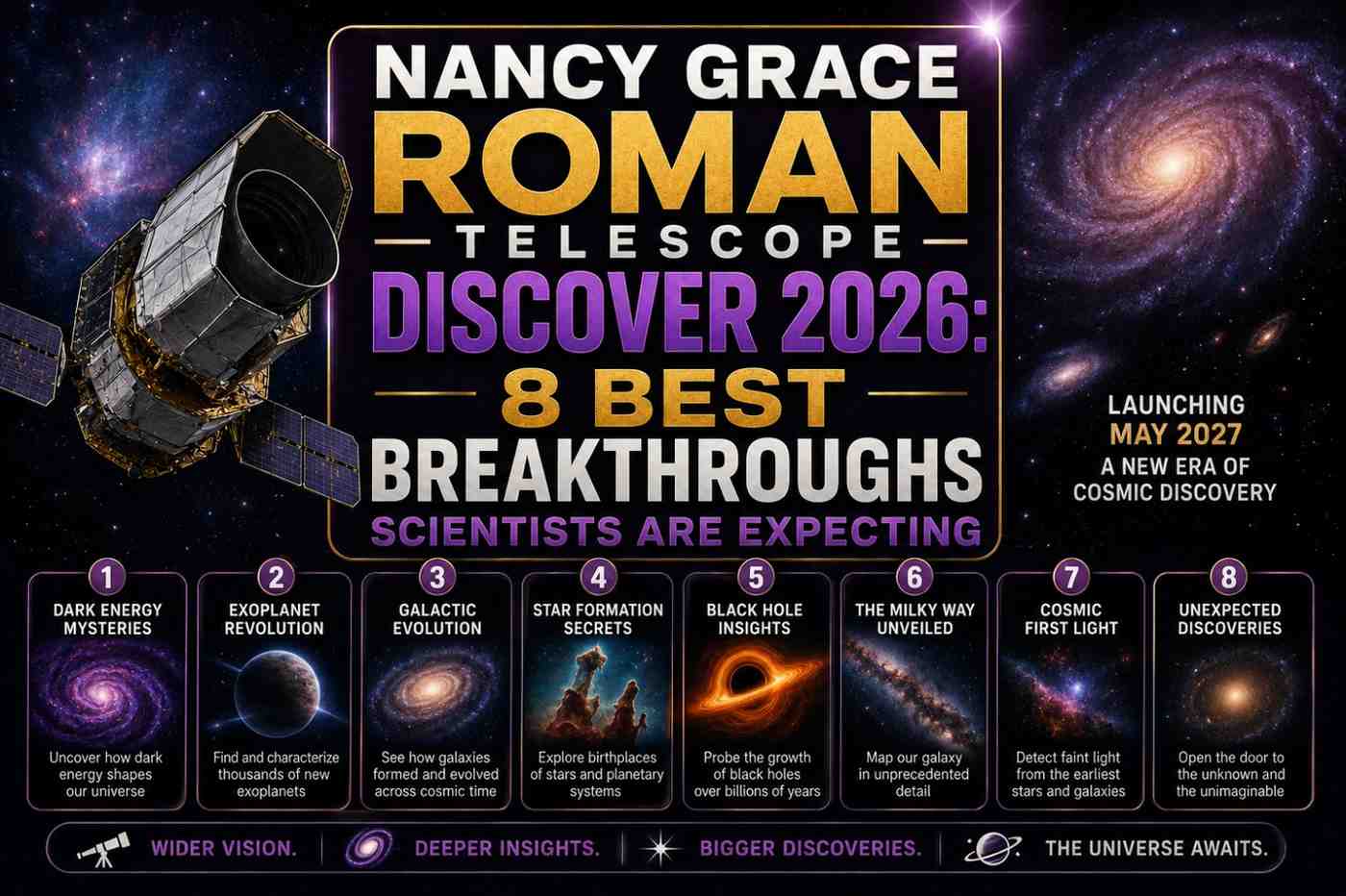
Introduction
What will the Nancy Grace Roman Telescope discover in 2026? That question is generating enormous excitement across the astronomical community. Set to launch in 2026 or early 2027, the Roman Space Telescope will be the most powerful wide-field infrared observatory ever built — and its science targets span dark energy, dark matter, exoplanets, and galactic archaeology.
The Nancy Grace Roman Telescope discover 2026 mission promises to reshape entire fields of astrophysics. Here are the 8 biggest breakthroughs scientists are expecting.
Why the Nancy Grace Roman Telescope Discover 2026 Mission Is Historic
The Roman Space Telescope represents a paradigm shift in how we do astronomy.
Previous telescopes — including Hubble and Webb — are precision instruments designed for deep study of specific targets. Roman is designed for massive-scale surveys. It will observe more of the sky, more quickly, than any space telescope before it.
The Nancy Grace Roman Telescope discover 2026 science program covers surveys that would take Webb over 1,000 years to complete — Roman will do them in under 5.
Expected Discovery 1 — The Dark Energy Map
The crown jewel of the Nancy Grace Roman Telescope discover 2026 mission is its dark energy survey.
Dark energy is the mysterious force making up ~68% of the universe’s total energy content — and causing cosmic expansion to accelerate. We don’t know what it is.
Roman will map:
- 2 billion galaxies across a significant fraction of the observable universe
- Weak gravitational lensing — how dark matter distorts galaxy shapes at cosmic scale
- Baryon acoustic oscillations — sound waves from the early universe frozen into galaxy distribution patterns
- Type Ia supernovae — standard candles for measuring cosmic expansion rate
This dataset will be the most comprehensive test of dark energy theories ever assembled.
Expected Discovery 2 — A Census of Rogue Planets
One of the most dramatic things the Nancy Grace Roman Telescope discover 2026 program will reveal: free-floating planets — worlds with no host star.
Using gravitational microlensing, Roman will detect the subtle brightening of background stars when a planet-sized object passes in front. This method works even for dark, starless objects.
How Many Rogue Planets Are There?
Current estimates suggest there may be more rogue planets than stars in the Milky Way — billions of worlds drifting alone through interstellar space.
Roman is expected to discover hundreds to thousands of rogue planets, revolutionizing our understanding of planet formation and ejection dynamics.
Expected Discovery 3 — Thousands of New Exoplanets via Microlensing
The Nancy Grace Roman Telescope discover 2026 galactic exoplanet survey will find planets in orbital configurations completely inaccessible to other detection methods.
Transit photometry (used by Kepler and TESS) only works for planets orbiting close to their star, aligned perfectly with Earth’s line of sight. Microlensing works for:
- Planets far from their host stars (analog to our outer solar system)
- Planets around any type of star at any distance in the galaxy
- Planets as small as Mars
Roman is expected to discover 1,400+ exoplanets via microlensing alone — providing the first true galactic census of planetary systems.
Related Article: Nancy Grace Roman Space Telescope vs James Webb
Expected Discovery 4 — Direct Imaging of Giant Exoplanets
The Nancy Grace Roman Telescope discover 2026 mission includes a coronagraph instrument that will attempt to directly image giant exoplanets and debris disks around nearby stars.
This is a technology demonstration, not the primary science mission — but even a demonstrator that achieves 1-billion-to-1 contrast ratios would be transformative.
If successful, Roman’s coronagraph paves the way for the next generation of planet-imaging telescopes, including the proposed Habitable Worlds Observatory designed to directly image Earth-like planets.
Expected Discovery 5 — The Structure of the Milky Way’s Bulge
The Nancy Grace Roman Telescope discover 2026 galactic survey will peer deep into the dense star fields at the center of our galaxy.
Roman will observe hundreds of millions of stars in the Milky Way’s central bulge — mapping stellar populations, star formation history, and the distribution of stellar remnants (white dwarfs, neutron stars, black holes).
This galactic archaeology program will reconstruct the formation history of our galaxy in extraordinary detail.
Expected Discovery 6 — Dark Matter Distribution
Alongside dark energy, the Nancy Grace Roman Telescope discover 2026 weak lensing survey will map the distribution of dark matter across cosmic scales.
Dark matter — constituting ~27% of the universe — is invisible but bends light through gravity. Roman will detect this lensing effect across billions of galaxies, creating the most detailed 3D map of dark matter ever assembled.
This will test competing theories of dark matter — from cold dark matter to warm dark matter — with unprecedented precision.
For the full science case, see NASA’s Roman Science Overview and The Roman Science Investigation Teams at STScI.
Expected Discovery 7 — Transient Events: Supernovae and Variable Stars
The Nancy Grace Roman Telescope discover 2026 time-domain survey will monitor the sky for change — detecting supernovae, variable stars, active galactic nuclei, and gravitational wave optical counterparts.
Roman will discover thousands of supernovae per year — far more than any previous survey. This statistical sample will:
- Refine measurements of the Hubble constant
- Identify new classes of stellar explosions
- Provide optical counterparts to gravitational wave events detected by LIGO and Virgo
Expected Discovery 8 — High-Redshift Galaxies at the Edge of the Observable Universe
While this is Webb’s primary domain, the Nancy Grace Roman Telescope discover 2026 wide-field survey will also discover enormous numbers of very distant galaxies.
Roman’s surveys will identify millions of galaxies at redshifts above z=2 — corresponding to the universe as it was less than 3 billion years after the Big Bang.
Webb then provides detailed follow-up. Roman casts the net; Webb examines the catch.
Related Article: James Webb Space Telescope Latest Images 2026
FAQs: Nancy Grace Roman Telescope Discovery 2026
Q1: When exactly will the Nancy Grace Roman Telescope launch in 2026? NASA is targeting a launch window opening in late 2026, with the latest acceptable launch date in May 2027 to maintain mission requirements. The exact date depends on rocket availability and final systems checks.
Q2: How long will Roman’s primary mission last? Roman has a planned primary mission of 5 years, with a design life of 10 years. Its L2 orbit is serviceable in principle, though no servicing missions are currently planned.
Q3: How does Roman find rogue planets? Roman uses gravitational microlensing — detecting the brightening of a background star as a planet-sized object passes in front. Even dark, starless planets create this detectable lensing signal.
Q4: Will Roman’s data be publicly available? Yes. Like all NASA missions, Roman’s data will be publicly released to the global astronomical community through the Mikulski Archive for Space Telescopes (MAST) at STScI.
Q5: What is Roman’s coronagraph expected to achieve? Roman’s coronagraph technology demonstrator aims to achieve contrast ratios of 1 billion to 1—suppressing starlight enough to reveal reflected light from giant exoplanets in the near-infrared.
Conclusion
What will the Nancy Grace Roman Telescope discover in 2026? The honest answer is: more than we can fully predict. That’s what makes it so exciting. From dark energy maps to rogue planets, galactic structure to thousands of new worlds—Roman’s science program is the broadest and most statistically powerful in the history of space astronomy.
Don’t miss a single discovery. Follow our complete space telescope coverage as Roman prepares for launch and begins its extraordinary survey of the universe.