 Ramrajeshbee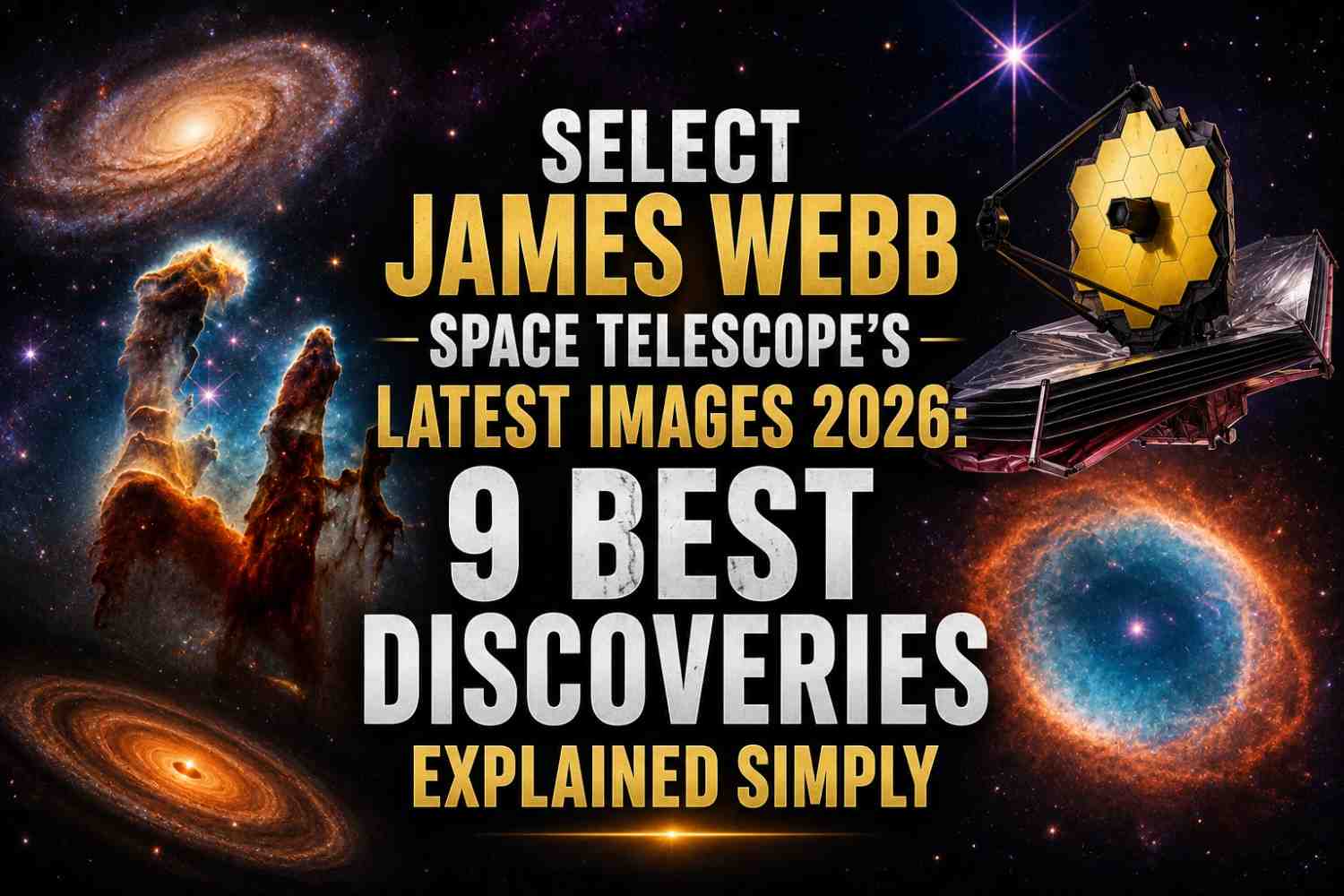
Introduction
The James Webb Space Telescope’s latest images in 2026 continue to stun scientists and the public alike. Now in its fifth year of operation, Webb shows no signs of slowing down — it’s producing some of its most scientifically significant results yet, from ancient galaxy clusters to detailed atmospheric maps of alien worlds.
Every new release of the James Webb Space Telescope’s latest images in 2026 rewrites something we thought we understood about the cosmos. Here are the 9 best discoveries, explained in plain language.
Why the James Webb Space Telescope’s Latest Images 2026 Keep Surprising Scientists
Webb was designed to see the universe’s first light. It’s doing that — and far more.
The James Webb Space Telescope’s latest images 2026 consistently reveal objects and structures that don’t fit existing models. Early galaxies are too massive. Exoplanet atmospheres are more complex. Star formation regions are more turbulent.
That’s the sign of a truly revolutionary instrument: it doesn’t just confirm what we expect. It breaks our expectations.
Discovery 1 — The Most Distant Galaxy Ever Confirmed
The James Webb Space Telescope’s latest images 2026 include confirmation of a galaxy at redshift z=14.3 — existing just 290 million years after the Big Bang.
Named JADES-GS-z14-0, this galaxy is more massive and brighter than any galaxy should be at such an early cosmic epoch — according to standard models.
What This Means
It means either galaxies formed faster than we thought, or dark matter behaved differently in the early universe, or both.
Webb’s early galaxy findings are forcing a fundamental revision of galaxy formation theory — the greatest upheaval in cosmology since the discovery of dark energy.
Discovery 2 — Water Vapor on a Rocky Exoplanet
One of the most celebrated James Webb Space Telescope’s latest images (2026 results in data form) is the detection of atmospheric water vapor signatures from a rocky exoplanet.
Webb’s transmission spectroscopy detected molecular signatures in the atmosphere of a super-Earth in the habitable zone — a first for rocky worlds.
What This Doesn’t Yet Mean
Finding water vapor doesn’t confirm habitability or life. The planet’s temperature, pressure, and surface conditions require further study. But it proves Webb can detect the chemical ingredients of life on worlds far smaller than gas giants.
Discovery 3 — Stunning Images of Stephan’s Quintet Reveal New Detail
The James Webb Space Telescope’s latest images in 2026 returned to Stephan’s Quintet — a compact group of interacting galaxies — with new observing modes that reveal previously hidden structure.
New mid-infrared data shows the following:
- Shock waves from galaxy collisions creating vast bridges of hot gas
- New star formation triggered by gravitational interaction
- A supermassive black hole in active feeding mode
The level of detail — at a distance of 280 million light-years — is extraordinary.
Discovery 4 — Carbon Dioxide Confirmed in Multiple Exoplanet Atmospheres
Building on its landmark 2022 detection of CO₂ in WASP-39b’s atmosphere, the James Webb Space Telescope’s latest images from the 2026 science program has now confirmed carbon dioxide in over a dozen exoplanet atmospheres.
This atmospheric chemical census is building a comparative database that will:
- Identify patterns between planet type and atmospheric composition
- Narrow the search for potentially habitable worlds
- Test atmospheric formation and evolution models
Discovery 5 — Protoplanetary Disks in Unprecedented Detail
Webb’s James Webb Space Telescope’s latest images 2026 program includes stunning near-infrared and mid-infrared views of protoplanetary disks — the rotating clouds of gas and dust around young stars where planets are forming right now.
These images reveal:
- Gap structures carved by forming planets
- Asymmetric distributions of dust suggesting planetary perturbations
- Chemical gradients across disk radii indicating where different planet types form
Watching planets form in real time — that’s what these images represent.
Related Article: How Space Telescopes Detect Exoplanets Explained
Discovery 6 — The Crab Nebula in a New Light
The James Webb Space Telescope’s latest images in 2026 returned to the Crab Nebula — one of astronomy’s most studied objects — and revealed structure that decades of Hubble observations had missed.
Webb’s mid-infrared view shows:
- A detailed map of synchrotron radiation from the central pulsar
- Never-before-seen filamentary structures in the nebula’s interior
- Dust grain composition in the expanding supernova remnant
Even familiar objects reveal new secrets to Webb’s infrared eye.
Discovery 7 — Gravitational Lensing Reveals Ultra-Faint Galaxies
The James Webb Space Telescope’s latest images (2026) from gravitational lensing programs use massive galaxy clusters as natural telescopes—magnifying light from even more distant objects behind them.
In 2026, Webb identified dwarf galaxies at z=10 and beyond — tiny building blocks of the early universe — that were completely invisible to Hubble even with lensing.
These ultra-faint early galaxies may hold the key to understanding how reionization — when the universe’s hydrogen became transparent — actually occurred.
Discovery 8 — Titan’s Atmosphere Mapped in Detail
Closer to home, the James Webb Space Telescope’s latest images (2026) include the most detailed infrared mapping of Saturn’s moon Titan ever produced.
Webb’s observations reveal:
- Seasonal changes in Titan’s cloud patterns
- New chemical detections in the upper atmosphere
- Surface features through the thick atmospheric haze
Titan is considered one of the most Earth-like environments in the solar system — and a potential target for life-detection missions.
For full technical details and image releases, see NASA Webb Telescope official site and ESA Webb Science Pages.
Discovery 9 — The Cosmic Cliffs of Carina Revisited
Webb returned to the Carina Nebula’s “Cosmic Cliffs”—one of the most iconic images from its first light release—with new observing modes that reveal additional detail.
The James Webb Space Telescope’s latest images, 2026 Carina revisit shows:
- Individual protostars emerging from the nebula wall
- Stellar jets (Herbig-Haro objects) previously hidden in dust
- The precise boundary between ionized and neutral gas at the cliff edge
Each revisit to a known target reveals Webb’s depth—there is always more hiding in the infrared.
Related Article: Best Space Telescope Discoveries of All Time 2026
FAQs: James Webb Space Telescope’s latest images
Q1: Where can I see the James Webb Space Telescope’s latest images in 2026? All Webb images are publicly released at webbtelescope.org and NASA’s Webb science portal. ESA also maintains a Webb image gallery at esawebb.org. Images are free to use under NASA’s open image policy.
Q2: How does Webb take images in infrared that look colorful? Webb detects infrared light invisible to the human eye. Scientists assign visible colors to different infrared wavelengths — a process called false-color mapping — to make the data visually meaningful and scientifically interpretable.
Q3: Has Webb found any signs of life yet? No confirmed signs of life. Webb has detected complex organic molecules in exoplanet atmospheres and in interstellar space, but none of these detections are evidence of biological activity.
Q4: How much longer will Webb operate? Webb launched with enough fuel for a 10-year mission. The precise launch trajectory was so efficient that fuel reserves may allow operations well beyond 20 years. Currently, no end-of-mission date is set.
Q5: What is the most important Webb discovery so far? Most astronomers point to the discovery of unexpectedly massive early galaxies — challenging fundamental models of galaxy formation — as Webb’s most consequential finding to date. The exoplanet atmosphere detections are a close second.
Conclusion
The James Webb Space Telescope latest images 2026 are rewriting textbooks across multiple fields of astrophysics simultaneously. From the universe’s first galaxies to the atmospheres of rocky exoplanets, Webb is delivering on its extraordinary promise — and then some.
Never miss a Webb discovery. Follow our space telescope coverage for every stunning image, surprising result, and scientific breakthrough from humanity’s greatest eye on the universe.