
 Ramrajeshbee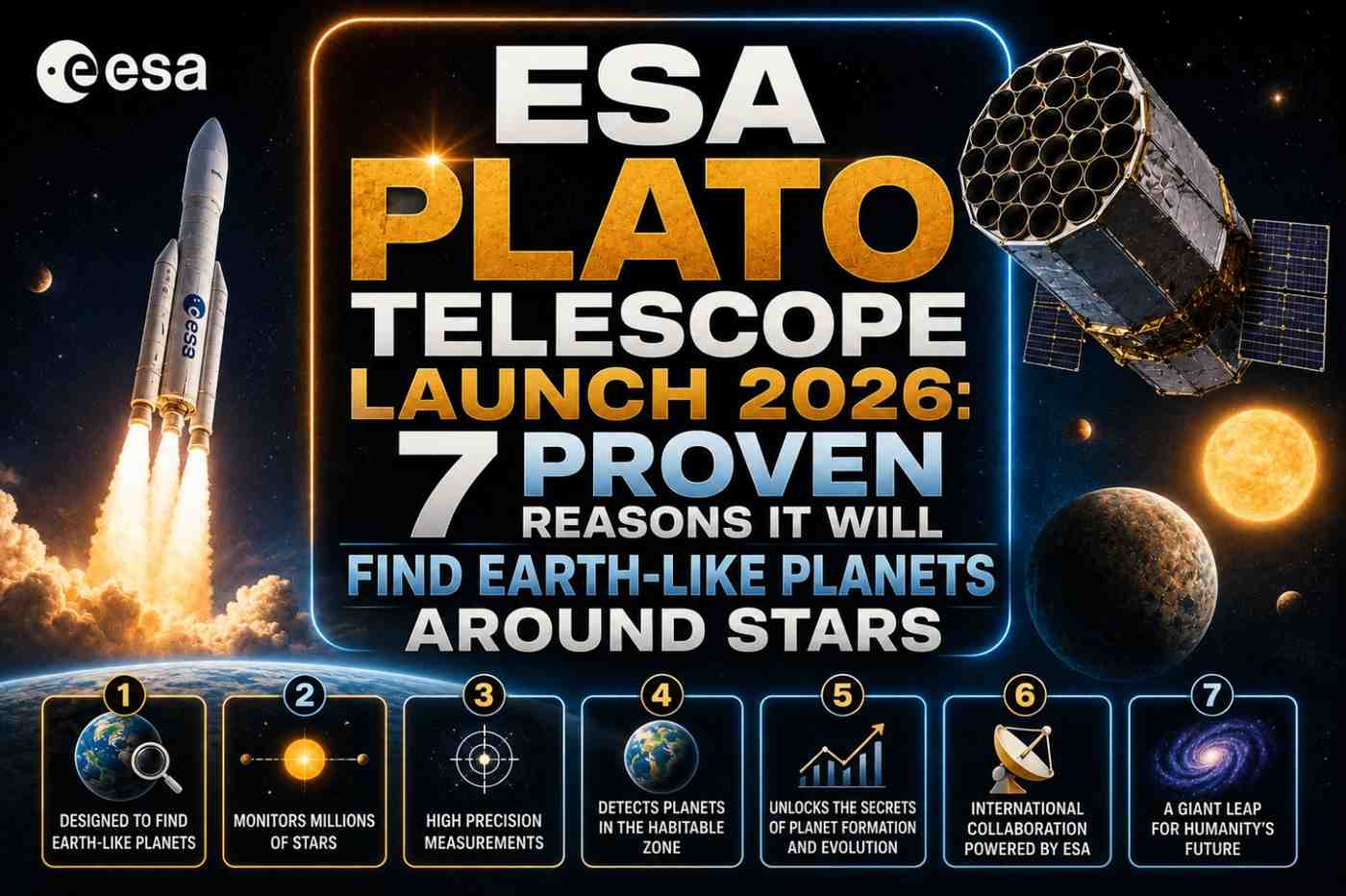
Introduction
The ESA PLATO telescope launch in 2026 represents Europe’s most ambitious exoplanet hunting mission to date. PLATO—PLAnetary Transits and Oscillations of stars—is designed specifically to find Earth-sized planets orbiting Sun-like stars in habitable zones and to measure the properties of those planets and their host stars with unprecedented precision.
The ESA PLATO telescope launch in 2026 is targeted for December 2026 aboard an Ariane 6 rocket. When it reaches its operational orbit at L2, it will begin the most systematic search for Earth 2.0 ever conducted.
Here are 7 proven reasons this mission will change how we think about life in the universe.
What Is the ESA PLATO Telescope Launch 2026 Mission?
PLATO is not a single telescope. It’s an array of 26 small cameras operating in concert—a completely novel design that gives it extraordinary sky coverage while maintaining high photometric precision.
The ESA PLATO telescope launch mission in 2026 is led by ESA with contributions from 22 European countries and more than 300 scientists across 120 institutions.
Its primary science goals:
- Find rocky planets in habitable zones of Sun-like stars
- Measure planetary radii to better than 3% accuracy
- Determine stellar ages to better than 10% using asteroseismology
- Characterize planetary systems including multiple planets
Reason 1 — PLATO Targets Sun-Like Stars (Unlike Kepler and TESS)
The most important distinction of the ESA PLATO telescope launch 2026 mission is its stellar target selection.
Kepler and TESS found thousands of exoplanets — but many orbit M-dwarf stars (red dwarfs), which are smaller, cooler, and more active than our Sun. Planets in their habitable zones face intense stellar flares and tidal locking.
Plato deliberately focuses on the following:
- G-type stars (Sun-like, 5,000–6,000 K)
- F-type stars (slightly hotter than Sun)
- K-type stars (slightly cooler — still highly favorable for life)
Planets found by the ESA PLATO telescope launch 2026 around these stars will be the most directly Earth-comparable worlds ever studied.
Reason 2 — 26-Camera Array Provides Unmatched Sky Coverage
PLATO’s revolutionary 26-camera design gives the ESA PLATO telescope launch 2026 mission a unique combination of sky coverage and photometric precision.
The cameras are arranged in four groups of six (plus two high-cadence cameras), offset from each other to cover different sky areas simultaneously.
What This Achieves
- Field of view: ~2,250 square degrees per pointing — vastly larger than Kepler
- Simultaneous observation of ~245,000 stars per field
- Redundancy: even if several cameras fail, science continues
- Two high-cadence cameras monitor bright stars at 2.5-second intervals for asteroseismology
No previous space telescope has combined this sky coverage with this level of photometric stability.
Reason 3 — Asteroseismology Gives Precise Stellar Ages
One of the ESA PLATO telescope launch 2026 mission’s most powerful and underappreciated capabilities: asteroseismology.
Stars oscillate — they ring like bells with characteristic frequencies determined by their internal structure. By measuring these oscillations precisely, PLATO can determine:
- Stellar age to better than 10% accuracy
- Stellar radius to better than 2% accuracy
- Stellar mass to better than 1% accuracy
Why Stellar Age Matters for Life
Knowing a planet’s age matters for life. A planet around a 500-million-year-old star has had far less time for life to evolve than one around a 4-billion-year-old star like our Sun.
The ESA PLATO telescope launch, 2026 asteroseismology program, will provide the most precise stellar characterization of any large exoplanet survey ever conducted.
Related Article: How Space Telescopes Detect Exoplanets Explained
Reason 4 — PLATO Will Identify the Best Targets for Webb Atmosphere Studies
The ESA PLATO telescope launch mission in 2026 acts as a pathfinder for atmospheric characterization.
Finding an Earth-like planet is step one. Studying its atmosphere for biosignatures — oxygen, ozone, methane, water — requires a telescope like Webb or Roman.
PLATO will:
- Identify rocky planets in habitable zones of nearby bright stars
- Precisely measure their radii, orbital periods, and stellar properties
- Deliver a prioritized target list for follow-up atmospheric studies by JWST, ARIEL, and future observatories
Without PLATO finding and characterizing the planets, Webb has no optimal targets to study.
Reason 5 — The PLATO Mission Will Monitor 1 Million Stars Total
Over its planned 4-year (extendable to 8-year) mission, the ESA PLATO telescope launch 2026 program will observe two or three long-duration fields plus additional step-and-stare fields.
Total stars monitored: approximately 1 million across the full mission.
Expected Planet Yield
Based on Kepler statistics extrapolated to PLATO’s target sample:
- Hundreds of rocky planets (< 2 Earth radii) expected
- Dozens of Earth-sized planets in habitable zones
- Thousands of larger planets for comparative study
The ESA PLATO telescope launch in 2026 will produce the largest and most precisely characterized sample of potentially habitable worlds ever assembled.
Reason 6 — PLATO Is Designed to Find “Earth Twins”
The explicit goal of the ESA PLATO telescope launch in 2026 mission, as stated in ESA’s science program, is to find “Earth twins” — planets matching Earth in size and receiving similar stellar flux from a Sun-like star.
No previous mission has had this as a primary, explicitly stated objective with the instrumentation to achieve it.
PLATO’s combination of:
- Target star selection (Sun-like stars)
- Photometric precision (detecting Earth-sized transits)
- Asteroseismology (confirming stellar and thus planetary properties)
- Long observing baseline (catching Earth-period orbital transits)
…makes it uniquely qualified to find genuine Earth analogs.
For full mission details, see ESA’s official PLATO mission page and the PLATO Science Consortium.
Reason 7 — PLATO Complements a Full European Exoplanet Ecosystem
The ESA PLATO telescope launch in 2026 doesn’t operate in isolation. It’s the centerpiece of a coordinated European exoplanet science strategy:
- CHEOPS (already operating): Precisely measures radii of known exoplanets
- PLATO (launching 2026): Finds new Earth-like planets and characterizes them
- ARIEL (planned 2029): Studies atmospheres of planets found by PLATO and CHEOPS
- Webb (operating): Detailed atmospheric chemistry of the best PLATO targets
This is the most systematic exoplanet science ecosystem ever assembled—and PLATO is its engine.
Related Article: NASA Pandora Telescope Exoplanet Atmospheres 2026
FAQs
Q1: When exactly is the ESA PLATO telescope launching in 2026? ESA has scheduled PLATO for launch in December 2026 aboard an Ariane 6 rocket from Kourou, French Guiana. The telescope will be placed in a halo orbit at the Sun-Earth L2 Lagrange point.
Q2: How is PLATO different from the Kepler mission? Kepler was a single telescope monitoring a single fixed field. PLATO has 26 cameras, observes far brighter nearby stars, focuses on Sun-like stars specifically, and adds asteroseismology for precise stellar characterization that Kepler couldn’t provide.
Q3: How long will PLATO’s mission last? PLATO has a planned primary mission of 4 years with potential extension to 8 years, depending on spacecraft health and fuel reserves.
Q4: Will PLATO be able to confirm if any planets are habitable? Plato itself cannot directly confirm habitability—it detects planet size and orbital period. Confirming habitability requires atmospheric characterization by telescopes like JWST and ARIEL, using PLATO’s discoveries as targets.
Q5: How many Earth-like planets is PLATO expected to find? Current estimates suggest PLATO will discover dozens of Earth-sized planets in habitable zones of Sun-like stars over its mission lifetime, providing the best sample of Earth analogs ever studied.
Conclusion
The ESA PLATO telescope launch in 2026 marks the beginning of Europe’s most focused search for planets like our own. With 26 cameras, a million target stars, and the asteroseismological power to know exactly what those stars are like, PLATO is built to find Earth 2.0 — not just any exoplanet, but one genuinely comparable to home.
Follow every step of PLATO’s journey. From launch to first light to the discovery of Earth’s twin — our space telescope coverage tracks it all.