 Ramrajeshbee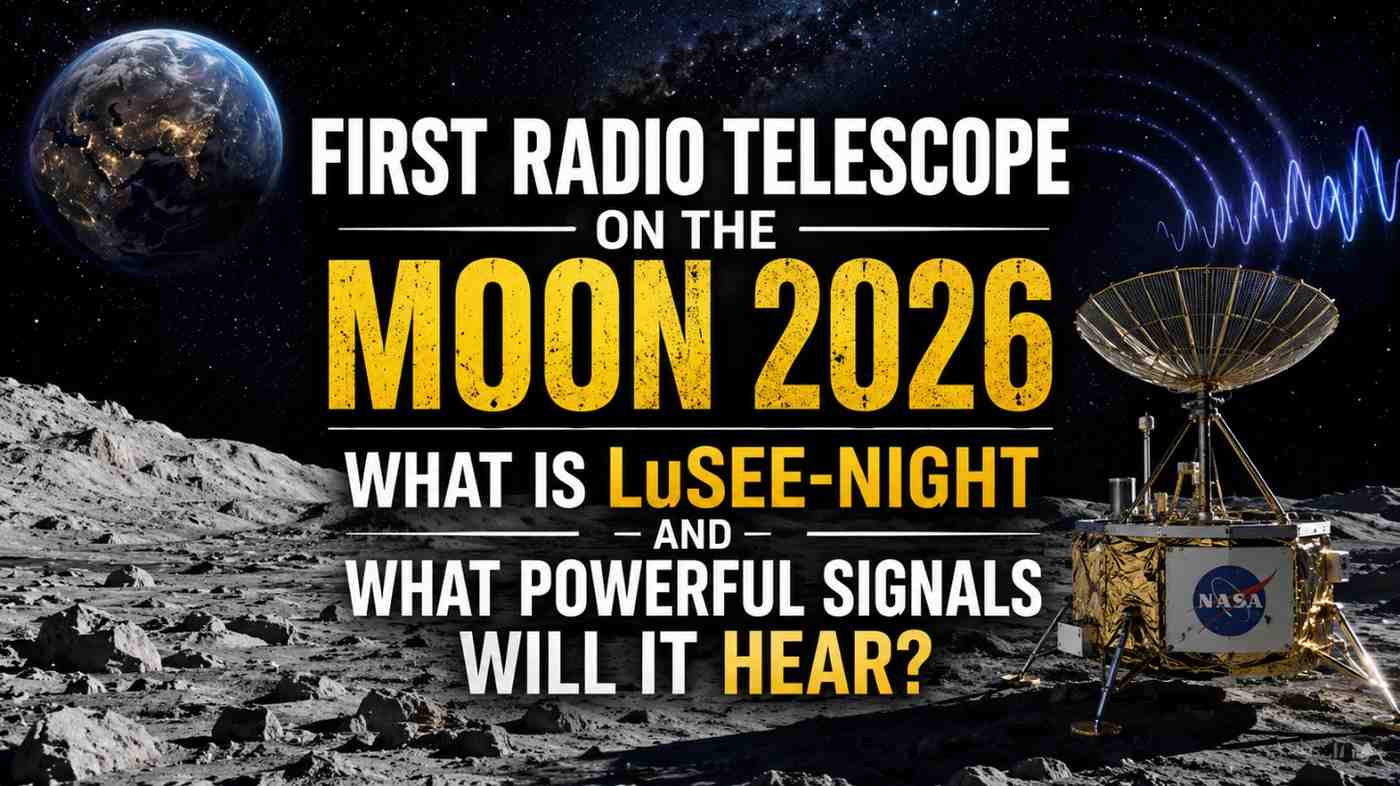
Introduction
The first radio telescope on the Moon 2026 is called LuSEE-Night — and scientists have been dreaming about building it for more than 40 years.
“I never thought — none of us thought — that it would take 40 years,” said Jack Burns of the University of Colorado Boulder, one of the project’s leading advocates. “Just think. We’re actually going to do cosmology from the moon.”
The reason for that four-decade wait is simple: the first radio telescope on the Moon 2026 can hear something that no telescope on Earth, or even in Earth orbit, has ever detected. It is aimed at a specific moment in cosmic history that scientists call the Cosmic Dark Ages — a period of time that has never been directly observed, and that could reshape our understanding of how the universe was born.
This guide explains everything: what LuSEE-Night is, why the far side of the Moon is the only place it can work, and what it might hear when the universe finally speaks.
What Is LuSEE-Night?
LuSEE-Night stands for Lunar Surface Electromagnetics Experiment-Night. It is a compact, self-contained radio telescope instrument designed to be deployed on the far side of the Moon.
The mission is a collaboration between:
- Brookhaven National Laboratory (DOE) — which built the core spectrometer
- UC Berkeley Space Sciences Laboratory — which leads the science program
- NASA’s Goddard Space Flight Center — contributing additional instrument components
- Firefly Aerospace — delivering LuSEE-Night to the Moon on the Blue Ghost Mission 2 lander
The first radio telescope on the Moon 2026 is scheduled to launch late in 2026 and land on the lunar far side — a location only China has ever reached before (with Chang’e 4 in 2019 and Chang’e 6 in 2024). Once on the surface, LuSEE-Night will deploy four 3-meter-long dipole antennas and begin listening to the universe.
Why the Far Side of the Moon? The Quietest Place in the Solar System
The first radio telescope on the Moon 2026 isn’t going to the lunar far side because it’s exotic or dramatic. It’s going there because it is the most radio-quiet location within a billion kilometers of Earth.
Here’s the problem with radio astronomy on Earth or even in Earth orbit:
Earth is deafeningly loud in radio frequencies. Television and radio broadcasts, cell phone signals, satellite transmissions, radar, Wi-Fi, aircraft communications — the electromagnetic environment around Earth is a constant roar of human-generated radio noise. Even in the most remote radio observatories on Earth, astronomers are fighting a constant battle against interference.
The ionosphere blocks low frequencies. Even if you could eliminate all human interference, Earth’s upper atmosphere — the ionosphere — reflects and absorbs radio waves below about 10 MHz (wavelengths longer than 30 meters). This means the lowest frequency radio signals from the universe simply cannot reach Earth’s surface at all.
Earth orbit is no better. Satellites in Earth orbit are still above the ionosphere — but they are still within range of Earth’s radio emissions, which bounce and scatter in ways that contaminate low-frequency observations.
The far side of the Moon solves all three problems at once. During its two-week-long lunar night:
- The entire bulk of the Moon — 2,159 miles (3,475 km) of solid rock — sits between the telescope and every radio signal emanating from Earth
- The Moon has no ionosphere, so there is no atmospheric absorption of low-frequency signals
- The solar wind is temporarily blocked by the Moon’s night side, removing another source of noise
“When you get down to those very low radio frequencies, there’s a source of noise associated with the solar wind,” explained Gregg Hallinan of Caltech. “And the only location where you can escape that within a billion kilometers of Earth is on the lunar surface, on the nighttime side.”
For up to 14 Earth days at a time, LuSEE-Night will experience a radio environment as quiet as any place in the inner solar system — the perfect conditions for hearing the faintest whispers from the early universe.
What Will the First Radio Telescope on the Moon 2026 Hear?
The Cosmic Dark Ages — A Period Never Directly Observed
The target of the first radio telescope on the Moon 2026 is one of the most profound gaps in human knowledge: the Cosmic Dark Ages.
Here is the timeline of the universe:
- The Big Bang — 13.8 billion years ago. The universe begins.
- 380,000 years after the Big Bang — The universe cools enough for electrons and protons to combine into neutral hydrogen atoms. This moment, called recombination, releases the Cosmic Microwave Background (CMB) radiation — the faint afterglow of the Big Bang that we can still detect today. This is the oldest light we have ever seen.
- 380,000 to ~200–400 million years after the Big Bang — The Cosmic Dark Ages. The universe is filled with neutral hydrogen gas but no stars, no galaxies, no light sources of any kind. This is the period that has never been directly observed.
- ~200 million years after the Big Bang — The first stars ignite, ending the Dark Ages in an event called the Epoch of Reionization. The universe “lights up” for the first time.
LuSEE-Night is targeting the radio signal from the Cosmic Dark Ages — specifically, the redshifted 21-cm hydrogen line.
Neutral hydrogen emits a characteristic radio signal at a wavelength of 21 centimeters (1.42 GHz). Because the universe was expanding during the Dark Ages, this signal has been stretched (redshifted) by the expansion of space to much longer wavelengths — arriving today at frequencies between roughly 10 and 100 MHz, squarely in the range blocked by Earth’s ionosphere.
“If we could measure the Dark Ages, it would tell us a lot about what the universe is made of and about the interesting things going on at the beginning of the universe,” said Anže Slosar, the LuSEE-Night science lead and a physicist at Brookhaven National Laboratory.
What LuSEE-Night Will Actually Do on the Moon
The Instruments
LuSEE-Night is a compact but sophisticated instrument package:
Four 3-meter dipole antennas — Two crossed pairs of antennas that detect radio waves across a broad range of low frequencies. Their “X” shape allows the telescope to detect signals from multiple directions simultaneously.
Spectrometer (built at Brookhaven National Laboratory) — The core of the instrument. The spectrometer converts the raw radio signals captured by the antennas into frequency spectra — detailed graphs showing exactly which radio frequencies are present and at what intensity. This is what actually “sees” the Dark Ages signal if it is there.
Orbital calibrator — A unique feature that distinguishes LuSEE-Night from all previous radio experiments. An orbital satellite will fly above the telescope to provide absolute calibration of the instrument — a capability essential for the precision needed to detect the extremely faint Dark Ages signal against background noise.
Frequency Range
LuSEE-Night will operate in the frequency range of 0.1 MHz to 50 MHz — the section of the radio spectrum below Earth’s ionospheric cutoff. This is entirely new territory for astronomical observation, making LuSEE-Night not just the first radio telescope on the Moon but a genuine pioneer of a new observational window on the universe.
Internal Link: Hubble Space Telescope vs James Webb vs Roman — Complete Comparison Guide 2026
Surviving the Lunar Night: The Hardest Engineering Challenge
The first radio telescope on the Moon 2026 faces a challenge that has no precedent in lunar exploration: it must survive and operate during the lunar night.
A lunar night lasts approximately 14 Earth days. During this time, temperatures on the far side of the Moon plunge to approximately -280°F (-173°C). There is no sunlight to power solar panels. And no direct communication with Earth is possible from the far side — all data must be relayed through an orbital communications satellite.
Previous lunar landers — including those in the CLPS program — have generally been designed to operate only during the lunar day and are not expected to survive the extreme cold of lunar night. LuSEE-Night is specifically engineered to operate in darkness, using specially designed thermal management systems and robust low-temperature electronics.
If LuSEE-Night can demonstrate that an instrument can survive and operate through one or more lunar nights on the far side, it will pave the way for larger, more powerful radio telescopes at this location in the future.
Why This Matters: What Detecting the Dark Ages Signal Would Mean
If the first radio telescope on the Moon 2026 successfully detects the 21-cm signal from the Cosmic Dark Ages, the implications would be staggering.
It would be the oldest signal ever directly detected. The Cosmic Microwave Background — currently our oldest observational window on the universe — dates from 380,000 years after the Big Bang. The Dark Ages signal would come from the hundreds of millions of years between the CMB and the first stars — a period that has been entirely invisible until now.
It would test fundamental cosmology. The precise spectrum of the Dark Ages signal is predicted by the Standard Model of cosmology. If the detected signal matches predictions, it confirms our understanding of the early universe. If it doesn’t — if there are surprises in the signal — it could indicate entirely new physics.
It would reveal what the universe is made of. The distribution and density of neutral hydrogen during the Dark Ages is directly connected to the amounts and properties of dark matter, dark energy, and ordinary matter in the early universe. Measuring the Dark Ages signal would constrain these quantities with extraordinary precision.
It is the first step toward a full 3D map of the Dark Ages. LuSEE-Night is a demonstration mission — proof that lunar far side radio astronomy is feasible. If it succeeds, it opens the path to a much larger array called FARSIDE, which would deploy a 10-kilometer radio telescope interferometer on the lunar far side — enough to make detailed 3D maps of the entire Dark Ages epoch.
According to NASA’s official LuSEE-Night page, LuSEE-Night is a key step in demonstrating whether the Moon’s far side can serve as a platform for a new generation of astronomical observatories.
The Journey to the Moon: How LuSEE-Night Gets There
The first radio telescope on the Moon 2026 will travel to the lunar surface aboard Firefly Aerospace’s Blue Ghost Mission 2 — the same company whose Blue Ghost Mission 1 lander successfully delivered 10 NASA payloads to Mare Crisium in early 2025.
Blue Ghost Mission 2 is significantly more complex than the first mission. To reach the lunar far side — which is permanently turned away from Earth — the Blue Ghost 2 lander must carry a transfer stage to reach the farside landing zone, and the mission includes deployment of ESA’s Lunar Pathfinder communications satellite into lunar orbit to relay signals between LuSEE-Night and Earth.
Without that relay satellite, there would be no way to receive data from LuSEE-Night or send commands to it — because the Moon’s bulk always blocks direct line-of-sight communication between the far side and Earth.
The entire chain — Firefly lander + ESA relay satellite + LuSEE-Night instrument + orbital calibrator — represents one of the most complex commercial lunar missions ever attempted.
Internal Link: NASA Commercial Lunar Payload Services CLPS 2026 — All Missions Explained Simply
What Happens After LuSEE-Night?
LuSEE-Night is explicitly described by its science team as a demonstration and pathfinder mission. Its primary goal is to prove that:
- A radio telescope can survive and operate through the lunar night
- The far side of the Moon is as radio-quiet as theorized
- The instrumentation and calibration techniques work as designed
- Meaningful scientific data can be returned to Earth via relay satellite
If it succeeds, it sets the stage for FARSIDE — a proposed NASA mission that would deploy 128 radio dipole antennas across a 10-kilometer area of the lunar far side, creating a true radio telescope array capable of mapping the 3D structure of the Cosmic Dark Ages in unprecedented detail.
This vision of a permanent lunar far side radio observatory has been described by astronomers as the potential beginning of a new era of observational cosmology — one that could answer questions about the universe’s first moments that no Earth-based telescope can ever address.
According to IEEE Spectrum’s detailed feature on LuSEE-Night, astronomers are cautiously but genuinely excited about what might be heard when the first radio telescope on the Moon turns its antennas toward the universe.
Conclusion
The first radio telescope on the Moon 2026 represents one of the most audacious experiments in the history of astronomy. For 40 years, scientists have known that the lunar far side is the ideal location to hear the radio whispers of the Cosmic Dark Ages — the most ancient, least understood epoch in cosmic history.
Now, in 2026, a small instrument called LuSEE-Night is finally going there. Four 3-meter antennas, a precision spectrometer built by hand at Brookhaven National Laboratory, and 14-day stretches of radio silence in the most electromagnetically quiet place within a billion kilometers of Earth.
If it works, what LuSEE-Night hears could be the oldest signal in the history of astronomy — a sound from before the first stars, before the first galaxies, from a universe in its deepest, darkest infancy.
Want to follow LuSEE-Night from launch to first data? Track the mission through NASA’s CLPS program updates and Brookhaven National Laboratory’s LuSEE-Night news.