 Ramrajeshbee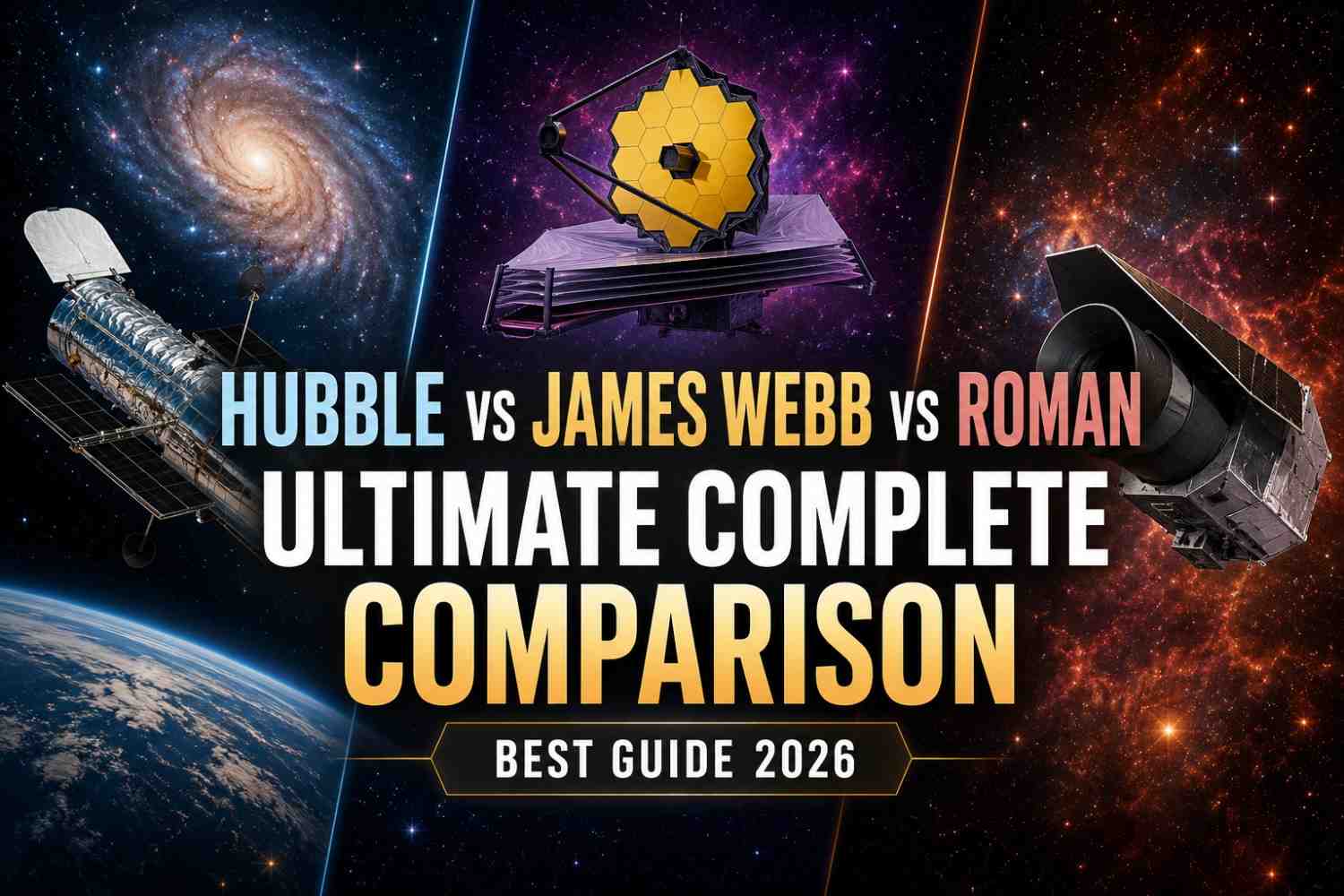
Introduction
Hubble Space Telescope vs James Webb vs Roman — three names that represent the greatest astronomical observatories humanity has ever built. Each one has transformed our understanding of the universe. And for the first time in history, all three will be operating simultaneously in space — with Roman launching in September 2026.
But which telescope is “best”? That is the wrong question. Each of these extraordinary instruments was built to do something the others cannot. Together, they form a complementary trio that will reveal more about the cosmos than any single telescope could dream of seeing alone.
This guide gives you the complete, honest, up-to-date comparison of all three — in plain language, with real numbers, and a clear explanation of what each telescope does better than the others.
The Quick Answer: What Each Telescope Does Best
Before going deep, here is the one-sentence summary for each:
- Hubble: Sharp, versatile, sees in ultraviolet/visible/near-infrared — the gold standard of space imaging for 36 years
- James Webb: Sees deeper and farther than anything before, in infrared — detects the oldest galaxies in the universe
- Roman: Surveys 100x more sky than Hubble or Webb in a single image — the wide-angle lens of the universe
Now let’s dig in.
Hubble Space Telescope vs James Webb vs Roman: Full Specs Comparison
| Specification | Hubble | James Webb | Roman |
|---|---|---|---|
| Launch Year | 1990 | 2021 | 2026 (Sep) |
| Location | Low Earth orbit (340 miles up) | Sun-Earth L2 (1M miles) | Sun-Earth L2 (1M miles) |
| Mirror Size | 2.4 meters | 6.5 meters | 2.4 meters |
| Field of View | ~10 sq. arcmin (narrow) | ~9 sq. arcmin (narrow) | ~0.28 sq. degrees (100x Hubble) |
| Camera Resolution | 16 megapixels | ~70 megapixels | 300.8 megapixels |
| Wavelengths | UV, visible, near-infrared (0.1–2.5 µm) | Near to mid-infrared (0.6–28.5 µm) | Visible to near-infrared |
| Survey Speed | Baseline (1x) | Similar to Hubble | 1,000x faster than Hubble |
| Primary Science | Multi-wavelength cosmic imaging | Early universe, dust-penetrating infrared | Wide-field surveys, dark energy, exoplanets |
| Expected Lifespan | Ending ~2028 (without reboost) | 20+ years (fuel for 20+ years) | 5-year primary mission |
| Cost | $4.7 billion (total) | $10 billion | $4.3 billion |
Hubble Space Telescope: The Grand Original
The Hubble Space Telescope launched on April 24, 1990 — and despite an embarrassing initial flaw in its mirror that was corrected by astronauts in 1993, it went on to become the most productive scientific instrument in human history. In 36 years of operation, Hubble has made more than one million observations and contributed to more than 20,000 peer-reviewed scientific papers.
What Hubble Does That Others Cannot
The single most important thing Hubble does that neither Webb nor Roman can replicate is observe the universe in ultraviolet (UV) light.
Ultraviolet light is emitted by the hottest, youngest stars and by extremely energetic processes like supernovae and black hole accretion. It is absorbed by Earth’s atmosphere — meaning only a space telescope can detect it. And Hubble is the only UV telescope currently in space.
When astronomers want to study young star-forming regions, the hot white dwarfs in distant galaxies, or the chemical composition of exoplanet atmospheres through UV spectroscopy — only Hubble can do it.
Hubble also provides the only high-resolution view of the ultraviolet universe and continues to deliver crisp visible-light images that complement Webb’s infrared observations beautifully. Recently, Hubble and Webb teamed up to deliver unprecedented views of Saturn — Hubble in visible light, Webb in infrared — revealing details neither could capture alone.
Hubble’s Current Status (2026)
Hubble celebrated its 36th birthday in April 2026 with a new image of the Trifid Nebula — a star-forming region it first captured in 1997. The comparison between the two images, 29 years apart, shows changes in the nebula on human timescales — a uniquely powerful demonstration of Hubble’s longevity.
However, Hubble’s future is uncertain. Without a reboost mission to raise its gradually decaying orbit, the telescope could reenter Earth’s atmosphere as early as 2028. NASA has been exploring commercial reboost options, but no contract has been finalized.
According to NASA’s official Hubble vs Webb comparison page, Hubble will continue to transform our understanding of the universe as long as it operates — but Webb and Roman now lead in infrared capability.
James Webb Space Telescope: The Deepest Eye Ever Built
The James Webb Space Telescope (JWST) launched on December 25, 2021, and began science operations in July 2022. It is the largest, most technically advanced telescope ever built — and within months of its first observations, it had already rewritten textbooks.
What James Webb Does That Others Cannot
Webb’s defining advantage in the Hubble Space Telescope vs James Webb vs Roman comparison is its infrared depth and sensitivity.
Webb’s 6.5-meter primary mirror — more than 6 times the light-gathering area of Hubble — combined with its deeply cooled instruments (operating near absolute zero, at -233°C), allows it to detect the faintest, most distant objects in the universe with stunning precision.
Webb can see objects 10 to 100 times fainter than Hubble can detect. Its infrared vision cuts through clouds of gas and dust that are completely opaque to Hubble, revealing star-forming regions and protoplanetary systems in crisp detail. And by detecting light that has been stretched (redshifted) to infrared wavelengths during its journey across 13+ billion years of cosmic time, Webb can observe the first galaxies that formed after the Big Bang — objects Hubble could not see at all.
Key Webb achievements so far include detecting galaxies less than 300 million years after the Big Bang, directly measuring the atmospheres of exoplanets in unprecedented chemical detail, revealing the structure of star-forming nebulae like never before, and identifying the most ancient black holes ever observed.
Webb’s Field of View Limitation
Webb’s one clear limitation compared to Roman is its narrow field of view. Like looking at the universe through a very powerful, very precise keyhole, Webb sees small patches of sky in extraordinary depth. But surveying large areas of sky with Webb would take an impossibly long time.
This is exactly where Roman comes in.
NASA Nancy Grace Roman Space Telescope: The Wide-Angle Revolution
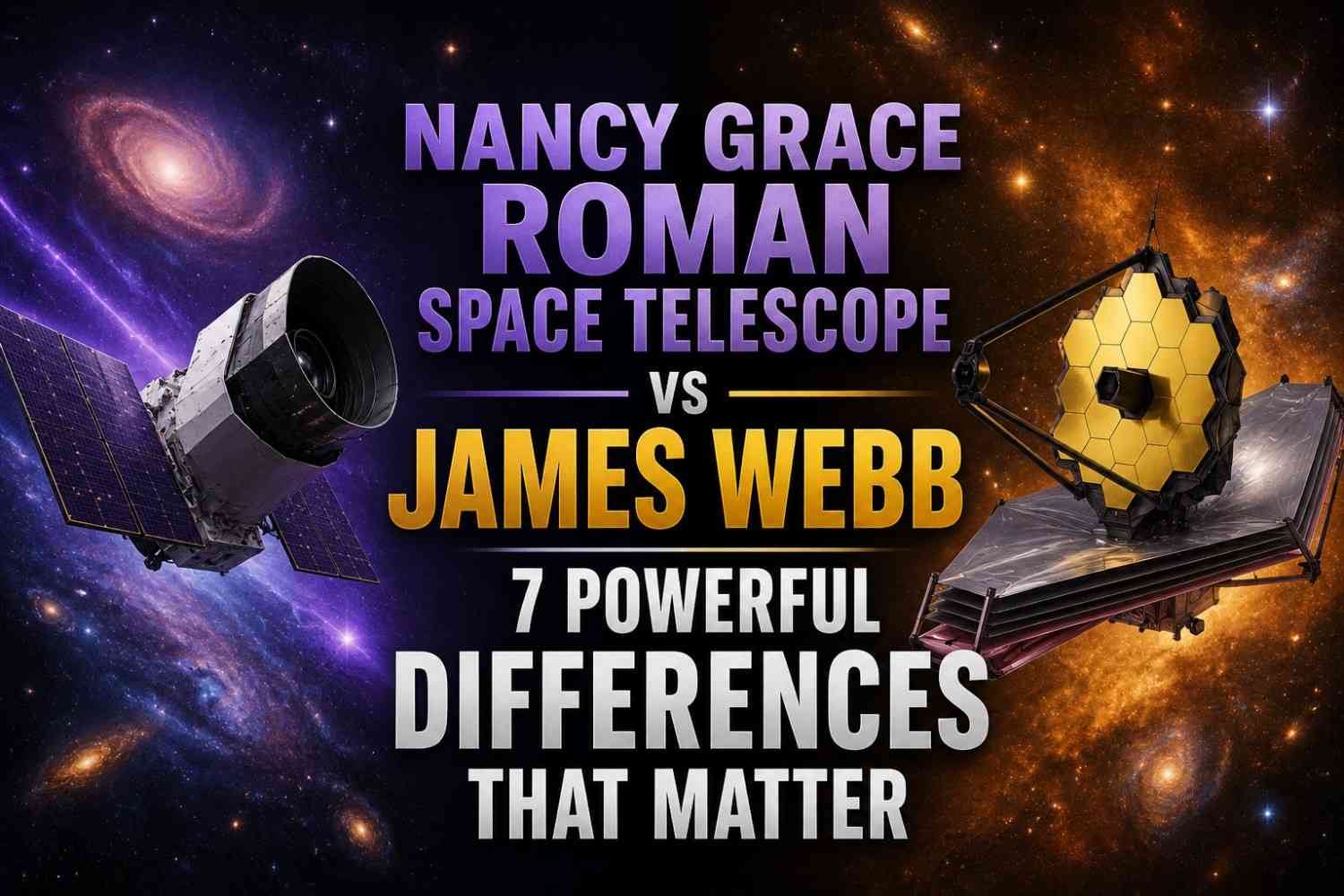
The Nancy Grace Roman Space Telescope is launching in September 2026 — 8 months ahead of schedule and under budget. And in the Hubble Space Telescope vs James Webb vs Roman comparison, Roman occupies a completely unique role: it is the survey telescope that will map vast swaths of the universe at Hubble-like resolution.
What Roman Does That Others Cannot
Roman’s 300.8-megapixel Wide Field Instrument covers a field of view 100 times larger than Hubble or Webb in a single image. What would take Hubble 85 years to photograph, Roman will capture in just 63 days.
“It would take longer than our lifetimes even for powerful telescopes like Hubble or Webb to cover as much sky,” said Jeffrey Kruk, a research astrophysicist at NASA Goddard. “Roman will take around 100,000 pictures every year.”
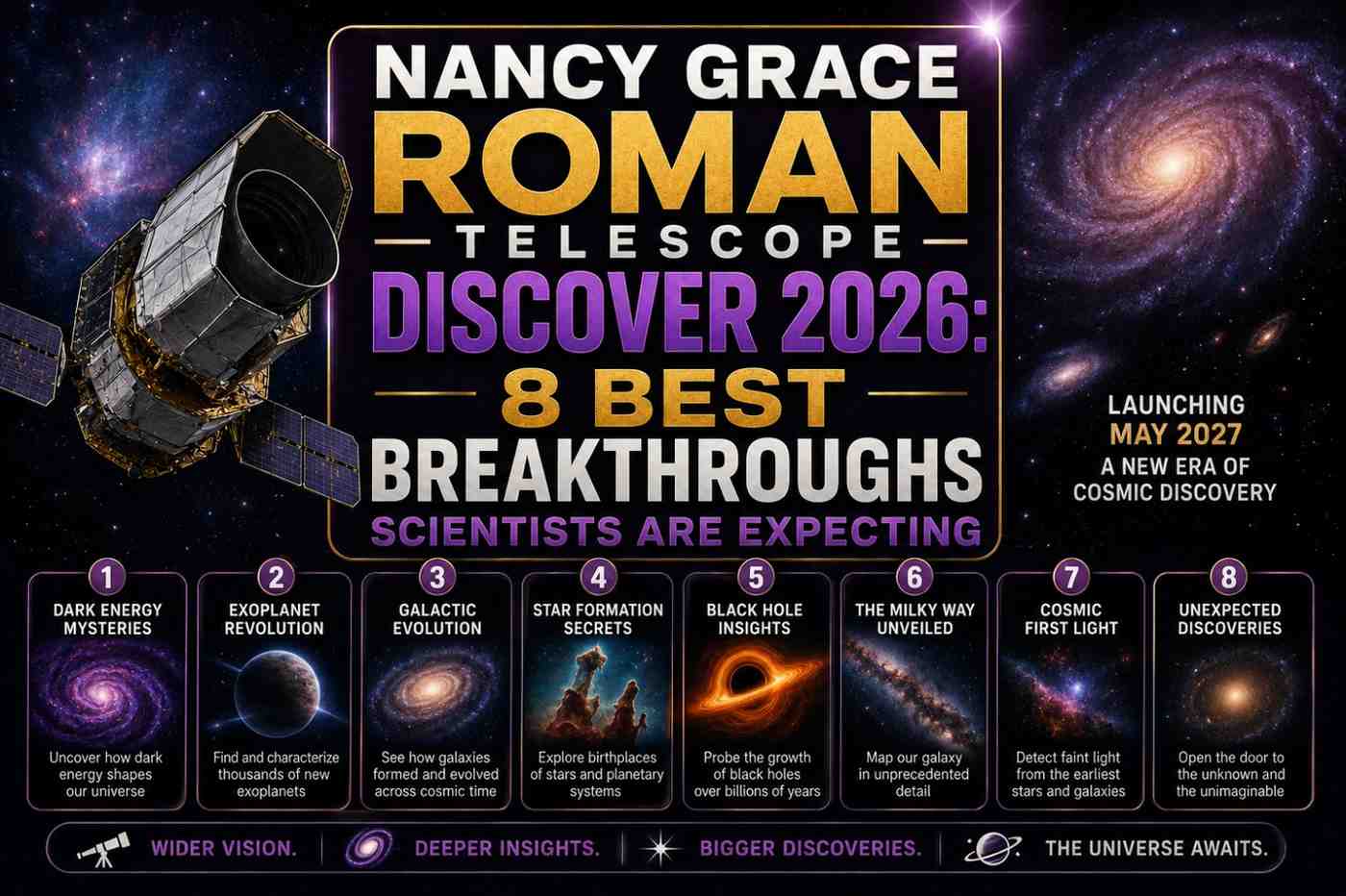
This extraordinary surveying power means Roman will discover things Hubble and Webb will never find — simply because it looks at so much more sky. Expected discoveries include:
- Tens of thousands of exoplanets through gravitational microlensing
- Billions of galaxies mapped across cosmic time to study dark energy
- Thousands of supernovae to measure the universe’s expansion rate
- Free-floating rogue planets drifting in interstellar space
- Transient events (exploding stars, colliding neutron stars) caught in real time
Over its first five years, Roman will image more than 50 times as much sky as Hubble has surveyed in its entire 36-year history.
Internal Link: NASA Nancy Grace Roman Space Telescope Launch 2026 — Everything You Need to Know
How All Three Work Together: The Dream Team of Astronomy
The most exciting aspect of the Hubble Space Telescope vs James Webb vs Roman story in 2026 is not competition — it is collaboration.
Each telescope fills a gap that the others leave:
Step 1 — Roman finds targets. Roman surveys billions of galaxies, thousands of exoplanets, and rare cosmic events across enormous areas of sky. It identifies the most interesting objects for follow-up study.
Step 2 — Webb examines them in detail. When Roman finds a remarkable galaxy, an unusual exoplanet, or a once-in-a-million-years transient event, Webb can zoom in with its deep infrared vision for precise spectroscopic analysis — identifying chemical compositions, temperatures, distances, and physical processes in exquisite detail.
Step 3 — Hubble adds the UV perspective. For objects that are bright in ultraviolet light — hot stars, star-forming regions, active galaxies — Hubble provides data that neither Webb nor Roman can obtain. Combining Hubble’s UV observations with Webb’s infrared and Roman’s wide-field surveys creates a complete multi-wavelength picture.
“Roman will offer a broad view of cosmic ecosystems and pinpoint rare objects. Webb can use its narrower view but more powerful vision to follow up on those uncommon objects,” according to NASA’s Roman and Webb science page.
Hubble Space Telescope vs James Webb vs Roman: Where Each Excels
For Seeing the Oldest Galaxies
Winner: James Webb. Webb’s 6.5-meter mirror and deep infrared capability allow it to see galaxies formed less than 300 million years after the Big Bang — objects completely invisible to Hubble and outside Roman’s scientific focus.
For Surveying Large Areas of Sky
Winner: Roman. Not even close. Roman covers 100 times more sky per image than Hubble or Webb and surveys 1,000 times faster than Hubble. It will produce a cosmic atlas that would take Hubble centuries to assemble.
For Ultraviolet Science
Winner: Hubble. Webb and Roman both work in infrared/visible light. Only Hubble can observe the universe in ultraviolet — a wavelength range critical for studying hot stars, galaxy evolution, and many types of exoplanet atmospheres.
For Exoplanet Atmosphere Analysis
Winner: James Webb. Webb’s spectrographs can detect the chemical fingerprints of molecules — water vapor, methane, carbon dioxide — in exoplanet atmospheres with stunning precision. Roman will discover far more exoplanets, but Webb will tell us what they’re made of.
For Finding Exoplanets in Large Numbers
Winner: Roman. Roman’s gravitational microlensing survey will discover tens of thousands of exoplanets, including types of worlds (free-floating planets, planets in the outer reaches of solar systems) that transit surveys like Kepler and TESS could never detect.
For Classic Visible-Light Astrophotography
Winner: Hubble. Webb’s infrared images are beautiful and scientifically rich, but Hubble’s visible-light images — the Pillars of Creation, the Hubble Deep Field, the Crab Nebula — remain unmatched in their combination of resolution, color depth, and emotional impact. Roman’s images will be similarly sharp but will cover enormous areas rather than detailed close-ups.
For Measuring Dark Energy and Dark Matter
Winner: Roman. Dark energy is Roman’s primary scientific mission. By mapping billions of galaxies across cosmic time and measuring weak gravitational lensing at an unprecedented scale, Roman will constrain the nature of dark energy more precisely than any previous telescope.
What’s Next: The Habitable Worlds Observatory
The Hubble Space Telescope vs James Webb vs Roman comparison will eventually have a fourth member. NASA has proposed the Habitable Worlds Observatory (HWO) — a future flagship telescope designed to directly image Earth-like planets around nearby stars and search for signs of life.
HWO is currently in the planning stages, with a major feasibility review expected in 2028. If approved, it could launch in the 2040s. It will operate in ultraviolet, visible, and infrared light — and in many ways will be Hubble’s true successor.
Until then, Hubble, Webb, and Roman form the most powerful ensemble of space telescopes humanity has ever assembled — three generations of extraordinary instruments, each looking at the universe in its own irreplaceable way.
According to ESA’s overview of space observatories, this multi-telescope approach is fundamental to modern astronomy — because the universe is far too vast and complex for any single observatory to comprehend alone.
Internal Link: Best Space Telescope Discoveries of All Time 2026 — Top 10 Mind-Blowing Findings
Conclusion
The Hubble Space Telescope vs James Webb vs Roman comparison is ultimately not a competition — it is a story of three telescopes that need each other. Hubble sees what Webb and Roman cannot (ultraviolet). Webb sees what Hubble and Roman cannot (the deep infrared early universe). Roman sees what Hubble and Webb will never have time to see (the vast structure of the entire observable universe, mapped with billion-galaxy surveys).
Together in 2026, for the first time in history, all three will be operational simultaneously — creating the most complete, multi-wavelength view of the cosmos humanity has ever achieved.
Want to explore all three telescopes for yourself? Dive into NASA’s Space Telescope Science Institute where the data and images from Hubble, Webb, and soon Roman are all publicly available for anyone to explore.