 Ramrajeshbee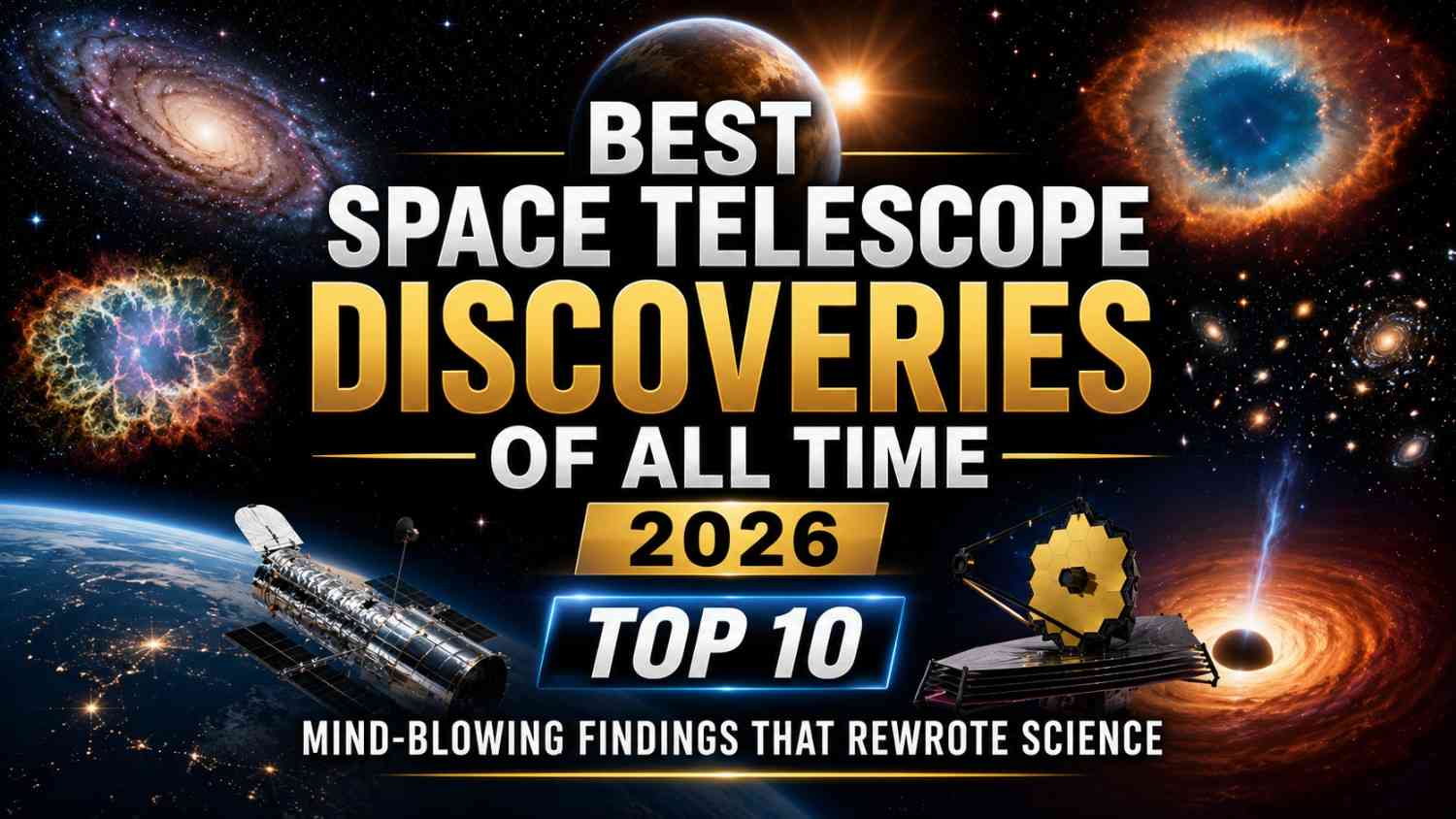
Introduction
The best space telescope discoveries of all time 2026 span more than three decades of observations from above Earth’s atmosphere — discoveries so profound that they permanently changed what humanity knows about the universe, about time, and about our own place in the cosmos.
In 36 years, the Hubble Space Telescope alone has made more than 1.7 million observations and contributed to more than 22,000 peer-reviewed scientific papers, with more than 1.4 million additional publications referencing those original papers. Since James Webb launched in 2021, it has already added a new tier of revolutionary findings on top of Hubble’s legacy.
Together, Hubble and Webb represent the most productive scientific collaboration in the history of astronomy — and the best space telescope discoveries of all time 2026 range from measuring the age of the universe to detecting molecules in the atmosphere of a world 40 light-years away.
Here are the 10 most mind-blowing of all time.
#1 — The Universe Is Accelerating — Dark Energy Exists
Telescope: Hubble Space Telescope Discovery Year: 1998
This is arguably the single most shocking discovery in the history of physics — and it came directly from the best space telescope discoveries of all time 2026 catalog.
In the late 1990s, two competing teams of astronomers used Hubble to measure the distances of Type Ia supernovae — exploding stars that serve as reliable “standard candles” for measuring cosmic distances. Both teams expected to find that the universe’s expansion, driven by the Big Bang, was gradually slowing down due to gravity.
Instead, they found the opposite: the universe’s expansion is accelerating. Galaxies are flying away from each other faster and faster over time. The only way to explain this is the existence of a mysterious repulsive force pervading all of space — which scientists have named dark energy.
Dark energy is estimated to make up approximately 68% of the total energy content of the universe — and we still have almost no idea what it actually is. This discovery earned the Nobel Prize in Physics in 2011 and remains the greatest unsolved mystery in physics.
#2 — The Hubble Deep Field — Billions of Galaxies, Each Full of Stars
Telescope: Hubble Space Telescope Discovery Year: 1995 (original), expanded in 2004 and 2012
In December 1995, Hubble pointed at a tiny, apparently empty patch of sky near the Big Dipper — a region about one-thirtieth the diameter of the full Moon — and stared at it for 10 consecutive days.
What emerged was the most important astronomical image in history: the Hubble Deep Field. In that tiny, seemingly empty sliver of sky, Hubble revealed approximately 3,000 galaxies — each one a complete island universe containing billions of stars, stretching back billions of years in time.
Extrapolating this result across the entire sky, astronomers realized the observable universe contains at least 200 billion galaxies — later revised upward to potentially 2 trillion. Every point of light in the Hubble Deep Field is not a star, but an entire galaxy. The human mind still struggles to fully grasp this revelation.
This remains one of the most transformative images ever created. It is difficult to overstate its impact on how humanity understands its place in the cosmos.
#3 — Supermassive Black Holes at the Center of Every Large Galaxy
Telescope: Hubble Space Telescope Discovery: 1990s–2000s
Before Hubble, astronomers suspected that some galaxies harbored massive black holes at their centers — but this was theoretical and unconfirmed. Hubble provided definitive proof.
By measuring the velocity of stars and gas clouds near galactic centers with unprecedented precision, Hubble demonstrated that virtually every large galaxy — including our own Milky Way — contains a supermassive black hole at its heart. These objects range from millions to billions of times the mass of the Sun.
Moreover, Hubble discovered a surprising relationship: the mass of a galaxy’s central black hole is tightly correlated with the mass of the galaxy’s bulge. This suggests that galaxies and their black holes grew together through a cosmic feedback process that astronomers are still working to fully understand.
This placed black holes — once considered exotic theoretical curiosities — at the center of our understanding of how galaxies form and evolve.
#4 — The Age of the Universe: 13.8 Billion Years
Telescope: Hubble Space Telescope Key Period: 1990s–2000s
One of the most fundamental questions in all of science is: how old is the universe? Before Hubble, estimates ranged wildly from 10 to 20 billion years — an embarrassingly large uncertainty for one of science’s most basic questions.
Hubble’s precise measurements of Cepheid variable stars — stellar “metronomes” that pulsate at rates directly tied to their intrinsic brightness — allowed astronomers to calibrate the cosmic distance ladder with extraordinary accuracy. Combined with measurements of the cosmic expansion rate (the Hubble constant), these observations pinned the age of the universe at approximately 13.8 billion years.
This number — now confirmed by multiple independent measurements — defines the entire timeline of cosmic history, from the Big Bang to the formation of the first stars, the birth of our Sun, the origin of life on Earth, and humanity looking back at the universe through the very telescope that measured it.
Internal Link: Hubble Space Telescope vs James Webb vs Roman — Complete Comparison Guide 2026
#5 — The First Galaxies After the Big Bang
Telescope: James Webb Space Telescope Discovery: 2022–2026
This is the flagship achievement of the best space telescope discoveries of all time 2026 era — and it belongs to James Webb.
Within weeks of its first science observations in July 2022, Webb detected galaxies formed within 300 to 400 million years of the Big Bang — the most ancient galaxies ever observed. Some of these galaxies, given catalog names like JADES-GS-z14-0, are so far away that their light has been traveling for more than 13.5 billion years before reaching Webb’s mirror.
But the truly astonishing part wasn’t just finding these galaxies — it was how big and well-structured they appeared. The Standard Model of cosmology predicts that early galaxies should be small, irregular, and chaotic. Instead, Webb found some that were surprisingly large, bright, and already displaying organized spiral structures. This has prompted serious scientific debate about whether our models of galaxy formation need revision.
As Webb continues observing the early universe, these findings are being refined and extended — making early galaxy science one of the most active and rapidly evolving fields in astronomy.
#6 — Carbon Dioxide in an Exoplanet Atmosphere — The First Step to Finding Life
Telescope: James Webb Space Telescope Discovery: 2022
This discovery makes the best space telescope discoveries of all time 2026 list because of what it represents, not just what it is.
In August 2022, Webb detected carbon dioxide (CO₂) in the atmosphere of exoplanet WASP-39b — a hot gas giant orbiting a star 700 light-years away. It was the first clear, unambiguous detection of CO₂ in the atmosphere of any planet outside our solar system.
Carbon dioxide is a molecule fundamental to life as we know it. But the true significance of this discovery was technical: it demonstrated that Webb can detect specific molecules in the atmospheres of planets hundreds of light-years away with extraordinary precision, even in thin atmospheric layers. This is the same technique that would eventually be used to detect oxygen, methane, water vapor, or other potential biosignatures in the atmosphere of a distant Earth-like world.
Webb has since detected additional molecules in numerous exoplanet atmospheres, including sulfur dioxide (SO₂) produced by photochemical reactions in a hot gas giant’s upper atmosphere — a detection that required the precision only Webb could provide.
#7 — Planets Orbiting Within a Star’s Habitable Zone: TRAPPIST-1
Telescope: Hubble Space Telescope (initial confirmation), Webb (detailed study) Discovery: 2017 (system), 2023–2025 (Webb atmospheric studies)
The TRAPPIST-1 system, located 40 light-years from Earth, contains seven Earth-sized rocky planets — three of which orbit within the habitable zone of their star, the region where liquid water could exist on a planet’s surface.
This single discovery transformed the search for life beyond Earth. Prior to TRAPPIST-1, astronomers had found Earth-sized planets, and they had found habitable-zone planets — but never seven Earth-sized planets at once, three in the habitable zone, all orbiting a single star close enough for detailed study.
James Webb has since studied the atmospheres of several TRAPPIST-1 planets, ruling out thick Venus-like carbon dioxide atmospheres for some. The search for an Earth-like atmosphere — with nitrogen, oxygen, or signs of active chemistry — continues. According to ESA’s Webb mission highlights page, Webb’s study of TRAPPIST-1 d ruled out an atmosphere similar to Earth’s, narrowing down the possibilities for this system.
#8 — Stellar Nurseries Revealed in Unprecedented Detail: The Pillars of Creation
Telescope: Hubble Space Telescope (1995), James Webb Space Telescope (2022) Discovery: 1995 (Hubble), 2022 (Webb)
The Pillars of Creation — towering columns of gas and dust in the Eagle Nebula, 6,500 light-years away — became one of the most famous astronomical images ever taken when Hubble captured them in 1995. The image revealed the actual process of star formation: newborn stars embedded in the dense pillars, their radiation and stellar winds slowly carving and eroding the gas clouds that birthed them.
When Webb captured the same region in 2022, it penetrated the dust that partially obscured Hubble’s view, revealing young stars embedded within the pillars that were completely invisible to Hubble. Webb’s infrared vision showed the pillars as translucent, glowing with the light of newly ignited protostars — taking one of the most famous images in astronomy and revealing an entire hidden layer of physics beneath it.
And in 2026, Hubble looked back at the Trifid Nebula — a star-forming region it first captured in 1997 — to reveal measurable changes in the nebula over 29 years. Real-time cosmic evolution, captured on human timescales.
#9 — The Most Distant Objects Ever Seen: Quasars, Gamma-Ray Bursts, and the Edge of the Observable Universe
Telescopes: Hubble and James Webb Space Telescopes Discovery: Ongoing
Both the Hubble and the best space telescope discoveries of all time 2026 include the detection of objects so distant that their light left them when the universe was less than 5% of its current age.
Quasars — supermassive black holes consuming material at extraordinary rates and blazing with billions of times the Sun’s luminosity — were detected by Hubble at distances exceeding 13 billion light-years. Webb has pushed this frontier further, detecting the most distant known quasar at a redshift of 10.6, corresponding to an age of just 400 million years after the Big Bang.
Gamma-ray bursts — the most energetic explosions in the universe, produced when massive stars collapse into black holes — have been detected at distances so vast their light is billions of years old before it reaches our telescopes.
These observations don’t just reveal individual objects. They tell us about the physical conditions of the early universe — the temperature, density, chemistry, and first structures that eventually evolved into everything we see today.
#10 — Components of Life Detected Beyond Earth
Telescope: James Webb Space Telescope Discovery: 2023–2026
Perhaps the most profound entry in the best space telescope discoveries of all time 2026 belongs to a discovery that is still unfolding.
Webb has detected the chemical precursors of life in places no telescope has ever reached before. Molecules including dimethyl ether — the largest complex organic molecule ever detected in interstellar space — have been found in star-forming regions. Complex carbon compounds have been detected in the earliest galaxies. And in a protoplanetary disk around a young star (IRAS 04302+2247), Webb revealed the swirling process by which planetary systems form in extraordinary detail.
In 2025, Webb detected molecules consistent with microbial life indicators in a deep space object — a finding that the scientific community is analyzing with extreme care before drawing conclusions. In December 2025, Hubble witnessed for the first time catastrophic collisions in a nearby planetary system, giving direct evidence of the violent processes that shape young solar systems.
These are not confirmed discoveries of life. But they are discoveries of the chemical building blocks that life uses — in the places and on the timescales where life could form. And they remind us that the universe is rich in the ingredients of biology.
According to Johns Hopkins University’s review of Hubble and Webb science, together these two telescopes have delivered nearly 2 million observations of more than 100 million astronomical objects — and the discoveries are accelerating, not slowing.
Internal Link: How Space Telescopes Detect Exoplanets Explained — Transit Method Made Simple
What Comes Next in Space Telescope Science?
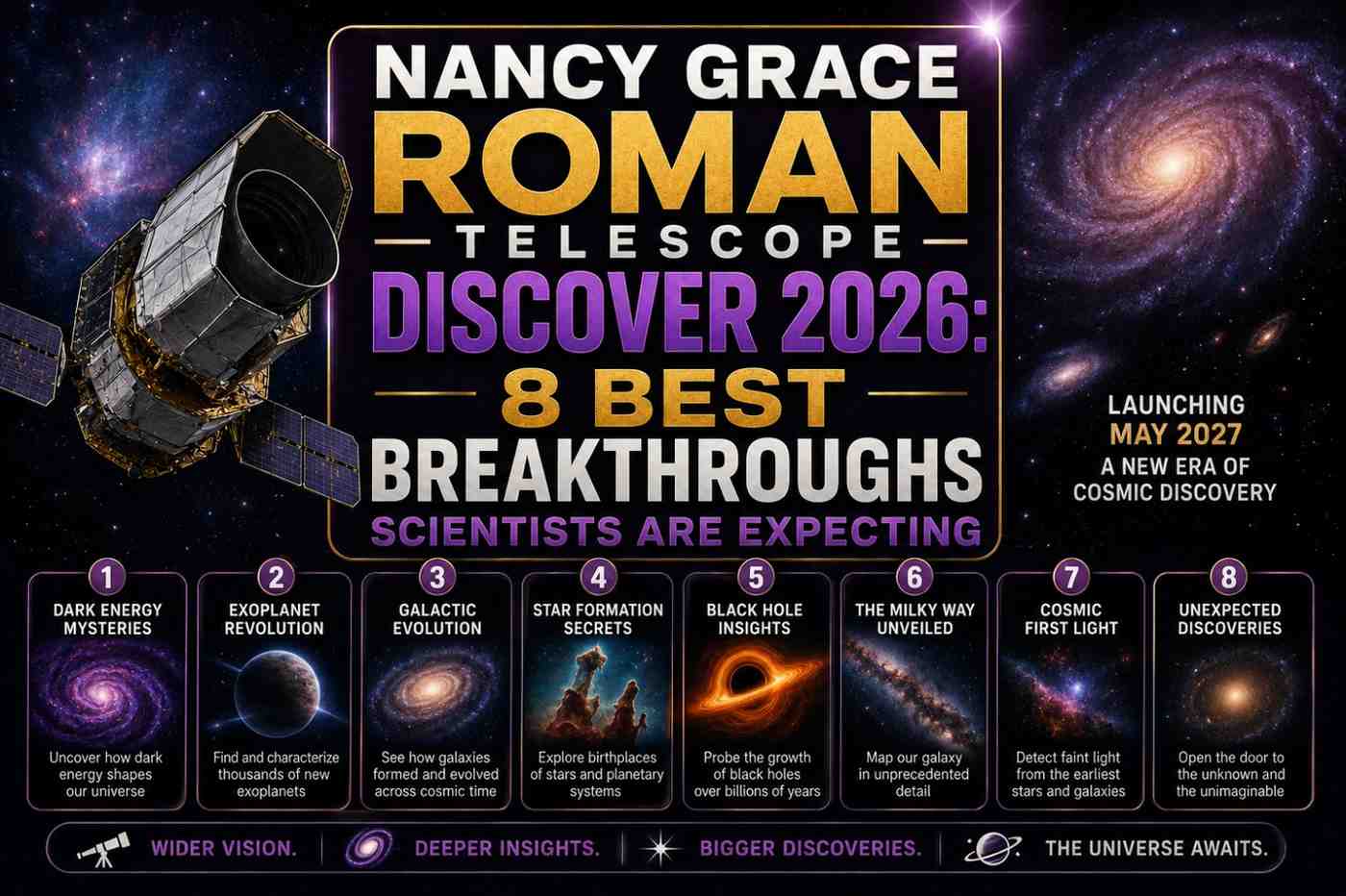
With Roman launching in September 2026 and LuSEE-Night heading to the Moon’s far side, the next chapter of the best space telescope discoveries of all time 2026 story is about to begin.
Roman will survey billions of galaxies and discover tens of thousands of exoplanets — providing a map of the universe’s large-scale structure that could finally tell us what dark energy actually is. Webb will continue analyzing exoplanet atmospheres, potentially finding the chemical signatures of life on a distant world. And LuSEE-Night will listen, for the first time ever, to the Cosmic Dark Ages — the oldest silence in the universe.
The pace of discovery is not slowing down. If anything, 2026 marks the beginning of astronomy’s most productive era.
Want to explore these discoveries for yourself? Visit NASA’s official image gallery and the Hubble and Webb image archives at STScI, where every image is free, high-resolution, and available to anyone who wants to look up at the universe.
Conclusion
The best space telescope discoveries of all time 2026 are not just scientific achievements — they are among the most significant moments in the history of human thought. From the revelation that the universe is 13.8 billion years old and filled with 2 trillion galaxies, to the first detection of specific molecules in the air of a world 700 light-years away, these discoveries have permanently expanded what it means to be an intelligent species living in the cosmos.
Every photon captured by Hubble’s mirror, every infrared signature recorded by Webb’s instruments, represents billions of years of travel from the farthest corners of reality — arriving, finally, in a telescope we built with our own hands, interpreted by minds we grew through millions of years of evolution.
That is what space telescopes do. And the best discoveries are still ahead.