
 Ramrajeshbee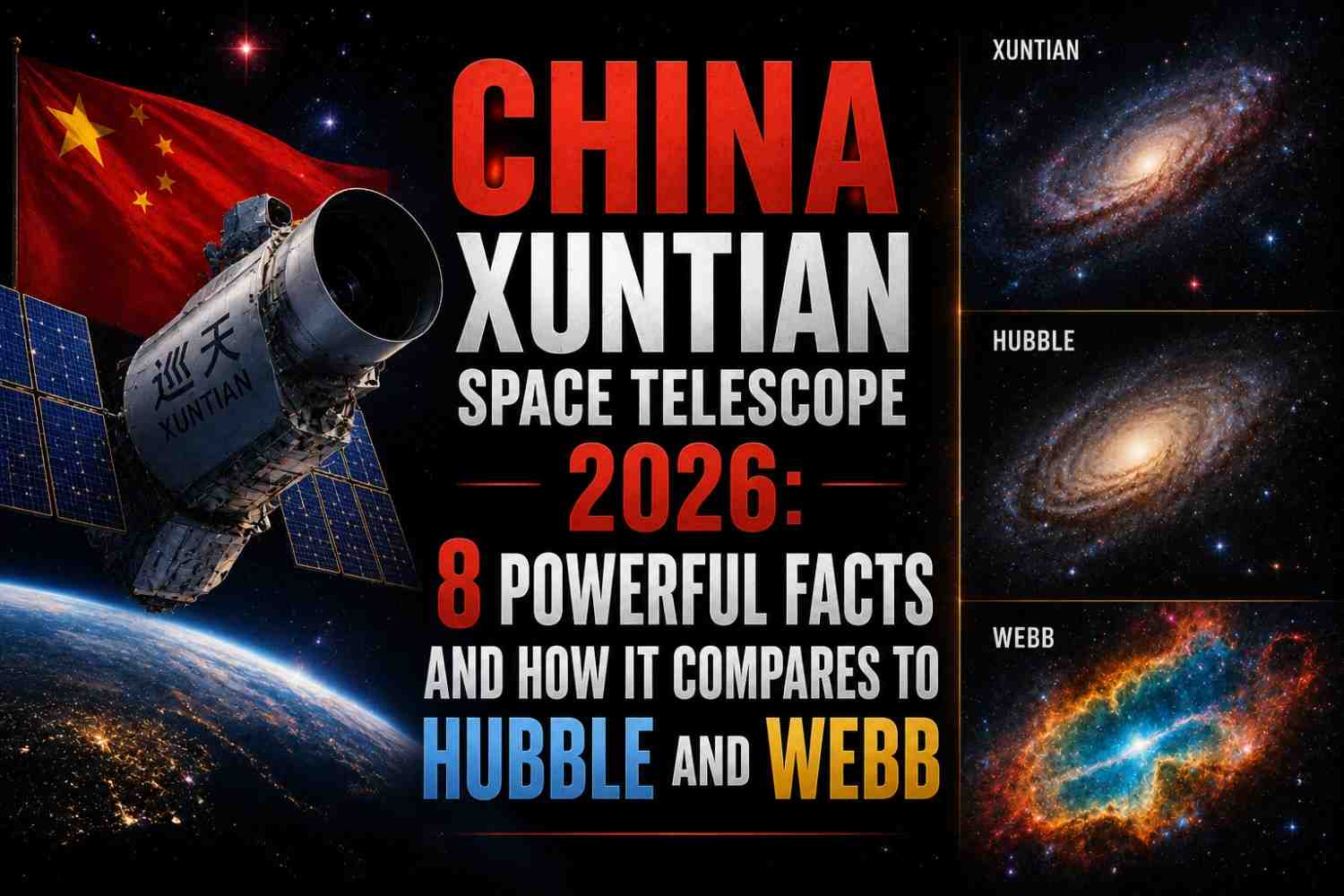
Introduction
The China Xuntian Space Telescope 2026 is one of the most significant developments in global astronomy—and one of the least discussed in Western media. Officially known as the Chinese Space Station Telescope (CSST) and nicknamed “Xuntian” (meaning “survey the sky”), this instrument is planned to begin full science operations around 2026.
The China Xuntian Space Telescope 2026 has a Hubble-sized mirror but a field of view 350 times larger. It represents China’s emergence as a major power in space-based astronomy — and a genuine contribution to humanity’s understanding of the universe.
Here are 8 powerful facts — including how it stacks up against Hubble and Webb.
What Is the China Xuntian Space Telescope 2026?
The China Xuntian Space Telescope 2026 is a 2-meter optical/ultraviolet/near-infrared space telescope that will operate in a similar orbit to China’s Tiangong Space Station — allowing it to periodically dock for servicing, upgrades, and instrument changes.
Key specifications:
- Primary mirror: 2 meters diameter
- Field of view: 1.1 square degrees — 350× larger than Hubble’s equivalent instrument
- Wavelength range: 255–1,000 nanometers (UV, optical, near-IR)
- Survey area goal: 17,500 square degrees (40% of the sky) over 10 years
- Image resolution: Comparable to Hubble (0.15 arcseconds)
This combination of resolution and field of view is the China Xuntian Space Telescope 2026‘s defining capability.
Fact 1 — Xuntian Has Hubble’s Resolution with 350 Times the Field of View
The headline specification of the China Xuntian Space Telescope 2026 bears repeating: it matches Hubble’s extraordinary 0.15-arcsecond optical resolution while simultaneously covering 350 times more sky per observation.
Why This Is Technically Remarkable
Hubble achieved its resolution through a 2.4-meter mirror and extremely stable space environment. Xuntian achieves similar resolution with a 2-meter mirror through advanced optical design and detector technology developed over decades of post-Hubble engineering learning.
Covering more sky without losing resolution is the fundamental challenge of survey telescope design. Xuntian’s achievement is genuinely impressive.
Fact 2 — Xuntian Shares an Orbit With the Chinese Space Station
The China Xuntian Space Telescope 2026 is designed to operate in close orbital proximity to the Tiangong Space Station — within a few hundred kilometers — allowing periodic rendezvous and docking.
This is unique in astronomy. No other space telescope has ever been designed for routine in-orbit servicing and instrument upgrades.
What Serviceability Means
Hubble’s servicing missions required Space Shuttle flights — enormously expensive and complex. Xuntian can dock with a Shenzhou crew vehicle or the station itself, enabling:
- Instrument replacement and upgrade
- Propellant resupply
- Technical repairs
- New detector installation as technology improves
The China Xuntian Space Telescope 2026 could remain scientifically current for decades — unlike fixed-instrument telescopes that become obsolete as technology advances.
Fact 3 — Xuntian vs Hubble: Direct Comparison
The China Xuntian Space Telescope 2026 is often described as “China’s Hubble” — but the comparison requires nuance.
| Feature | Hubble | Xuntian |
|---|---|---|
| Primary mirror | 2.4 m | 2.0 m |
| Field of view | ~11 sq arcmin | ~1.1 sq degrees (350× larger) |
| Wavelength range | 110–2,400 nm | 255–1,000 nm |
| Resolution | ~0.05–0.1 arcsec | ~0.15 arcsec |
| Serviceable | Yes (retired) | Yes (ongoing) |
| Survey capability | Very limited | Primary mission |
| Launch | 1990 | 2023 (partial ops) |
Xuntian is not a copy of Hubble. It’s a next-generation survey instrument that learned from Hubble’s strengths and limitations.
Related Article: Hubble Space Telescope vs James Webb vs Roman
Fact 4 — Xuntian vs James Webb: Different Domains
The China Xuntian Space Telescope 2026 and James Webb operate in complementary but distinct scientific domains.
Webb observes primarily in infrared (0.6–28 micrometers) — designed to see through dust and observe the coolest, most distant objects.
Xuntian observes in UV/optical/near-IR (255–1,000 nm) — Hubble’s domain, optimized for resolved galaxy imaging, stellar populations, and UV science.
Where They Overlap and Diverge
- Overlapping domain: Near-infrared (0.9–1.0 μm)
- Xuntian’s unique strength: Wide-field UV and optical surveys
- Webb’s unique strength: Deep mid-infrared observations of dust-embedded objects
The China Xuntian Space Telescope 2026 fills a gap between Hubble (no longer operating its wide-field camera fully) and Webb (infrared focus).
Fact 5 — Primary Science Programs
The China Xuntian Space Telescope 2026 science program covers four main survey components:
Wide-field multi-band imaging survey: Covering 17,500 sq degrees of sky in seven optical/UV bands — creating the most comprehensive optical sky atlas since the Sloan Digital Sky Survey, but from space.
Deep field survey: Ultra-deep observations of selected sky areas — comparable to the Hubble Ultra Deep Field in depth but covering larger areas.
UV galaxy survey: Mapping star formation rates across cosmic time using UV emission.
Nearby galaxy survey: Resolved stellar population studies of galaxies within ~10 Mpc.
Fact 6 — Dark Energy and Cosmological Science
Like NASA’s Roman telescope, the China Xuntian Space Telescope 2026 has major dark energy science goals.
Its wide-field imaging survey will:
- Measure weak gravitational lensing across hundreds of millions of galaxies
- Study galaxy clustering to probe dark matter distribution
- Identify Type Ia supernovae for cosmic distance measurements
- Map the large-scale structure of the universe
China will produce an independent dark energy dataset that can cross-check results from Roman and Euclid — increasing confidence in cosmological conclusions or revealing systematic differences.
For official mission information, see CSST Science Center at NAOC and China National Space Administration.
Fact 7 — Xuntian Began Limited Operations in 2024
The China Xuntian Space Telescope 2026 is not a future concept — it launched as part of the Tiangong space station program and began limited early science operations in 2024.
Full science operations are expected to ramp up through 2025 and 2026 as the telescope’s focal plane instruments are fully commissioned and survey programs begin.
This makes Xuntian arguably the fastest space telescope development-to-operations timeline of any major observatory in recent history.
Fact 8 — International Collaboration Is Possible but Uncertain
The China Xuntian Space Telescope 2026 science community has expressed openness to international collaboration on data access and joint research programs.
However, geopolitical constraints — particularly U.S. restrictions on NASA collaboration with Chinese space programs under the Wolf Amendment — mean formal joint programs with American institutions face significant hurdles.
European and other international astronomers may have more accessible pathways to Xuntian data collaboration.
Related Article: Nancy Grace Roman Space Telescope vs James Webb
5 Short FAQs
Q1: Is the Xuntian telescope already in space? Yes. The Xuntian telescope module was launched and attached to the Tiangong Space Station in 2023. It is currently in commissioning and early science operations, with full survey science expected to begin around 2026.
Q2: How does Xuntian’s resolution compare to Hubble? Xuntian achieves approximately 0.15 arcseconds resolution — comparable to Hubble’s optical performance — while covering 350 times more sky area per observation.
Q3: Can scientists outside China use the Xuntian telescope? China has indicated openness to international collaboration, but formal access agreements have not been widely established. The situation may evolve as the telescope enters full operations.
Q4: What is Xuntian’s relationship to the Chinese Space Station? Xuntian orbits close to the Tiangong Space Station and can dock with it for servicing. It operates independently during science observations but returns to station proximity for maintenance.
Q5: Will Xuntian data be publicly released? China’s space science data policies are evolving. Early science results are expected to be published in international journals, but full public data releases similar to NASA’s open data policy have not yet been confirmed.
Conclusion
The China Xuntian Space Telescope 2026 is a world-class observatory that the global astronomical community cannot afford to ignore. With Hubble-equivalent resolution across a 350-times-larger field of view, serviceable design, and a science program covering dark energy, galaxy evolution, and cosmological mapping, Xuntian is a genuine contribution to humanity’s understanding of the cosmos.
Stay ahead of global space telescope developments. Follow our complete observatory coverage — from Webb and Roman to Xuntian and PLATO — as astronomy enters its golden age.