
 Ramrajeshbee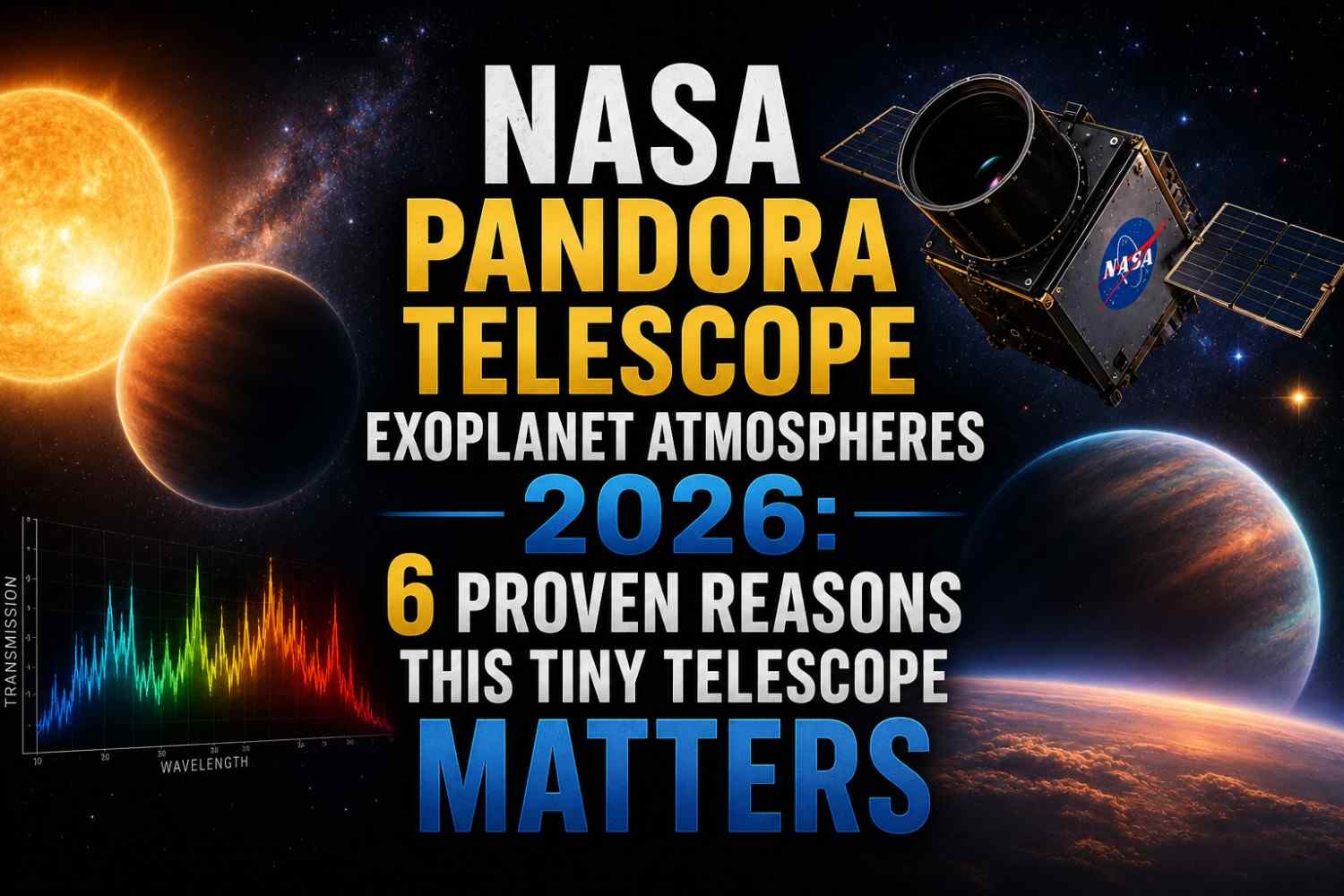
Introduction
The NASA Pandora telescope exoplanet atmospheres 2026 mission proves that size isn’t everything in space science. Pandora is a SmallSat—a compact, relatively inexpensive satellite—but its science impact is disproportionate to its modest dimensions.
The NASA Pandora telescope exoplanet atmospheres 2026 mission is designed to solve one of the most persistent problems in exoplanet science: how do you separate the signal of a planet’s atmosphere from the noise created by the star it orbits?
This seemingly technical problem has enormous implications. The answer determines whether we can reliably detect signs of life on other worlds.
Here are 6 proven reasons this tiny telescope matters enormously.
What Is the NASA Pandora Telescope Exoplanet Atmospheres 2026 Mission?
Pandora is a NASA Pioneers mission — a category of relatively low-cost astrophysics SmallSats designed to address focused, high-priority science questions.
Key facts about the NASA Pandora telescope exoplanet atmospheres 2026 mission:
- Size: About the size of a kitchen refrigerator
- Mirror: 0.45-meter primary mirror
- Wavelength: Optical and near-infrared (0.5–1.8 μm)
- Orbit: Low Earth orbit (~550 km)
- Launch: Targeted for 2025–2026
- Primary goal: Observe 20 exoplanets across 300+ transits to characterize stellar variability
Its entire mission is built around one brilliant insight: to understand a planet’s atmosphere, you must first understand its star.
Reason 1 — Pandora Solves the Stellar Contamination Problem
The most critical problem the NASA Pandora telescope exoplanet atmospheres 2026 mission addresses is stellar contamination — one of the biggest challenges in transit spectroscopy.
What Is Stellar Contamination?
When a planet transits its star, starlight filtered through the planet’s atmosphere carries chemical signatures. But the star itself is not uniform — it has dark spots (starspots) and bright regions (faculae) that also affect the spectrum.
If you don’t precisely account for stellar variability, you misinterpret the atmospheric signal. You might think you see water vapor when you’re actually seeing a starspot.
The NASA Pandora telescope exoplanet atmospheres 2026 mission simultaneously monitors both the planet’s transit AND the star’s surface variability — allowing scientists to cleanly separate the two signals.
Reason 2 — Pandora Enables Trustworthy Webb Atmosphere Detections
The James Webb Space Telescope is the most powerful exoplanet atmosphere detector ever built. But Webb’s results can only be fully trusted when stellar contamination is properly accounted for.
The NASA Pandora telescope exoplanet atmospheres 2026 mission is explicitly designed as a support mission for Webb — providing the stellar characterization data that Webb needs to interpret its atmospheric spectra correctly.
The Pandora-Webb Partnership
Pandora observes the same exoplanet targets as Webb’s atmospheric programs, simultaneously or in coordinated campaigns, providing:
- Optical wavelength stellar activity monitoring
- Starspot and facula coverage maps
- Long-baseline variability records
With Pandora’s data, Webb’s atmospheric detections become far more robust and scientifically credible.
Related Article: James Webb Space Telescope Latest Images 2026
Reason 3 — Pandora Observes 20 Planets Across 300+ Transits
One of the most powerful aspects of the NASA Pandora telescope exoplanet atmospheres 2026 approach is its statistical depth.
Pandora won’t just observe each target once. It will observe:
- 20 selected exoplanets spanning a range of sizes, temperatures, and star types
- At least 10 transits per planet on average — some targets receiving 20+ observations
- Simultaneous optical + near-IR data for each transit
This multi-transit approach averages out random noise, builds up a precise model of stellar variability, and produces atmospheric detections with far higher statistical confidence than single-transit observations.
Reason 4 — Pandora Targets the Most Important Exoplanets for Life Detection
The NASA Pandora telescope exoplanet atmospheres 2026 target list isn’t random. It’s carefully selected to include the planets most relevant to the search for life:
- TRAPPIST-1 system planets — seven Earth-sized worlds, several in the habitable zone
- K2-18b — a sub-Neptune with detected dimethyl sulfide hints
- LHS 1140b — a rocky super-Earth in the habitable zone
- 55 Cancri e — a hot rocky super-Earth with potential atmosphere
The NASA Pandora telescope exoplanet atmospheres 2026 program concentrates on the planets where atmospheric detections matter most for astrobiology.
Reason 5 — It Costs a Fraction of Webb While Addressing Complementary Science
The NASA Pandora telescope exoplanet atmospheres 2026 mission costs approximately $50 million — less than 0.1% of Webb’s ~$10 billion total program cost.
Yet it directly enhances the scientific return of Webb’s multi-billion-dollar investment by solving the stellar contamination problem that limits atmosphere characterization accuracy.
The SmallSat Science Revolution
Pandora exemplifies a growing trend in NASA astrophysics: targeted, lower-cost missions that address specific bottlenecks in our scientific understanding rather than trying to do everything.
For technical mission details, see NASA’s Pandora SmallSat mission page and Goddard Space Flight Center’s Pandora overview.
Reason 6 — Pandora Builds the Foundation for Future Life Detection
The ultimate goal of studying NASA Pandora telescope exoplanet atmospheres 2026 targets is to create the methodology and target list for future missions designed to directly detect life.
The proposed Habitable Worlds Observatory — NASA’s next flagship concept — aims to directly image Earth-like planets and search for biosignatures. Its success depends on:
- Knowing which stars are quiet enough for reliable atmospheric measurements
- Understanding stellar contamination well enough to recognize a true biosignature
- Having a prioritized list of the best planetary targets
The NASA Pandora telescope exoplanet atmospheres 2026 mission builds exactly that foundation.
Related Article: ESA PLATO Telescope Launch 2026
5 Short FAQs
Q1: What is NASA’s Pandora telescope and how big is it? Pandora is a NASA SmallSat (small satellite) roughly the size of a kitchen refrigerator. It has a 0.45-meter primary mirror and is designed to observe exoplanet transits in optical and near-infrared wavelengths simultaneously.
Q2: Why does stellar contamination matter for detecting exoplanet atmospheres? Stars have variable surface features (starspots, faculae) that alter the starlight spectrum during planet transits. Without correcting for these variations, atmospheric chemical detections can be false positives. Pandora solves this by monitoring both star and planet simultaneously.
Q3: Which exoplanets will Pandora study? Pandora’s target list includes planets from the TRAPPIST-1 system, K2-18b, LHS 1140b, and other high-priority targets relevant to habitability and atmospheric science — 20 planets with 10+ transit observations each.
Q4: Is Pandora working with James Webb? Yes. Pandora is explicitly designed to complement and support Webb’s exoplanet atmosphere programs by providing simultaneous stellar monitoring that makes Webb’s atmospheric detections more reliable and scientifically robust.
Q5: How does a SmallSat telescope compare to Webb in sensitivity? Pandora is far less sensitive than Webb — it cannot detect faint atmospheric signatures on its own. Its value is in monitoring stellar variability at optical wavelengths where Webb has limited access, providing the context data that makes Webb’s results trustworthy.
Conclusion
The NASA Pandora telescope exoplanet atmospheres 2026 mission demonstrates that transformative science doesn’t always require a $10 billion flagship. By solving the stellar contamination problem that limits atmosphere characterization, Pandora amplifies the scientific return of every other observatory studying exoplanet atmospheres — including the mighty James Webb.
Great science comes in all sizes. Follow our space telescope coverage for every discovery — from the smallest SmallSat to the largest space observatory ever built.