 Ramrajeshbee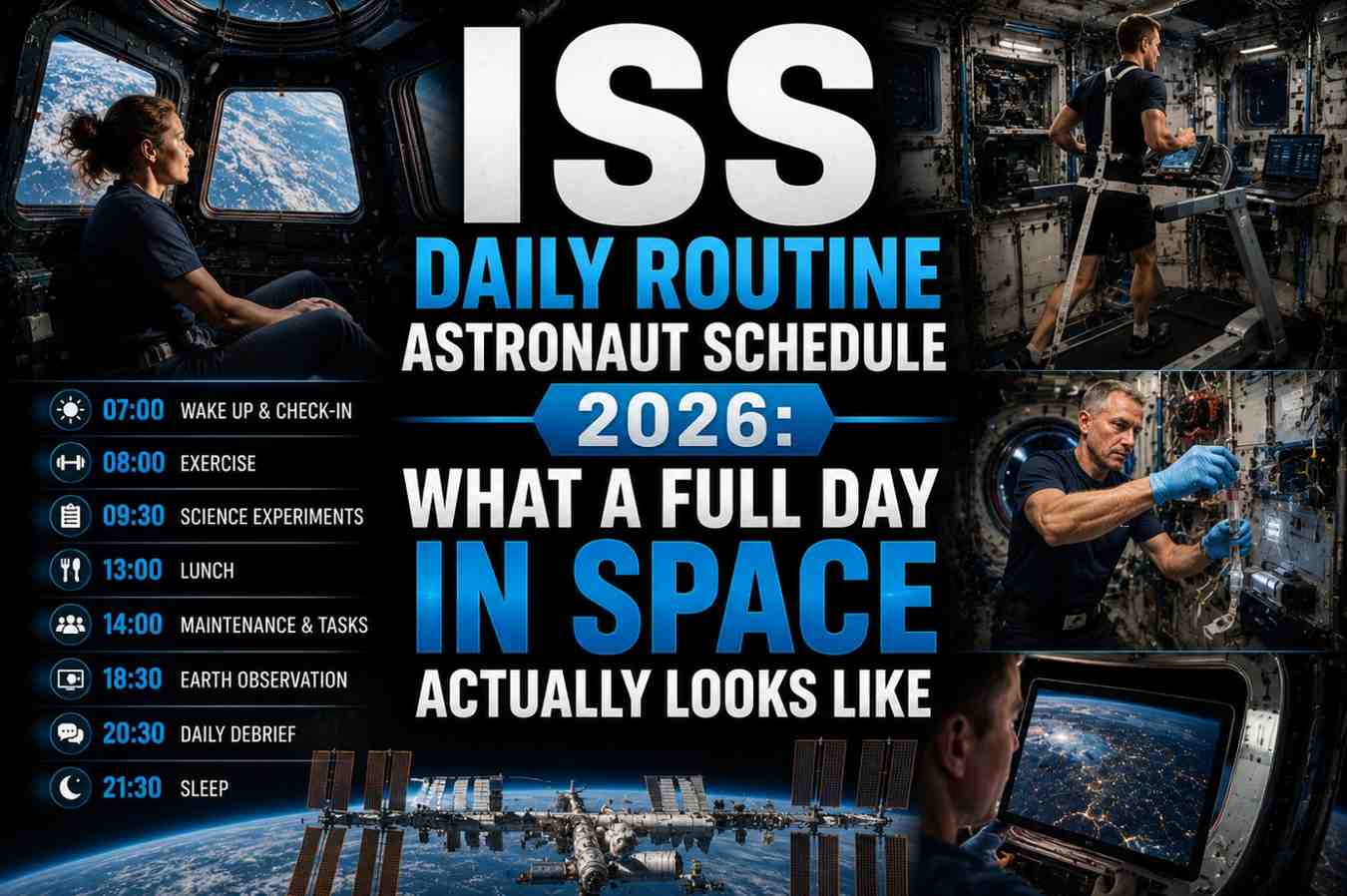
Introduction
The ISS daily routine astronaut schedule 2026 is nothing like a typical workday on Earth — and yet it’s surprisingly structured, disciplined, and even mundane in some ways.
Aboard the International Space Station, time management isn’t just about productivity. It’s about keeping six human beings healthy, safe, and mentally stable in one of the harshest environments in existence.
Here’s a complete look at the ISS daily routine astronaut schedule 2026 — hour by hour, from wakeup to sleep.
Wake-Up: 6:00 AM GMT
The ISS daily routine begins at 6:00 AM Greenwich Mean Time. The station operates on GMT to maintain a single consistent schedule across all international crew members.
Wake-up calls used to be NASA mission control playing songs over the radio — a beloved tradition from the Shuttle era. Today, alarms are set individually, though the cultural tradition continues for special occasions.
The first 30 minutes are personal time: hygiene, breakfast preparation, and morning review of the day’s schedule.
Morning Hygiene in Space
This is already more complex than on Earth:
- Teeth brushing with edible toothpaste (spit floats dangerously)
- No-rinse shampoo and water that doesn’t flow freely
- Towel baths or rinsed wipes instead of showers
- Razor and vacuum combo for shaving, or electric razors with suction
7:00–7:30 AM: Daily Planning Conference (DPC)
One of the first formal items on the ISS daily routine astronaut schedule 2026 is the Daily Planning Conference. This is a 30-minute video call between the crew and mission control teams in Houston, Moscow, and sometimes Europe and Japan.
Topics covered:
- Schedule for the day’s experiments and maintenance tasks
- Any system anomalies flagged overnight
- Weather briefings (relevant for EVA planning)
- Crew health check-ins
8:00 AM – 1:00 PM: Primary Work Block
The heart of the ISS daily routine astronaut schedule 2026 is the primary work block — five hours of scheduled tasks, experiments, and maintenance.
A typical morning might include:
- Science experiments — biology, physics, Earth observation, materials science
- Station maintenance — filter replacements, water system checks, equipment calibration
- Robotics operations — controlling Canadarm2 for cargo operations
- Spacewalk preparation — suit checks, airlock procedures (if EVA scheduled)
- Communications support — media events, student calls, official interviews
Schedules are extremely detailed. Each task is broken into 5–15 minute increments by ground teams called Procedure Writers. Astronauts essentially follow a moving digital checklist throughout the day.
1:00 – 2:00 PM: Lunch and Personal Time
The ISS daily routine astronaut schedule 2026 includes a structured 1-hour midday break. Crew members gather at the galley (usually in the US segment) for lunch — the most social meal of the day.
Conversation flows freely. Crews from different national space agencies exchange stories, share snacks from their personal food supplies, and briefly decompress.
Some crew members use this time for personal calls home.
2:00 – 5:00 PM: Secondary Work Block
The afternoon work block continues experiments and maintenance from the morning. This is also when:
- Ground teamwork handoffs occur between control centers
- Systems briefings happen for upcoming operations
- Vehicle berthing or approach is managed (if a cargo ship is docking)
- Medical check procedures are conducted
5:00 – 7:30 PM: Exercise — 2 Hours Daily
Mandatory exercise is the most critical non-work item on the ISS daily routine astronaut schedule 2026. Every crew member must complete approximately 2.5 hours of exercise, though scheduling allows flexibility.
Equipment aboard includes:
- ARED (Advanced Resistive Exercise Device) — simulates weightlifting with vacuum canisters
- COLBERT Treadmill — crew members strap in with bungees to run
- CEVIS Cycle Ergometer — stationary cycling
Skipping exercise is not an option. Bone density and muscle mass losses from even one missed day compound rapidly. Flight surgeons track exercise metrics daily.
Related Article: Effects of Space Travel on the Human Body 2026
7:30 – 8:30 PM: Evening DPC and End-of-Day Reports
A brief end-of-day conference with mission control reviews what was accomplished, flags any concerns, and confirms the next day’s schedule.
Crew members also complete written daily logs — documenting personal health observations, experiment notes, and any incidents.
8:30 PM – 9:30 PM: Personal Time
The ISS daily routine astronaut schedule 2026 protects one hour of genuine free time in the evening. Astronauts use this for:
- Earth observation through the Cupola (the beloved seven-windowed dome)
- Watching movies or TV shows downloaded from Earth
- Reading, journaling, playing instruments
- Video calls with family and friends
- Social time with crewmates
The Cupola is the most popular spot on the ISS. Many astronauts describe floating at its windows, watching the Earth rotate below, as the most profound experience of their lives.
9:30 PM: Lights Out
The ISS daily routine astronaut schedule 2026 concludes with sleep prep at 9:30 PM, with lights-out targeting 10:00 PM for an 8-hour sleep window.
Crew members retreat to their individual sleeping compartments, anchor their sleeping bags, and prepare for tomorrow — another day in the most extraordinary workplace in human history.
Related Article: How Astronauts Sleep in Space — Zero Gravity Sleep Explained
Weekends on the ISS
Weekends are lighter on the ISS astronaut daily schedule. Crew members have reduced work requirements on Saturdays and a near-full day off on Sundays. Some maintenance tasks continue 7 days a week, but Sundays are primarily for rest, personal calls, and creative activities.
Holidays are observed. At Christmas, crews decorate the station with small ornaments and share a special meal.
External Resources
FAQ: ISS Daily Routine Astronaut Schedule 2026
Q1: What time do astronauts wake up on the ISS? The ISS daily routine astronaut schedule 2026 typically starts at 6:00 AM GMT.
Q2: How many hours a day do astronauts work on the ISS? Primary work fills roughly 6–8 hours per day, plus 2+ hours of mandatory exercise.
Q3: Do astronauts get days off in space? Yes — weekends are lighter schedules, and Sundays are largely free days for rest and personal activities.
Q4: How much free time do astronauts have on the ISS? The schedule typically protects about 1–1.5 hours of personal time in the evening.
Q5: What do astronauts do for fun on the ISS? Earth observation, movies, music, video calls home, photography, and socializing with crewmates are the most common leisure activities.
Conclusion
The ISS daily routine astronaut schedule 2026 is a masterpiece of operational planning — balancing science, maintenance, health, and human wellbeing in an environment that punishes every mistake.
It’s structured enough to maintain safety and productivity, but flexible enough to accommodate the realities of human needs — rest, connection, creativity, and joy.
The next time you have a busy workday, remember: somewhere above your head, six people are having a busier one — in orbit.