 Ramrajeshbee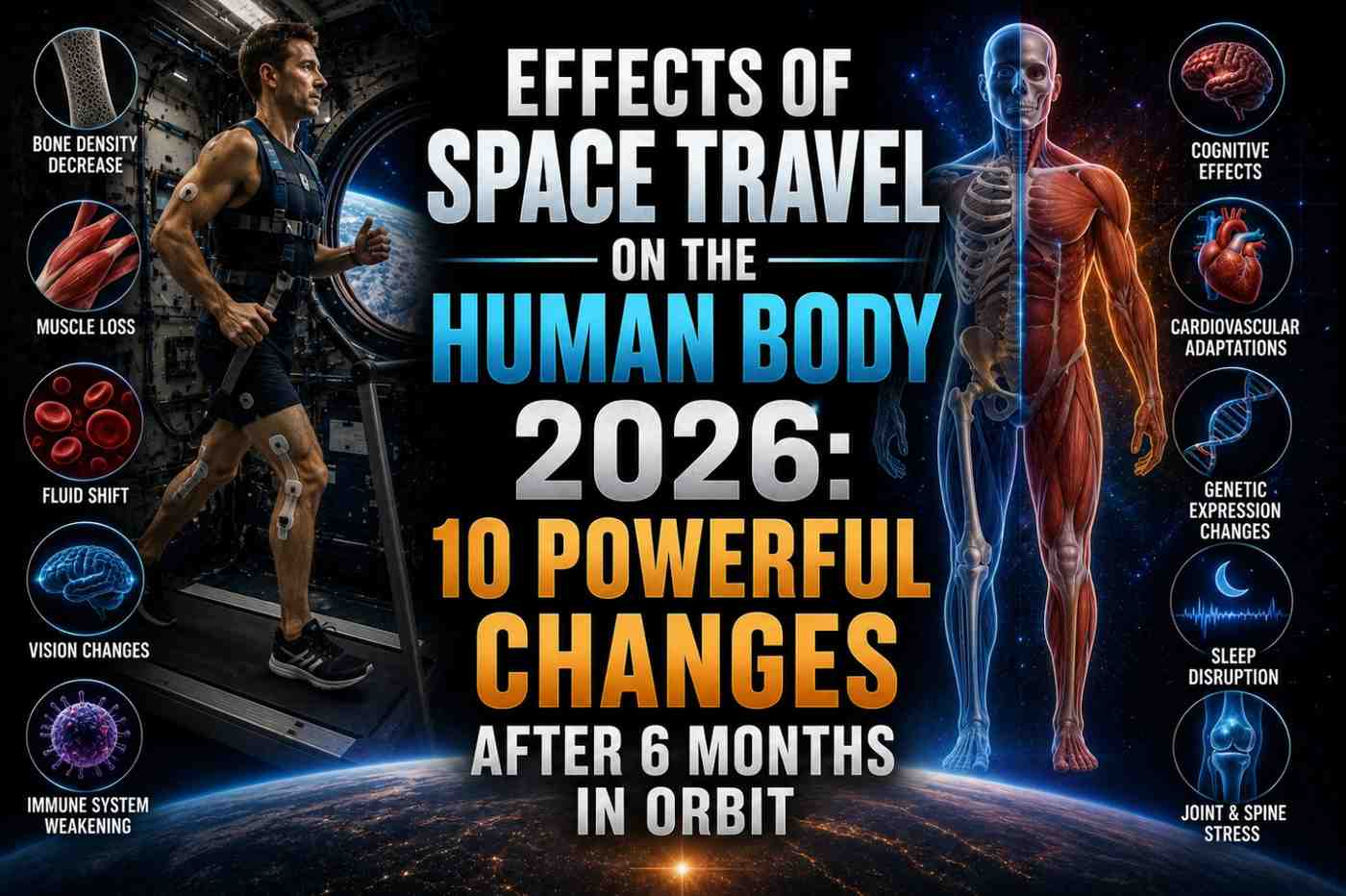
Introduction
The effects of space travel on the human body in 2026 are more dramatic than most people imagine. Six months on the International Space Station fundamentally alters nearly every major physiological system in the human body.
And returning to Earth is just the beginning of the story — recovery can take months or even years.
Here are the 10 most significant effects of space travel on the human body that researchers are studying right now.
1. Bone Density Loss
One of the most well-documented effects of space travel on the human body in 2026 is bone loss. Without gravity loading bones, they deteriorate at a rate of approximately 1–2% per month in the hips and spine.
A six-month mission can result in 10–12% bone density loss—comparable to a decade of aging-related bone decline on Earth.
Recovery takes months to years after return. NASA combats this with a 2-hour daily exercise regimen and vitamin D supplementation.
2. Muscle Atrophy
Gravity is the world’s greatest gym. Without it, muscles—particularly leg and core muscles—weaken rapidly.
Astronauts can lose up to 20% of their muscle mass in six months in space. This is why returning astronauts are often seen being carried from their capsule — they literally cannot walk immediately after landing.
3. Cardiovascular Changes
The effects of space travel on the human body in 2026 include significant changes to the heart and circulatory system.
Without gravity, blood shifts toward the upper body and head. Over time, the heart “forgets” how to pump effectively against gravity—a condition called “orthostatic intolerance.” Returning astronauts can faint when they stand up.
The heart also becomes more spherical in shape and slightly smaller after extended spaceflight.
4. Vision Impairment
This is one of the most alarming recent discoveries. A condition called spaceflight-associated neuro-ocular syndrome (SANS) affects a significant percentage of ISS astronauts.
Symptoms include:
- Flattening of the eyeball
- Swelling of the optic nerve
- Shifts in refraction requiring new glasses prescriptions
- In some cases, permanent vision changes
The cause is believed to be intracranial pressure changes due to fluid shifts in microgravity. The effects of space travel on the human body in 2026 include SANS as a top research priority.
5. Fluid Shifts and “Puffy Face”
In microgravity, bodily fluids shift toward the head and chest. Astronauts develop famously puffy faces and “bird legs” — swollen faces with thin, deflated-looking lower legs.
This fluid shift also causes nasal congestion, alters taste perception, and increases intracranial pressure.
6. Immune System Changes
Space travel profoundly affects the immune system. Studies show that:
- Dormant viruses like herpes zoster can reactivate in space
- Immune cell function is reduced
- Inflammatory markers are elevated
- The gut microbiome shifts significantly
The effects of space travel on the human body in 2026 related to immunity are particularly concerning for deep space missions where return is not possible.
7. Radiation Exposure
Beyond Earth’s magnetosphere, astronauts are exposed to high levels of galactic cosmic rays and solar particle events.
ISS astronauts receive approximately 10 times more radiation than people on Earth — equivalent to a full-body CT scan every few days. Long-duration deep space missions (moon, Mars) dramatically increase this exposure.
This raises lifetime cancer risk and may affect cognitive function over time.
8. Sleep Disruption
As discussed in other articles, the effects of space travel on the human body in 2026 include chronic sleep deprivation. Poor sleep compounds every other physiological challenge — slowing recovery, impairing judgment, and accelerating cognitive decline.
Related Article: How Astronauts Sleep in Space
9. Psychological and Cognitive Changes
Extended isolation, confinement, and stress affect the brain. Studies from long-duration spaceflight missions show:
- Reduced gray matter volume in certain brain regions
- Cognitive performance changes (memory, attention)
- Increased risk of depression and anxiety
- Behavioral changes from social isolation
NASA’s twin study (Scott Kelly vs. his twin brother Mark) revealed measurable gene expression changes after a year in space — some of which persisted months after return.
10. Microbiome Disruption
The human gut microbiome changes significantly in space. The altered diet, stress, radiation, and environment combine to shift the bacterial populations in ways that affect digestion, immunity, and overall health.
The effects of space travel on the human body 2026 related to the microbiome are an active frontier of NASA research.
Recovery After Returning from Space
After landing, recovery is a serious medical process. Typical recovery timeline:
- Days 1–7: Readaptation to gravity, cardiovascular stabilization
- Weeks 1–4: Muscle and balance rehabilitation
- Months 1–6: Bone density recovery begins
- Months 6–12: Most systems approach pre-flight baseline
- Long term: Some vision changes may be permanent; bone density may not fully recover
Related Article: ISS Daily Routine Astronaut Schedule 2026
External Resources
FAQ: Effects of Space Travel on the Human Body 2026
Q1: What are the most serious effects of space travel on the human body 2026? Bone density loss, vision impairment (SANS), cardiovascular deconditioning, and radiation exposure are among the most clinically significant effects.
Q2: Is space travel damage to the body permanent? Most changes reverse after returning to Earth, but some — particularly vision changes from SANS — may be permanent.
Q3: Do astronauts age faster in space? Interestingly, Scott Kelly’s telomeres actually lengthened in space — though some effects of cellular aging did accelerate. The relationship between space and aging is complex.
Q4: How does space travel affect the brain? Studies show reduced gray matter volume in some brain regions and measurable cognitive changes, though most recover after return to Earth.
Q5: Can the body fully recover from 6 months in space? Most systems recover within 6–12 months, but bone density and vision may not fully return to pre-flight baseline in all cases.
Conclusion
The effects of space travel on the human body 2026 are profound, widespread, and in some cases permanent. From bone loss to vision impairment, microgravity challenges every system in the human body in ways Earth-based medicine never prepared for.
Understanding these effects of space travel on the human body is essential as we prepare for longer and more ambitious missions — to the Moon, to Mars, and beyond.
The science of keeping humans healthy in space has never been more important — or more fascinating.