 Ramrajeshbee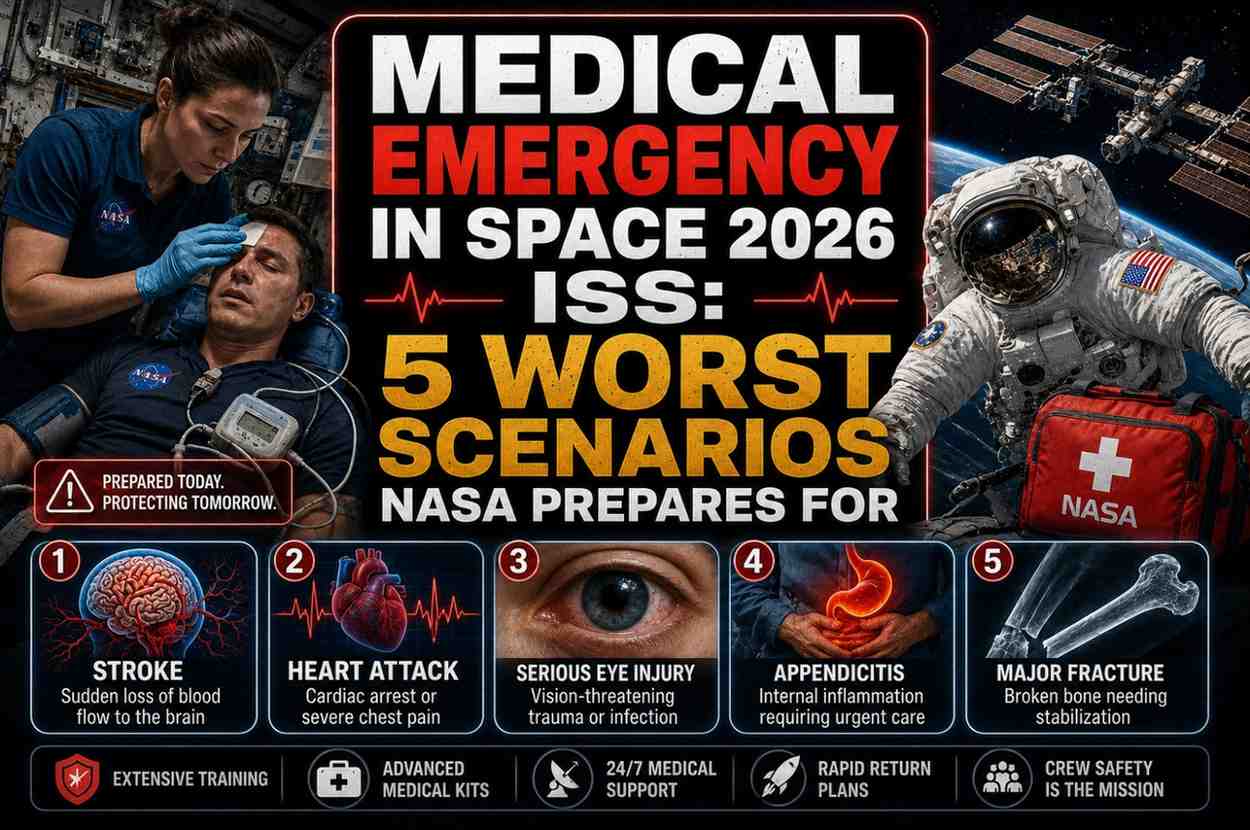
Introduction
A medical emergency in space, 2026 ISS, is one of the most terrifying scenarios mission planners face. When something goes wrong 250 miles above Earth, there’s no calling 911 — and the nearest emergency room is a multi-hour return journey away.
Every astronaut aboard the International Space Station is trained in emergency medicine. But some situations push the limits of what’s possible.
Here’s what you need to know about the reality of a medical emergency in space — and how NASA prepares for the worst.
What Counts as a Medical Emergency in Space?
A medical emergency in space in 2026 on the ISS could be almost anything that threatens an astronaut’s life or mission capacity. Common categories include:
- Cardiac events — heart attack or arrhythmia
- Dental emergencies — tooth abscesses or fractures
- Eye injuries — critically important due to vision changes in space
- Bone fractures from equipment accidents
- Appendicitis — one of the most feared scenarios
- Severe infections—limited antibiotic options in orbit
- Psychological crises — covered under mental health protocols
- Toxic exposure from chemical spills or equipment failures
The ISS has a medical kit stocked with hundreds of medications and instruments. But its capabilities are fundamentally limited compared to a terrestrial hospital.
The Mike Fincke Crew-11 Medical Situation
One of the most talked-about cases of a medical emergency in space in the 2026 ISS context involves veteran NASA astronaut Mike Fincke.
Fincke, originally assigned to Boeing’s Starliner program, was removed from his flight assignment due to a health issue that required evaluation. His situation drew attention to the reality that even highly trained, elite astronauts can face sudden health challenges that ground them—or could potentially affect them mid-mission.
While specifics of Fincke’s medical situation remain private, his case highlights how seriously NASA takes pre-mission health screening and how rapidly circumstances can change, even for the most experienced crew members.
The broader lesson: a medical emergency in space 2026 ISS can begin even before launch.
5 Worst Medical Scenarios in Space — And How NASA Prepares
1. Cardiac Arrest
Cardiac arrest in orbit is potentially survivable—but CPR in microgravity requires a completely different technique. Standard chest compressions don’t work when both you and the patient float away.
Astronauts train for a technique called the “Evetts-Russomano method,” where the rescuer wraps their legs around the patient to gain leverage. The ISS also carries an automated external defibrillator (AED).
A cardiac medical emergency in space in 2026 on the ISS would trigger immediate ground consultation with flight surgeons available 24/7.
2. Appendicitis
This is widely considered one of the most dangerous possible medical emergencies in space. An inflamed appendix can rupture within hours, causing fatal sepsis without surgical intervention.
The ISS has no surgical suite. Options are limited: aggressive antibiotic therapy and emergency return to Earth, which takes approximately 3–5 hours via Soyuz or Dragon.
3. Dental Emergency
Dental abscesses can escalate rapidly without treatment. The ISS medical kit includes dental tools, temporary filling materials, and pain management medications.
A trained crew medical officer (CMO) can perform basic dental procedures with guidance from Earth-based specialists via telemedicine.
4. Severe Trauma from Equipment Failure
A medical emergency in space 2026 ISS could result from collision with equipment, a spacesuit failure during EVA, or a micrometeorite strike. The ISS protocols include tourniquets, wound closure materials, and IV fluids.
For severe trauma, stabilization and emergency return are the primary options.
5. Psychological Crisis
Mental health emergencies are increasingly recognized as a serious risk on long-duration missions. Severe depression, panic attacks, or acute stress reactions can impair mission safety.
The ISS maintains private communication channels between crew members and Earth-based psychiatrists. Medications for anxiety, depression, and sleep disorders are available aboard.
Related Article: Astronaut Mental Health in Space — How NASA Prepares Crews
The ISS Medical Kit: What’s Available?
The medical emergency in space: the 2026 ISS response relies heavily on what’s physically aboard the station. The ISS Advanced Life Support Pack includes:
- Defibrillator (AED)
- Ultrasound machine (for internal injury assessment)
- Oxygen supply system
- IV fluids and administration equipment
- Surgical instruments (limited)
- Hundreds of medications across categories
- Dental kit
- Ophthalmology instruments
The ultrasound machine is particularly impressive—astronauts have been trained to perform basic ultrasound scans that can detect internal bleeding, fluid around organs, and cardiac function, all transmitted to Earth-based physicians in real time.
Telemedicine: Earth’s Role in Space Emergencies
During any medical emergency in space, 2026 ISS, astronauts are never truly alone. NASA maintains 24/7 flight surgeon coverage, and private medical consultations can occur at any time.
The communication delay from ISS to Earth is minimal — essentially real-time. This means physicians can observe ultrasound images, review vital signs, and guide procedures in near real-time.
This telemedicine capability will become increasingly critical as missions extend beyond low Earth orbit—where communication delays make real-time consultation impossible.
Related Article: How to Become a NASA Astronaut 2026
External Resources
FAQ: Medical Emergency in Space 2026 ISS
Q1: What happens during a medical emergency in space 2026 ISS? The crew medical officer takes charge, consults with Earth-based flight surgeons via telemedicine, and administers treatment using the onboard medical kit.
Q2: Can astronauts perform surgery in space? No surgical suite exists on the ISS. Minor procedures are possible, but major surgery would require emergency return to Earth.
Q3: How long does it take to return to Earth from the ISS in an emergency? An emergency return via Soyuz or Dragon takes approximately 3–5 hours from undocking to landing.
Q4: What medical training do astronauts receive? All astronauts receive extensive first-aid, CPR, dental, and basic surgical training. Each crew has a designated crew medical officer with advanced training.
Q5: What happened with Mike Fincke and Crew-11? Mike Fincke was removed from his Starliner flight assignment due to a health evaluation. His case highlighted how medical issues can affect even veteran astronauts pre-launch.
Conclusion
A medical emergency in space 2026 ISS is a scenario NASA takes with extreme seriousness—and for good reason. Every astronaut who leaves Earth knows that a health crisis in orbit is a true life-or-death situation.
Through rigorous training, a well-stocked medical kit, and 24/7 telemedicine support, NASA has built a remarkable system for managing the unthinkable.
But ultimately, the best strategy for a medical emergency in space is prevention—which is why the astronaut health screening and monitoring systems are among the most advanced in the world.