 Ramrajeshbee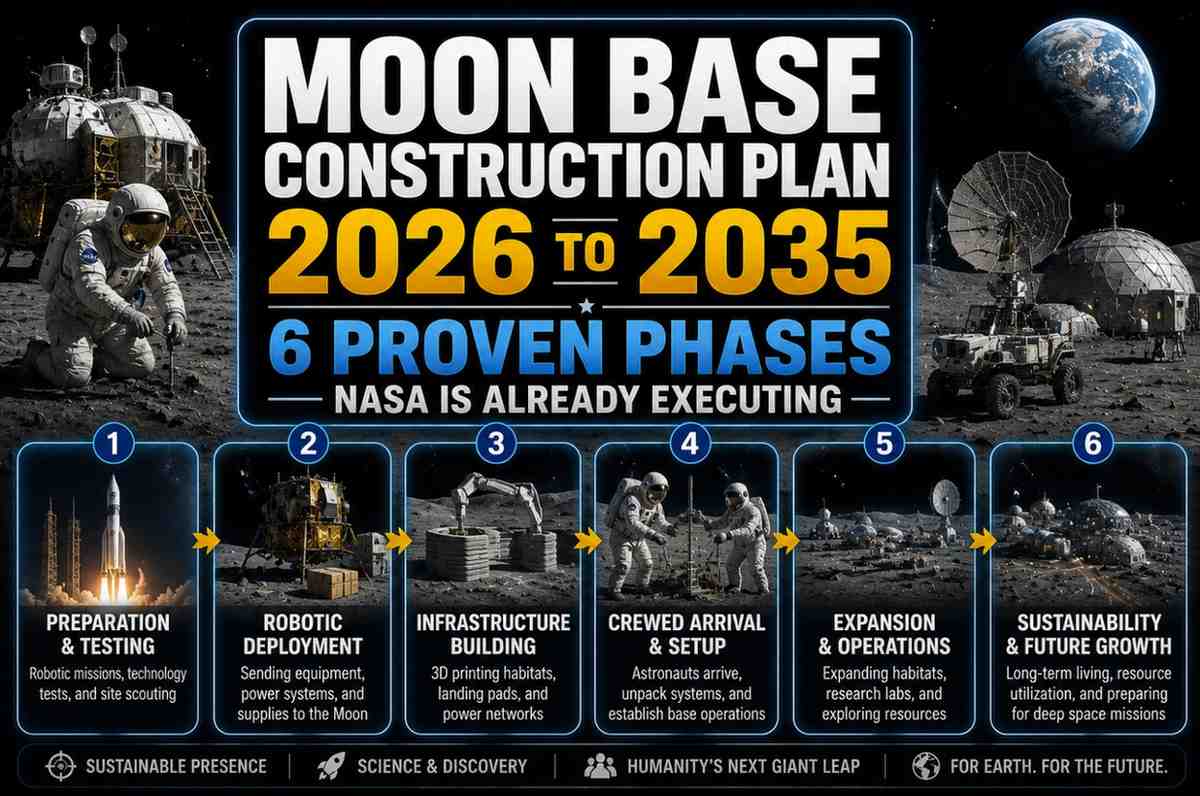
Introduction
The Moon base construction plan from 2026 to 2035 is not a dream. It has a budget, a timeline, international partners, and hardware already being built in factories right now.
NASA calls it the Artemis program, and its centerpiece infrastructure is the Lunar Gateway — a space station orbiting the Moon that serves as the hub for all surface operations.
This article walks you through exactly how the Moon base construction plan 2026 to 2035 works, phase by phase, in plain language.
Why Build a Moon Base at All?
Before diving into the Moon base construction plan 2026 to 2035, it’s worth understanding the why.
Scientific reasons:
- The Moon’s South Pole craters contain water ice — unchanged for billions of years and a record of the early solar system
- Low gravity makes telescopes vastly more powerful than Earth-based counterparts
- The lunar far side, permanently shielded from Earth’s radio noise, is perfect for radio astronomy
Strategic reasons:
- Water ice can be split into hydrogen and oxygen: rocket propellant
- Whoever controls cislunar infrastructure controls access to deep space
- China plans a Moon base by 2035 — the US and partners are not yielding that territory
Economic reasons:
- Helium-3 on the Moon could theoretically fuel fusion reactors
- Rare earth minerals exist in lunar regolith
- The Moon is the ideal proving ground for Mars technologies
The 6 Phases of the Moon Base Construction Plan 2026 to 2035
Phase 1 (2025–2026): Artemis III — First Humans on the Moon Since 1972
The Moon base construction plan 2026 to 2035 begins with a landing, not a base.
Artemis III sends two astronauts to the lunar South Pole using SpaceX Starship HLS as the lander. This is humanity’s return to the Moon after 52 years.
Objectives:
- Prove Starship HLS can land on the Moon safely
- Conduct geological surveys of the South Pole
- Demonstrate EVA operations in lunar spacesuits (xEMU)
- Collect samples and operate surface science instruments
Duration: approximately 6.5 days on the surface.
Phase 2 (2026–2028): Gateway Assembly — Building the Lunar Space Station
The Lunar Gateway is the linchpin of the Moon base construction plan 2026 to 2035. Without it, surface operations beyond a few days are impossible.
Gateway’s first two modules:
- HALO (Habitation and Logistics Outpost): Crew quarters, life support, communications hub
- PPE (Power and Propulsion Element): Solar electric propulsion system; provides Gateway’s orbital maneuvering and ~60kW of power
Both modules launch aboard a single Falcon Heavy rocket, targeting late 2025 / early 2026. They are built by Maxar Technologies (PPE) and Northrop Grumman (HALO).
Phase 3 (2027–2029): International Modules Join Gateway
The Moon base construction plan 2026 to 2035 is explicitly international. NASA’s partners contribute modules that expand Gateway’s capability:
- ESA ESPRIT module: Refueling infrastructure and additional communications
- ESA I-Hab: International habitation — crew quarters doubling Gateway’s living space
- JAXA HLS interface: Japan provides logistics resupply
- CSA (Canada) Canadarm3: Robotic arm for external maintenance
With all modules attached, Gateway supports crews of 4 for stays of up to 30 days.
Phase 4 (2028–2030): Sustained Surface Operations Begin
This is where the Moon base construction plan 2026 to 2035 transitions from exploration to presence.
Beginning with Artemis V (2028), missions are no longer one-time visits. Each crew stays 30 days on the surface, rotating through Gateway like Antarctic research stations on Earth.
Surface infrastructure deployed during this phase:
- Pressurized Lunar Rover (PLR): Allows crews to explore up to 100km from base without EVA suits
- ISRU pilot plant: Small-scale water ice extraction and electrolysis for propellant
- Power arrays: NASA’s Kilopower nuclear reactors (10kW each) deployed for reliable electricity independent of solar cycles
Phase 5 (2030–2033): Permanent Lunar Outpost Established
By 2030, the Moon base construction plan 2026 to 2035 reaches its critical milestone: continuous human habitation of the Moon.
The surface base, called Artemis Base Camp in NASA planning documents, consists of:
- A Foundation Surface Habitat — a pressurized habitat module launched aboard SLS or Starship, rated for multi-year deployment
- An expandable habitat using inflatable technology (similar to Bigelow designs) for additional volume
- Dedicated science labs for geology, astrobiology, and materials research
- A landing pad of stabilized regolith to prevent dust storms during Starship arrivals
Power comes from a combination of solar arrays and nuclear Kilopower units — providing 40kW minimum, enough for a crew of 6.
Related: Future of Space Exploration 2026 to 2040 — Moon Bases, Mars Colonies & Beyond
Phase 6 (2033–2035): ISRU at Scale — The Moon Fuels Itself
The final phase of the Moon base construction plan 2026 to 2035 achieves the ultimate goal: a Moon base that doesn’t fully depend on resupply from Earth.
Full-scale ISRU operations:
- Water extraction: Mining ice from permanently shadowed craters using thermal extraction
- Electrolysis: Splitting water into H₂ and O₂ for rocket propellant and crew oxygen
- 3D printing: Using lunar regolith (mixed with binders) to print shielding blocks, roads, and structural components
If successful, each Starship mission to the Moon could refuel there rather than carrying all propellant from Earth. This reduces the cost of a round trip by 60–70%.
Key Technologies Making the Moon Base Construction Plan Possible
Nuclear Power: Kilopower Reactors
The Moon’s poles have 14-day periods of darkness. Solar panels don’t work then. NASA’s Kilopower project uses compact fission reactors (each the size of a large trash can) to provide reliable baseload power.
A 10kW Kilopower unit uses uranium-235 fuel. Four units provide 40kW — enough for comfortable sustained habitation.
Lunar Spacesuits: Axiom xEMU
The old Apollo suits worked for hours. The new Axiom Space xEMU suits for the Moon base construction plan 2026 to 2035 are designed for daily EVA operations, with:
- Greater joint flexibility for crouching, climbing, sample collection
- Built-in biometric monitoring
- Dust-resistant seals (lunar dust is microscopically sharp and pervasive)
- Rated for South Pole temperatures (-173°C in shadowed craters)
Autonomous Robots
Before and between human missions, autonomous robots:
- Survey landing sites and map terrain
- Begin ISRU infrastructure deployment
- Maintain equipment during unmanned periods
- Operate science instruments continuously
Companies including Astrobotic, Intuitive Machines, and ispace are delivering commercial lunar landers carrying this robotic infrastructure as early as 2025–2026.
Related: SpaceX Starship Version 3 Capabilities 2026 — What the New Rocket Can Actually Do
International Partners in the Moon Base Construction Plan
The Moon base construction plan 2026 to 2035 is a coalition effort under NASA’s Artemis Accords — a framework for peaceful, transparent lunar exploration signed by 40+ nations as of 2026.
Key partners:
- ESA (Europe): Two Gateway modules; Orion service module
- JAXA (Japan): Lunar Terrain Vehicle (pressurized rover); logistics
- CSA (Canada): Canadarm3 robotic system
- ISRO (India): Potential surface science partnerships under Artemis Accords
China is not a signatory to the Artemis Accords and is pursuing its own lunar base program independently, targeting 2035.
Budget: What Does a Moon Base Actually Cost?
NASA has not released a single “Moon base price tag,” but estimates from the agency’s Inspector General and Congressional Budget Office suggest:
- Artemis Program through 2025: ~$93 billion total investment
- Gateway construction: ~$8–12 billion
- Surface base infrastructure (2026–2035): $35–60 billion additional
- Total 2026–2035 investment estimate: ~$45–70 billion
Commercial partnerships (SpaceX HLS, Axiom spacesuits, commercial landers) are intended to reduce NASA’s share significantly compared to doing everything in-house.
5 Frequently Asked Questions
Q1: When will the first permanent Moon base be ready? NASA’s Moon base construction plan 2026 to 2035 targets continuous human habitation beginning around 2030, with full ISRU operations by 2033–2035.
Q2: Will the Moon base be underground? Partially. Lava tubes discovered by lunar orbiters could provide natural radiation shielding and stable temperatures. Some planning documents include eventual lava tube utilization, but the first habitats will be surface-based with regolith berms for radiation protection.
Q3: What happens if funding is cut? Historically, US space programs suffer from political instability. The Moon base construction plan 2026 to 2035 has been designed with international partners specifically to make cancellation politically costly — a lesson learned from Apollo.
Q4: How does the Moon base handle medical emergencies? Gateway serves as a medical facility with telemedicine support from Earth. A pressurized rover can evacuate crew from the surface to Gateway within hours. Emergency return to Earth requires several days minimum.
Q5: Will the Moon base be open to non-NASA astronauts? Yes. Artemis Accords partners will send their own astronauts. Commercial visitors are also planned — private astronaut missions to the surface are expected by 2030.
Conclusion
The Moon base construction plan from 2026 to 2035 is the most ambitious infrastructure project in human history — and it’s already underway.
Gateway modules are being built. Spacesuits are being tested. Landers have already touched down commercially. The hardware is real, the partnerships are signed, and the launches are scheduled.
By 2035, humans will not have visited the Moon — they will live there.
Explore our complete lunar exploration coverage and follow every mission milestone as humanity builds its first home beyond Earth.
External sources: NASA Artemis Program | ESA Moon Gateway Overview