 Ramrajeshbee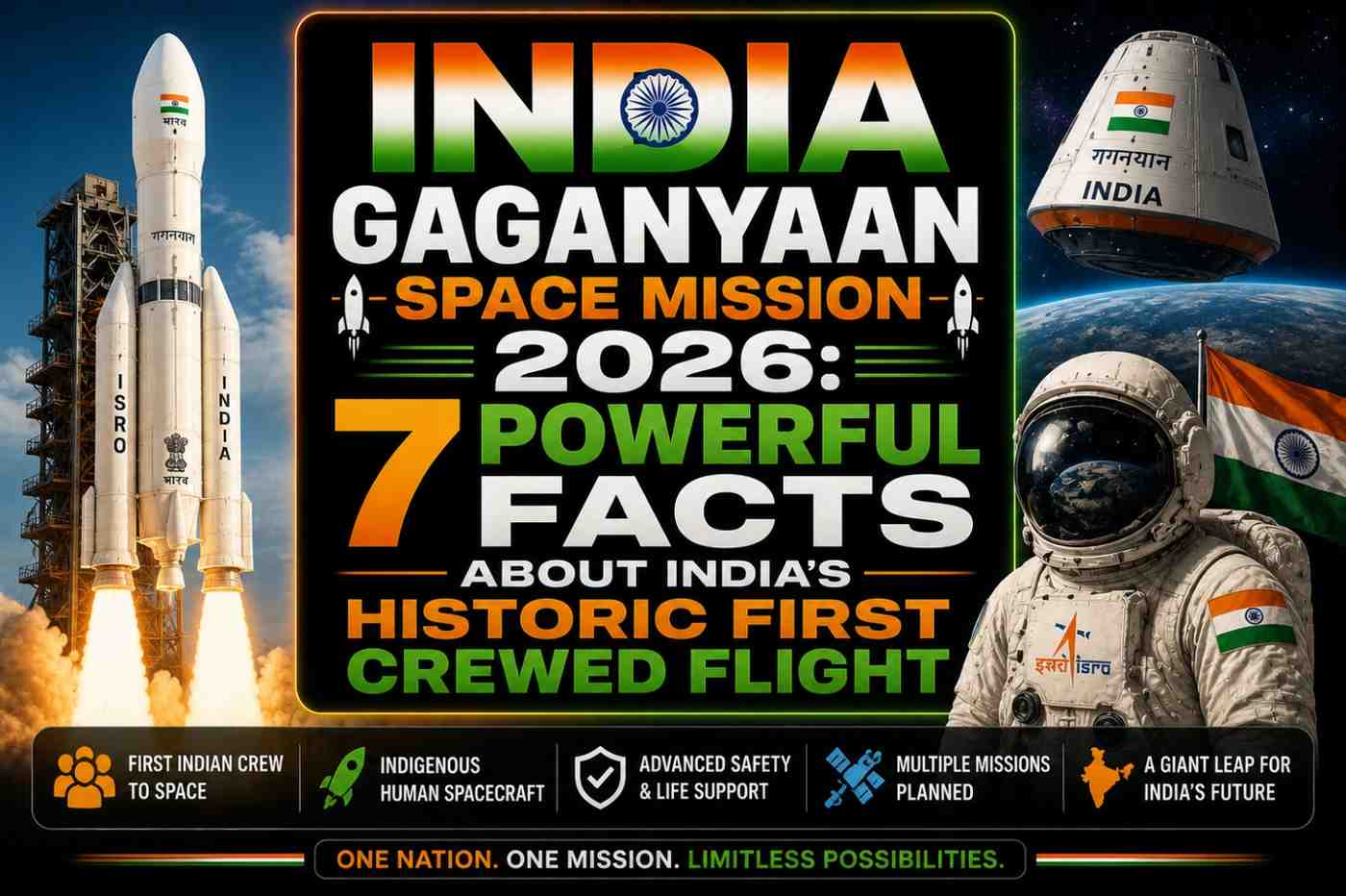
Introduction
The India Gaganyaan space mission in 2026 will be one of the most consequential moments in the history of human spaceflight — not just for India, but for every nation that dreams of sending its citizens to space.
When Gaganyaan launches, India becomes only the fourth nation in history to independently send humans to orbit, joining the US, Russia, and China. No other country has achieved this on its own.
This article covers everything you need to know about the India Gaganyaan space mission in 2026: the crew, the vehicle, the mission profile, and what it means for India’s future in space.
What Is the Gaganyaan Program?
Gaganyaan (Sanskrit for “sky vehicle”) is India’s national human spaceflight program, developed by ISRO — the Indian Space Research Organisation.
The India Gaganyaan space mission 2026 is the culmination of a program that began in 2018, was delayed by COVID-19, and has now completed all its critical uncrewed test milestones.
Goals of Gaganyaan:
- Demonstrate India’s capability to launch and safely return a crew from low Earth orbit
- Develop all critical systems independently (no foreign crew vehicle or life support outsourcing)
- Lay the foundation for future Indian space stations and deep space ambitions
The Road to 2026: How India Got Here
The India Gaganyaan space mission 2026 is not a sudden leap. ISRO systematically worked through every milestone:
TV-D1 (October 2023): Crew Escape System Test
This was the first critical test — verifying that the Crew Escape System (CES) can pull astronauts away from a failing rocket at any point during ascent.
TV-D1 successfully aborted, deployed the parachutes, and recovered the crew module from the Bay of Bengal. A flawless demonstration.
G1 Uncrewed Mission (2025): Full Dress Rehearsal
The G1 mission flew a fully equipped Gaganyaan spacecraft without crew — testing life support, orbital mechanics, reentry, and recovery. All systems performed nominally.
G2 Uncrewed Mission with Vyommitra (Early 2026)
Vyommitra is ISRO’s humanoid space robot. She (named and gendered by ISRO’s team) flew aboard G2 to test crew systems under real orbital conditions — monitoring cabin atmosphere, operating control panels, and transmitting health data.
India Gaganyaan Space Mission 2026 — Crewed Flight
With all precursors verified, the crewed India Gaganyaan space mission in 2026 carries three Indian Air Force pilot-astronauts to orbit.
Meet the Gaganyaan Crew
Four astronauts were selected and trained for the India Gaganyaan space mission 2026:
- Group Captain Prashanth Balakrishnan Nair — Mission Commander
- Group Captain Ajit Krishnan
- Group Captain Angad Pratap
- Wing Commander Shubhanshu Shukla — also selected for Axiom Mission 4 to the ISS
Three will fly on the primary mission; one will serve as backup.
All four trained at the Yuri Gagarin Cosmonaut Training Centre in Russia and at India’s newly established Astronaut Training Facility in Bangalore. Their training includes:
- Microgravity adaptation (parabolic flights)
- Spacecraft systems operation
- Emergency procedures and survival training
- Russian language (for safety cross-training)
Wing Commander Shubhanshu Shukla is expected to gain valuable ISS experience aboard Axiom Mission 4 (2025) before the India Gaganyaan space mission 2026 launches — making him the most experienced Indian astronaut in history.
The Spacecraft: Gaganyaan Vehicle Explained
The LVM3 Launch Vehicle
The India Gaganyaan space mission 2026 launches on LVM3 (Launch Vehicle Mark-3), ISRO’s most powerful rocket. Previously known as GSLV Mk III, it has an impeccable reliability record:
- 7 consecutive successful flights
- Successfully launched Chandrayaan-3 (which landed on the Moon’s South Pole in 2023)
LVM3 specifications for Gaganyaan:
- Two strap-on solid boosters
- Liquid core stage (L110)
- Cryogenic upper stage (C25) with LOX/LH2 propellant
- Payload to LEO: ~10 tonnes
The Crew Module
The Gaganyaan crew module is a blunt-body capsule reminiscent of Apollo or Soyuz in philosophy — proven geometry for reentry dynamics.
Key specs:
- Crew capacity: 3 (current mission)
- Habitable volume: ~8 cubic meters
- Orbital duration: 3 days (initial mission)
- Life support: Closed-loop system with atmospheric revitalization
- Reentry: 4-parachute descent system; water landing in the Bay of Bengal
The Service Module
The service module provides propulsion for orbital maneuvering, attitude control, and power (solar arrays).
It separates from the crew module before reentry and burns up. The crew module alone hits the atmosphere at ~11km/s, protected by a carbon phenolic heat shield.
Mission Profile: What Happens During the India Gaganyaan Space Mission 2026
Launch Day (T+0)
LVM3 lifts off from Satish Dhawan Space Centre (Sriharikota). The entire ascent to orbit takes approximately 16 minutes.
The Crew Escape System remains armed throughout ascent — capable of pulling the crew module away from a failing rocket up to the moment of orbital insertion.
Orbital Operations (Days 1–3)
The India Gaganyaan space mission in 2026 is a 3-day mission for the inaugural crewed flight:
- Orbit altitude: ~400km (matching ISS altitude for potential future docking compatibility)
- Orbital inclination: ~28.5° (from Sriharikota’s latitude)
- Daily experiments: Medical monitoring, microgravity experiments, systems testing
- Communication: Real-time with ISRO’s Mission Control in Bangalore
- Earth observation: Indian territory passes visible multiple times per day
Future extended missions will last 7+ days, and the Gaganyaan program roadmap includes rendezvous with the future Indian Space Station (Bharatiya Antariksh Station) by 2030.
Reentry and Splashdown
After 3 days, the service module fires to deorbit. The crew module separates and enters the atmosphere over the Indian Ocean.
Recovery: Indian Navy vessels wait in the Bay of Bengal. Helicopters extract the crew after splashdown. Medical checks follow immediately.
What Comes After the India Gaganyaan Space Mission 2026?
The India Gaganyaan space mission in 2026 is not the end — it’s the foundation.
ISRO’s roadmap post-Gaganyaan:
- 2026–2028: Extended duration Gaganyaan missions (7–14 days)
- 2028: Gaganyaan rendezvous demonstration with an unmanned module
- 2030: First module of Bharatiya Antariksh Station (BAS) — India’s own space station
- 2035: India aims for human lunar mission (Chandrayaan-4 crewed variant under planning)
- 2040: India targets crewed Mars mission (aspirational)
The India Gaganyaan space mission in 2026 is therefore the moment India enters the permanent spacefaring tier — not as a visitor to others’ programs, but as an independent capability nation.
Related: Future of Space Exploration 2026 to 2040 — Moon Bases, Mars Colonies & Beyond
India’s Space Achievements That Built Gaganyaan
The India Gaganyaan space mission 2026 doesn’t happen in isolation. ISRO built the skills through:
- Chandrayaan-1 (2008): Discovered water molecules on the Moon
- Mangalyaan (2014): India reaches Mars on its first attempt — only nation to do so
- Chandrayaan-3 (2023): First soft landing on the Moon’s South Pole
- Aditya-L1 (2023): India’s first solar observation mission to L1 point
This track record demonstrates that the India Gaganyaan space mission in 2026 is built on genuine engineering excellence, not political prestige alone.
Related: Private Space Companies 2026 Comparison — SpaceX vs Blue Origin vs Rocket Lab
Economic and Strategic Significance
The India Gaganyaan space mission in 2026 has implications far beyond exploration:
Commercial: India’s space economy is projected to grow from $8B (2023) to $44B by 2033 (ISRO Economic Report). Human spaceflight capability makes India eligible for international crew exchange programs and commercial astronaut services.
Strategic: In a world where China is building its own Moon base and the US leads the Artemis coalition, India as an independent human spaceflight nation gains significant diplomatic leverage and Artemis partnership opportunities.
National pride: Few moments unify a nation like watching its own astronauts fly to space. The India Gaganyaan space mission 2026 will be watched by 1.4 billion people.
5 Frequently Asked Questions
Q1: When exactly will the India Gaganyaan space mission 2026 launch? ISRO has targeted the second half of 2026 for the crewed mission. The exact date depends on final system readiness reviews and weather windows at Sriharikota.
Q2: Who will be the first Indian in space since Rakesh Sharma? Rakesh Sharma flew aboard Soyuz T-11 in 1984 — the first and (until now) only Indian in space. All four Gaganyaan astronauts are candidates to become the second. The mission commander, Group Captain Prashanth Nair, is most likely to hold that title.
Q3: Does India’s Gaganyaan connect with the ISS? Not for the initial 2026 mission. Future Gaganyaan variants may have docking capability for ISS visits, as demonstrated by Wing Commander Shukla’s Axiom Mission 4 seat.
Q4: How much does the Gaganyaan program cost? ISRO’s total Gaganyaan program budget is approximately ₹10,000 crore (~$1.2 billion USD) — extraordinary value given the technical complexity. For comparison, NASA’s Orion capsule cost over $20 billion.
Q5: Will India send a woman to space on Gaganyaan? The 2026 crewed mission features all-male military pilots. ISRO has not yet announced female astronaut selection for Gaganyaan, but the program’s roadmap explicitly includes gender diversity in future missions.
Conclusion
The India Gaganyaan space mission in 2026 is a defining moment — for ISRO, for India, and for the global space community.
When those three Indian Air Force officers ascend from Sriharikota, the fourth flag joins the exclusive club of nations with independent human spaceflight. And behind Gaganyaan lies a roadmap that extends to the Moon, Mars, and India’s own space station.
The India Gaganyaan space mission in 2026 proves what India has been demonstrating since Chandrayaan-1: that world-class space exploration is possible at a fraction of Western cost, built on extraordinary indigenous engineering talent.
Follow our full Gaganyaan coverage — from final crew selection to splashdown — right here.
External sources: ISRO Official Gaganyaan Page | ESA Gaganyaan Partnership Overview