 Ramrajeshbee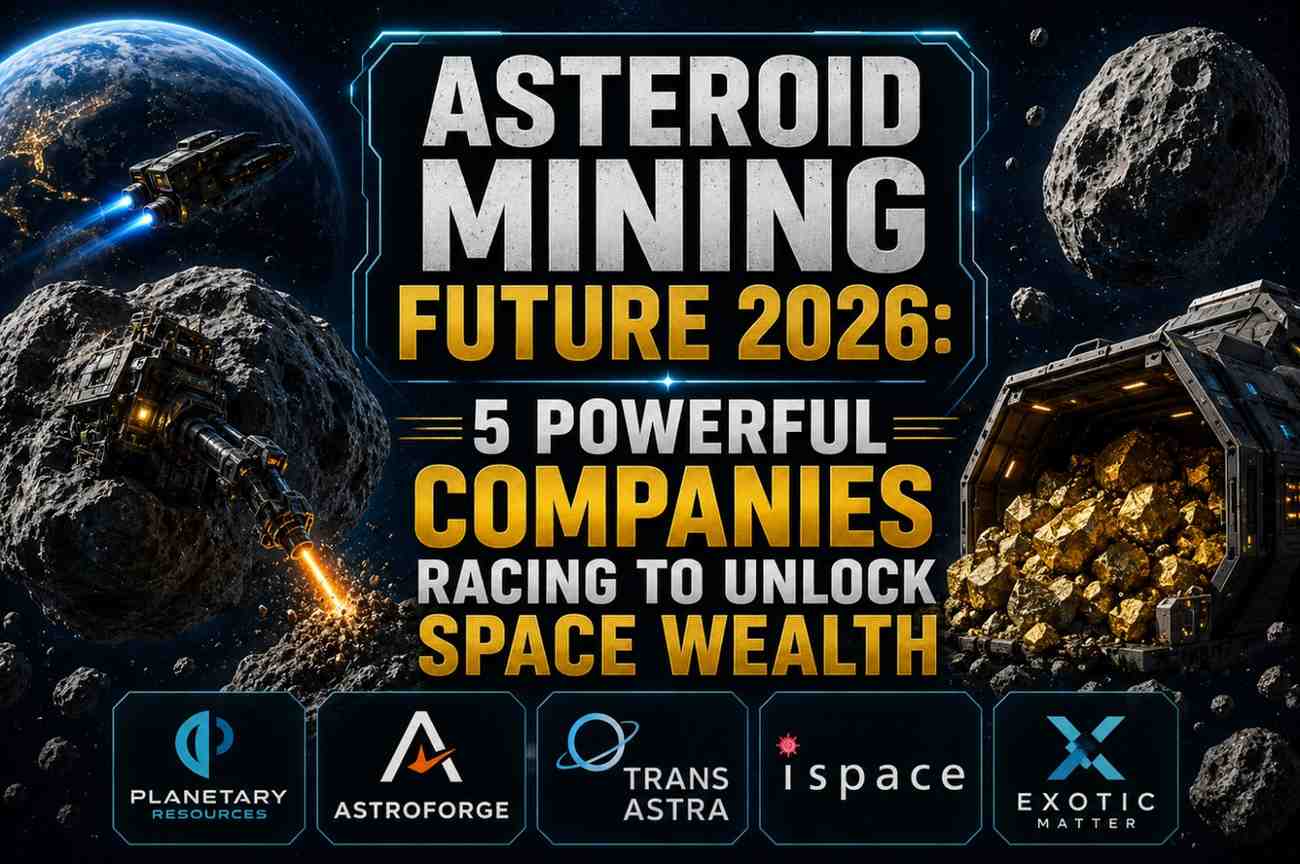
Introduction
The asteroid mining future in 2026 sits at a fascinating crossroads: the technology is advancing rapidly, the economics are becoming clearer, and a handful of serious companies are closer than ever to the first commercial extraction operation beyond Earth.
Asteroids contain trillions of dollars in metals, water, and rare minerals. The asteroid mining future in 2026 isn’t about getting rich quick — it’s about building the infrastructure of a spacefaring civilization.
Here’s where things actually stand.
Why Asteroid Mining Matters
A single metallic asteroid 1 km in diameter could contain more iron, nickel, and platinum than Earth has ever mined in history.
The asteroid mining future in 2026 targets three primary resources:
- Metals (iron, nickel, cobalt, platinum group metals): For in-space construction or return to Earth markets
- Water (H₂O in carbonaceous asteroids): Electrolyzed into hydrogen/oxygen rocket propellant — the “gas stations” of deep space
- Rare earth elements: Critical for electronics, batteries, and defense applications
Water is actually the most strategically valuable target in the asteroid mining future in 2026 — not gold. Whoever provides propellant in space controls access to deeper space destinations.
The 5 Companies Closest to Real Asteroid Mining
1. AstroForge — The Most Serious Contender
AstroForge is the company that best embodies the asteroid mining future in 2026. Founded in 2022, they’ve moved faster than any predecessor.
2023: Launched a rideshare mission (Brokkr-1) to test metal refining in microgravity — the first ever commercial mission with that goal. 2024: Launched Brokkr-2 for a lunar flyby reconnaissance of target asteroid 2022 OB5. 2025–2026: First dedicated asteroid rendezvous mission targeting a near-Earth metallic asteroid.
AstroForge’s approach is pragmatic: refine metal aboard the spacecraft, return just the refined product. This dramatically reduces mass returned versus raw ore.
Their funding includes significant venture capital and a partnership with OrbAstro for spacecraft hardware.
2. TransAstra — The Optical Mining Approach
TransAstra holds NASA patents on “optical mining” — using concentrated sunlight to superheat an asteroid’s surface, vaporizing volatile materials (including water) which are then captured.
Their asteroid mining future 2026 milestones include:
- Testing optical concentrators in LEO
- Developing the “Mini Bee” spacecraft for carbonaceous asteroid prospecting
- Targeting water-rich C-type near-Earth asteroids
TransAstra’s vision is explicitly about propellant — building the fuel infrastructure that makes Mars missions cheaper.
3. Karman+ (formerly Bradford Space) — Government-Backed Prospecting
Karman+ is developing prospecting missions with both commercial and government funding, including DARPA contracts.
Their focus in the asteroid mining future 2026 strategy:
- In-situ analysis of asteroid composition without Earth-based sample return
- Developing autonomous prospecting spacecraft that self-navigate to multiple targets
- Creating the compositional database needed before any extraction investment is justified
4. ispace — Lunar Resources Bridge
ispace, the Japanese lunar lander company, is relevant to the asteroid mining future 2026 because of their approach: start with the Moon, develop the technology stack, then expand to asteroids.
Their M1 and M2 missions to the Moon test resource prospecting sensors that will eventually be adapted for asteroid use. Their partnership with Draper and NASA’s PRISM program gives them credibility and funding.
5. Planetary Resources (Legacy Influence)
Planetary Resources was the first company to make asteroid mining a serious commercial conversation (2012–2019). They were acquired by ConsenSys Space and ultimately dissolved. But their technical work — spacecraft design, prospecting sensor development, legal advocacy — directly influenced every company operating today.
The asteroid mining future in 2026 is built on their intellectual foundation even if the company itself is gone.
The Technology Behind Asteroid Mining
Step 1: Prospecting
Before any extraction, you need to know what’s there. Current technology uses:
- Spectroscopy: Reflected sunlight analysis reveals surface mineral composition
- Radar: Penetrates surface to assess internal structure
- Mass measurement: Orbital perturbation techniques estimate total mass
The asteroid mining future in 2026 relies on Earth-based telescopes, reconnaissance spacecraft, and AI analysis to pre-qualify targets before committing extraction missions.
Step 2: Rendezvous and Anchoring
Asteroids have almost zero gravity. Landing is really “docking” — you approach at centimeters per second and anchor yourself with harpoons, screws, or electrostatic attachment.
This has been demonstrated by JAXA’s Hayabusa2, which returned samples from asteroid Ryugu in 2020.
Step 3: Extraction
Methods under development:
- Optical mining (TransAstra): Concentrated sunlight vaporizes volatiles
- Mechanical drilling: Adapted from oil industry equipment
- Thermal extraction: Heating surface with microwaves or focused heat
- Mass driver systems: Electromagnetic catapults that launch raw material into space
Step 4: Processing and Return
The asteroid mining future in 2026 requires either:
- In-situ processing: Refine material in space, return small high-value product
- Orbit staging: Capture material in Earth/lunar orbit for later processing
- Direct return: Small high-value samples returned to Earth (only economical for platinum-group metals)
Water doesn’t need to return to Earth — it’s most valuable consumed in space as propellant.
Related: Future of Space Exploration 2026 to 2040 — Moon Bases, Mars Colonies & Beyond
The Economics of Asteroid Mining in 2026
Is It Profitable Yet?
Not commercially — not in 2026. The asteroid mining future in 2026 is still in the pre-revenue prospecting phase for all companies.
The economic equation:
| Factor | Current Reality | 2030 Projection |
|---|---|---|
| Mission cost to near-Earth asteroid | $50–150M | $10–30M |
| Return mass (metallic) | None yet | <100kg |
| Platinum price per kg | ~$30,000 | ~$30,000 |
| Break-even return mass | N/A | ~1,000kg |
The numbers work for platinum and rare earth elements at scale. They work now for water used as in-space propellant, where the savings on launch costs from Earth are enormous.
The asteroid mining future in 2026 becomes economically compelling for in-space water by the time a permanent lunar base and Mars missions are consuming large amounts of propellant. That’s 2030–2035.
The Legal Framework
Under the 2015 US SPACE Act, American citizens and companies can own resources extracted from space, though they cannot claim sovereignty over celestial bodies.
Luxembourg, UAE, Japan, and other nations have passed similar laws. The Artemis Accords reinforce resource extraction rights for signatories.
The international legal framework for the asteroid mining future in 2026 is clearer than it was a decade ago — but disputes over exclusion zones and environmental protection remain unresolved.
Related: Commercial Space Stations After ISS 2030 — Who Will Replace the Space Station?
What Asteroid Is Most Worth Mining?
The best targets for the asteroid mining future in 2026 are near-Earth asteroids (NEAs) of specific types:
- M-type (metallic): Iron, nickel, platinum — most valuable but rare
- C-type (carbonaceous): Water-rich, organic material — most accessible and strategically important for propellant
- S-type (silicaceous): Silicates and some metals — common but lower value
The asteroid 16 Psyche (now being orbited by NASA’s Psyche mission, launched 2023) is an M-type metal world with an estimated value of $10 quintillion — more than Earth’s entire economy times 1,000. That’s not a 2026 mining target. But it’s a preview of what exists.
More practical 2026 targets are C-type NEAs within 1–2 AU of Earth: smaller, water-rich, and reachable within months rather than years.
5 Frequently Asked Questions
Q1: When will asteroid mining actually generate revenue? Most analysts project first commercial revenues from in-space water/propellant sales by 2032–2036. Return of metallic ore to Earth is unlikely to be economical before 2040.
Q2: Could asteroid mining crash commodity markets on Earth? Theoretically yes — returning massive quantities of platinum or gold would reduce scarcity and prices. In practice, return masses will be small enough in the early decades that market impact is minimal.
Q3: What is the asteroid mining future in 2026 most focused on? Water. In-space propellant is the near-term revenue opportunity because it removes the need to launch fuel from Earth’s gravity well, dramatically reducing mission costs.
Q4: Has anyone actually mined an asteroid yet? JAXA’s Hayabusa2 returned 5.4 grams of material from asteroid Ryugu in 2020 — the most successful sample return mission. Commercial extraction at scale has not occurred as of 2026.
Q5: How dangerous is working near an asteroid? The main hazards are microgravity complexity, regolith (fine sharp particles), and deep space radiation. No human missions to asteroids are planned before 2035 at the earliest.
Conclusion
The asteroid mining future in 2026 is moving from concept to demonstration. AstroForge is the company to watch most closely — they’re attempting the first real commercial asteroid rendezvous this year with actual extraction hardware aboard.
The economics aren’t there yet for Earth return. But in-space propellant from water-rich asteroids becomes commercially valuable the moment sustained Moon and Mars operations begin — and that’s exactly where the asteroid mining future and the lunar base timeline converge.
The gold rush in space is coming. The companies planting flags now will define who profits.
Follow our asteroid mining coverage for mission updates, company reports, and the latest on in-space resource economics.
External sources: NASA Psyche Mission | Space Foundation Space Report 2024