 Ramrajeshbee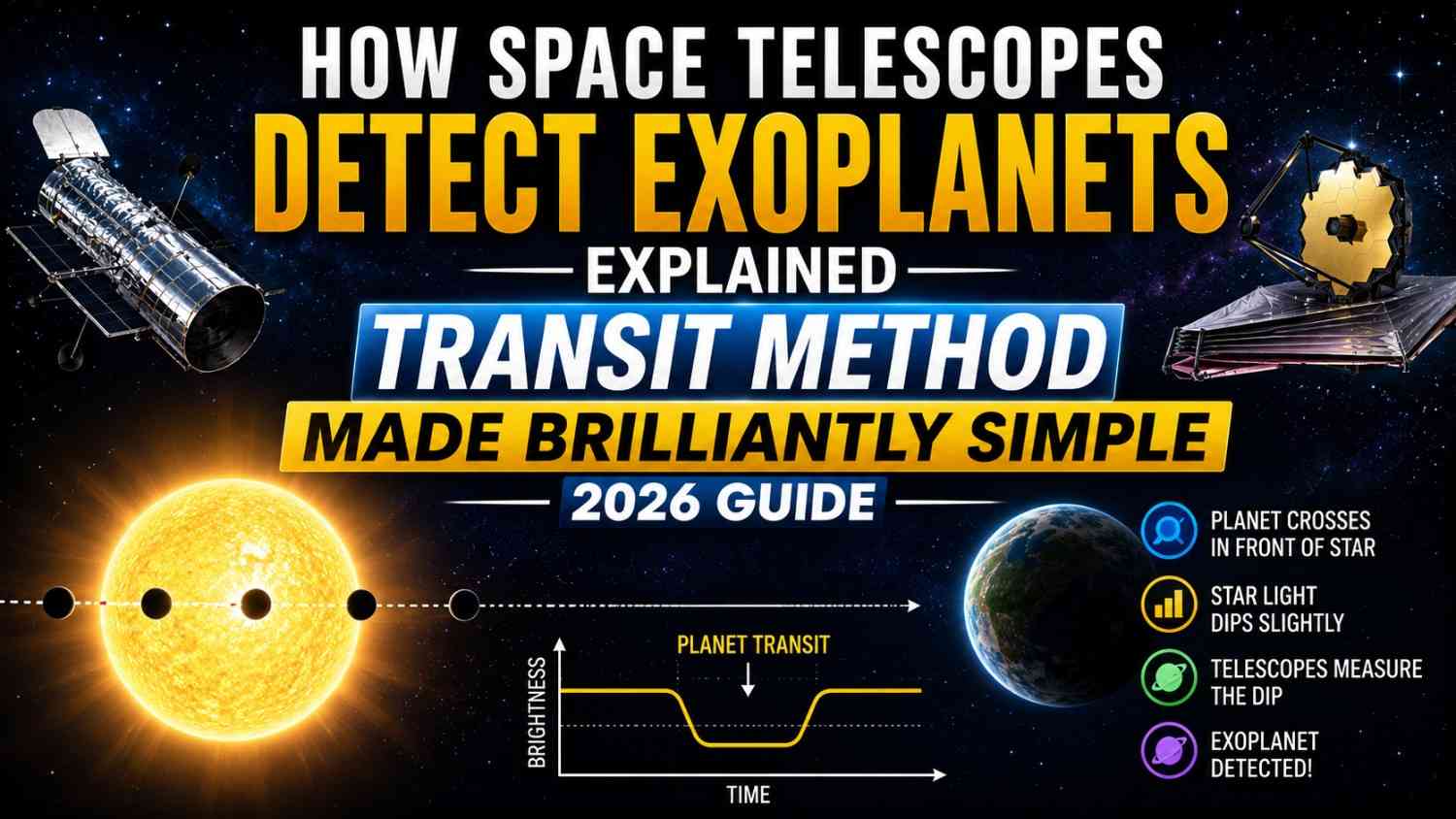
Introduction
How space telescopes detect exoplanets explained simply is one of the most satisfying topics in all of modern science — because the answer is surprisingly elegant, and the scale of what astronomers have achieved is breathtaking.
Think about this: exoplanets are planets orbiting other stars, often hundreds or thousands of light-years away. They produce no light of their own. They are completely invisible against the blazing glare of their host stars. And yet, as of 2026, astronomers have confirmed more than 5,700 exoplanets — with thousands more candidates waiting for confirmation.
How is that possible?
This guide explains every major method used to detect exoplanets from space — starting with the most powerful and widely used technique (the transit method), then covering gravitational microlensing, radial velocity, direct imaging, and astrometry. By the end, you will understand exactly how space telescopes detect exoplanets explained in a way that any curious person can follow.
Method 1: The Transit Method — The Gold Standard of Exoplanet Detection
The Simple Explanation
Imagine you are looking at a bright lamp from across a dark room. Now imagine someone walks between you and the lamp. For a moment, the lamp gets slightly dimmer — and then brightens again as the person walks past.
That is, in essence, the transit method of exoplanet detection. When a planet passes directly between its host star and Earth — a moment called a transit — it blocks a tiny fraction of the star’s light. A sensitive telescope watching the star will record a tiny, temporary dip in brightness.
That dip is a planet.
The Numbers
Even a large planet like Jupiter, if it were transiting a sun-like star, would block only about 1% of the star’s light. An Earth-sized planet would block roughly 0.01% — a signal so tiny that it is undetectable from the ground but well within the capability of precision space telescopes like Kepler and TESS.
What the Transit Tells Us
The beauty of the transit method is how much information it contains:
Planet size — The deeper the dip in brightness, the larger the planet. A planet blocking 1% of the starlight is roughly 10 times the diameter of Earth. The relationship is direct and calculable.
Orbital period — If the same star shows repeated dips at regular intervals, the time between dips is the planet’s orbital period (its year). Once scientists observe at least three dips at consistent intervals, they have a planetary candidate.
Distance from the star — Using Kepler’s laws of planetary motion, the orbital period can be converted to the planet’s orbital distance. A 365-day period means the planet is at about the same distance from its star as Earth is from the Sun.
Atmospheric composition — During a transit, the star’s light shines through the thin ring of the planet’s atmosphere (if it has one). Different molecules in the atmosphere absorb different wavelengths of light — creating a spectroscopic fingerprint. James Webb Space Telescope has used this technique to detect water vapor, carbon dioxide, methane, and sulfur dioxide in exoplanet atmospheres with stunning precision.
The Track Record: Kepler, K2, and TESS
Understanding how space telescopes detect exoplanets explained requires knowing the telescopes that made this field explode:
Kepler Space Telescope (2009–2018): NASA’s revolutionary planet hunter stared at 150,000 stars simultaneously for years, discovering more than 3,000 confirmed exoplanets using the transit method — more than any previous mission. Kepler taught astronomers that planets are extraordinarily common in our galaxy.
K2 (2014–2018): After a reaction wheel failure reduced Kepler’s pointing precision, engineers repurposed the telescope to survey different patches of sky, discovering hundreds more planets.
TESS (Transiting Exoplanet Survey Satellite, 2018–present): NASA’s current planet hunter monitors nearly the entire sky, focusing on bright, nearby stars. TESS has identified thousands of exoplanet candidates, many of them prime targets for atmospheric follow-up by James Webb.
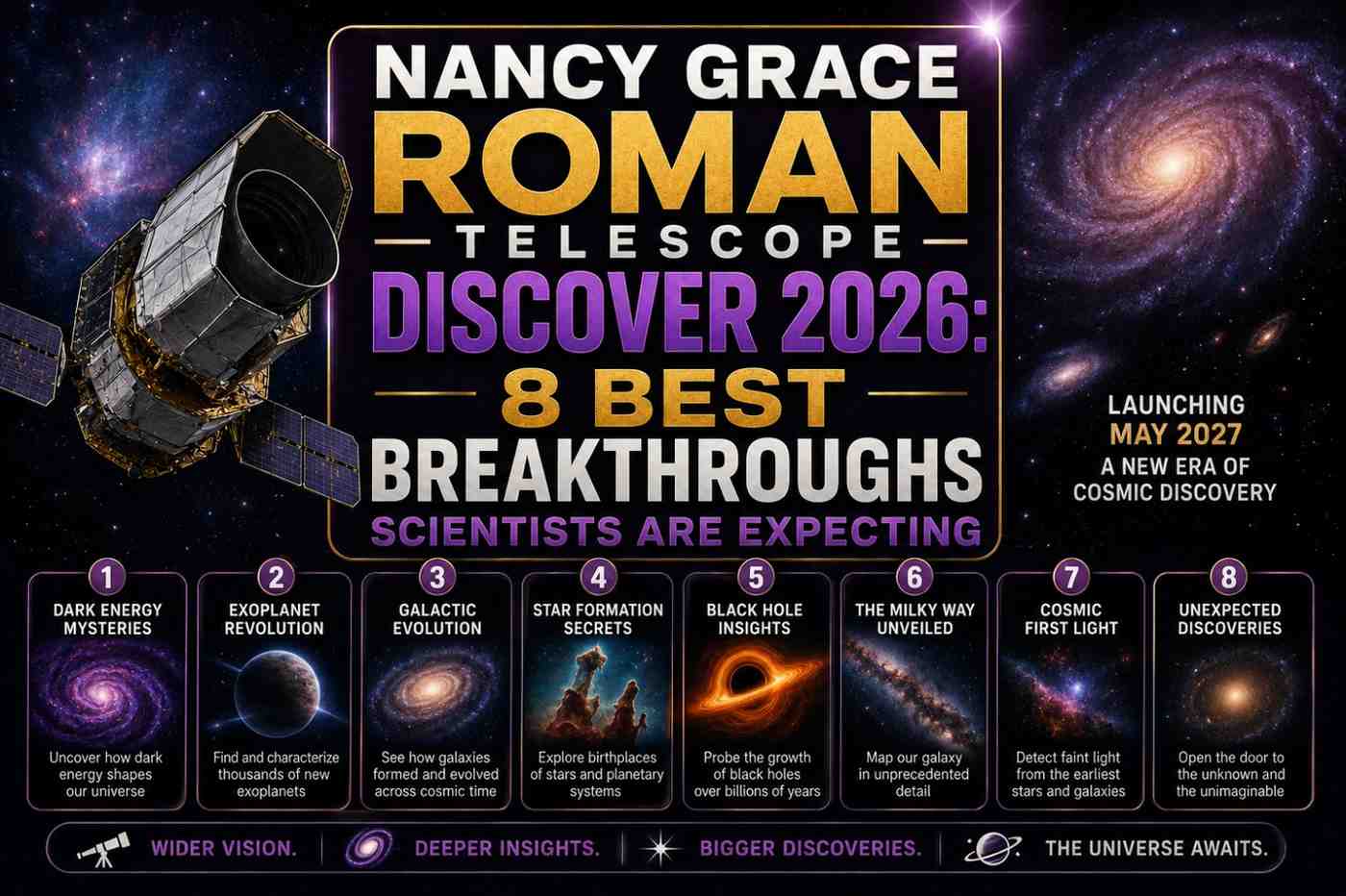
Roman Space Telescope (launching September 2026): Roman’s combination of wide-field imaging and continuous monitoring will discover more than 100,000 transiting exoplanets during its five-year primary mission — more than all previous missions combined.
Internal Link: Hubble Space Telescope vs James Webb vs Roman — Complete Comparison Guide 2026
Method 2: The Radial Velocity Method — Listening to Stars Wobble
How It Works
Every planet in the solar system does not orbit its star — both the planet and the star orbit their common center of mass. For a massive planet like Jupiter, this center of mass is actually just outside the Sun’s surface. As Jupiter orbits, the Sun “wobbles” very slightly back and forth.
The radial velocity method detects this stellar wobble by measuring tiny changes in the color of the star’s light. When a star moves toward Earth, its light is compressed to slightly shorter (bluer) wavelengths. When it moves away, its light is stretched to slightly longer (redder) wavelengths. This is the Doppler effect — the same phenomenon that makes a siren sound higher-pitched as it approaches and lower-pitched as it recedes.
By precisely measuring these tiny color shifts (sometimes as small as 1 meter per second), astronomers can detect an unseen planet pulling on its star.
What It Tells Us
Radial velocity reveals the planet’s minimum mass and orbital period. Combined with transit measurements from space telescopes, it can determine the planet’s full mass and therefore its density — telling us whether a planet is rocky, icy, or a gas ball.
The radial velocity method was the first to discover a planet orbiting a sun-like star (51 Pegasi b, in 1995) — a discovery that earned its discoverers the 2019 Nobel Prize in Physics.
Method 3: Gravitational Microlensing — Using Space-Time as a Lens
How It Works
Einstein’s general relativity tells us that massive objects warp the fabric of space-time, bending light that passes near them. When a distant star passes behind a closer star (and its planet system) from Earth’s perspective, the closer star’s gravity bends and magnifies the light of the background star — making it appear briefly brighter.
If there is a planet orbiting the closer star, it adds an additional, shorter-duration brightening event to the microlensing light curve. This additional blip reveals the planet’s existence.
Why It Matters
Gravitational microlensing is uniquely powerful for detecting planets that the transit method and radial velocity cannot reach. It finds:
- Planets at large orbital distances from their stars (out where the transit probability is nearly zero)
- Free-floating rogue planets — planet-sized objects drifting through space without any host star
- Low-mass planets around dim, distant stars
NASA’s Roman Space Telescope will monitor hundreds of millions of stars in the galactic bulge for microlensing events, expected to reveal more than 2,600 new exoplanets through this method alone — including types of worlds that no other technique can find.
Method 4: Direct Imaging — Taking Actual Pictures of Exoplanets
How It Works
In principle, the most straightforward way to detect an exoplanet is simply to take a picture of it. In practice, this is extraordinarily difficult — like trying to photograph a firefly sitting next to a searchlight from 1,000 miles away.
A star is billions to trillions of times brighter than any planet orbiting it. Blocking the star’s glare precisely enough to reveal the faint reflected light of a planet requires a device called a coronagraph — an optical mask that blocks starlight while allowing planet light to pass through.
Direct imaging works best for very large, young planets orbiting far from their stars — where the contrast ratio between star and planet is more manageable. The James Webb Space Telescope has already directly imaged several gas giant exoplanets, including detailed spectroscopic studies of their atmospheres.
The Roman Space Telescope’s Coronagraph Instrument will be the most advanced coronagraph ever flown in space — capable of blocking starlight to a precision that could, for the first time, directly image planets similar in size to Uranus and Neptune.
This technology is also a demonstration for the proposed Habitable Worlds Observatory — a future telescope designed to directly image Earth-like planets and search their atmospheres for biosignatures (chemical signs of life).
Method 5: Astrometry — Watching Stars Wobble in Position
How It Works
Like the radial velocity method, astrometry detects the gravitational tug of a planet on its host star — but instead of measuring color shifts in the star’s light, astrometry measures tiny shifts in the star’s position on the sky as it wobbles around the center of mass it shares with its planet.
These positional shifts are extraordinarily small — for a Jupiter-mass planet orbiting a sun-like star at Earth’s orbital distance, the star moves by about 1 milliarcsecond as seen from 10 light-years away. That is equivalent to the width of a quarter coin seen from 160 kilometers (100 miles).
The European Space Agency’s Gaia mission has been measuring the positions of more than a billion stars with extraordinary precision since 2013 — and is expected to confirm thousands of exoplanets via astrometry in its final data releases, particularly at large orbital distances where other methods are less sensitive.
How Space Telescopes Detect Exoplanets Explained: Comparison Table
| Method | Best For | Key Telescope(s) | Planets Found |
|---|---|---|---|
| Transit | Close-in planets, atmospheric study | Kepler, TESS, Roman, Webb | 4,000+ |
| Radial Velocity | Nearby bright stars, planet mass | Ground telescopes (HARPS, ESPRESSO) | 1,000+ |
| Microlensing | Distant, outer-orbit & rogue planets | Roman Space Telescope | 2,600+ expected |
| Direct Imaging | Large young gas giants, atmosphere | Webb, Roman (CGI) | ~30 confirmed |
| Astrometry | Long-period planets | Gaia (ESA) | Thousands expected |
How James Webb Takes Exoplanet Science to the Next Level
Understanding how space telescopes detect exoplanets explained in 2026 must include what James Webb has added to the picture.
Webb doesn’t primarily discover new exoplanets — TESS and Roman do that. Webb’s role is to study the atmospheres of planets already found.
When a planet transits its star, Webb captures the starlight that passes through the planet’s thin atmospheric layer during the transit and after (when the planet passes behind the star). By comparing the spectra of these two measurements, Webb isolates the chemical fingerprint of the planet’s atmosphere.
Webb has already detected carbon dioxide, sulfur dioxide, methane, and water vapor in exoplanet atmospheres. It has spotted weather patterns on gas giants. And it is searching for biosignatures — chemical combinations like oxygen and methane that cannot coexist without a living process maintaining them.
The combination of Roman discovering tens of thousands of planets and Webb analyzing the most interesting ones represents the most powerful exoplanet science program in history.
According to NASA’s official exoplanet detection page, the transit method remains the most productive discovery tool in the field — and Roman will expand its reach dramatically when it launches in September 2026.
Internal Link: NASA Nancy Grace Roman Space Telescope Launch 2026 — Everything You Need to Know
What Are Scientists Looking For When They Study Exoplanets?
Now that you understand how space telescopes detect exoplanets explained, it helps to know what the bigger goal is.
The ultimate prize in exoplanet science is finding a planet that is:
- Rocky (like Earth, not a gas ball)
- The right temperature for liquid water (in the “habitable zone” of its star)
- With an atmosphere containing oxygen, methane, or other potential biosignatures
Thousands of exoplanets have been confirmed. A few dozen are in the habitable zones of their stars. None has yet been confirmed to have a truly Earth-like atmosphere. That confirmation — if it comes — would be one of the most significant discoveries in human history.
The tools to make that confirmation are now being built and launched. TESS finds the candidates. Roman will find thousands more. Webb analyzes their atmospheres. And the Habitable Worlds Observatory — planned for the 2040s — may one day take a direct photograph of an Earth-like world and measure the chemicals in its air.
Conclusion
Understanding how space telescopes detect exoplanets explained through the transit method and its companion techniques reveals a story of extraordinary scientific ingenuity. Astronomers cannot travel to other star systems. They cannot even resolve exoplanets as dots of light in most cases. Yet from across light-years of space, they measure the thickness of alien atmospheres, the size and mass of rocky worlds, and the orbital paths of planets that may harbor liquid water.
Every time a star’s light dips by one hundredth of a percent, the universe is whispering a message: there is a world out here. And our telescopes are finally sensitive enough to listen.
Want to explore real exoplanet data for yourself? Visit NASA’s Exoplanet Archive — a free, publicly accessible database of every confirmed exoplanet ever discovered, with light curves, spectra, and interactive visualizations.