 Ramrajeshbee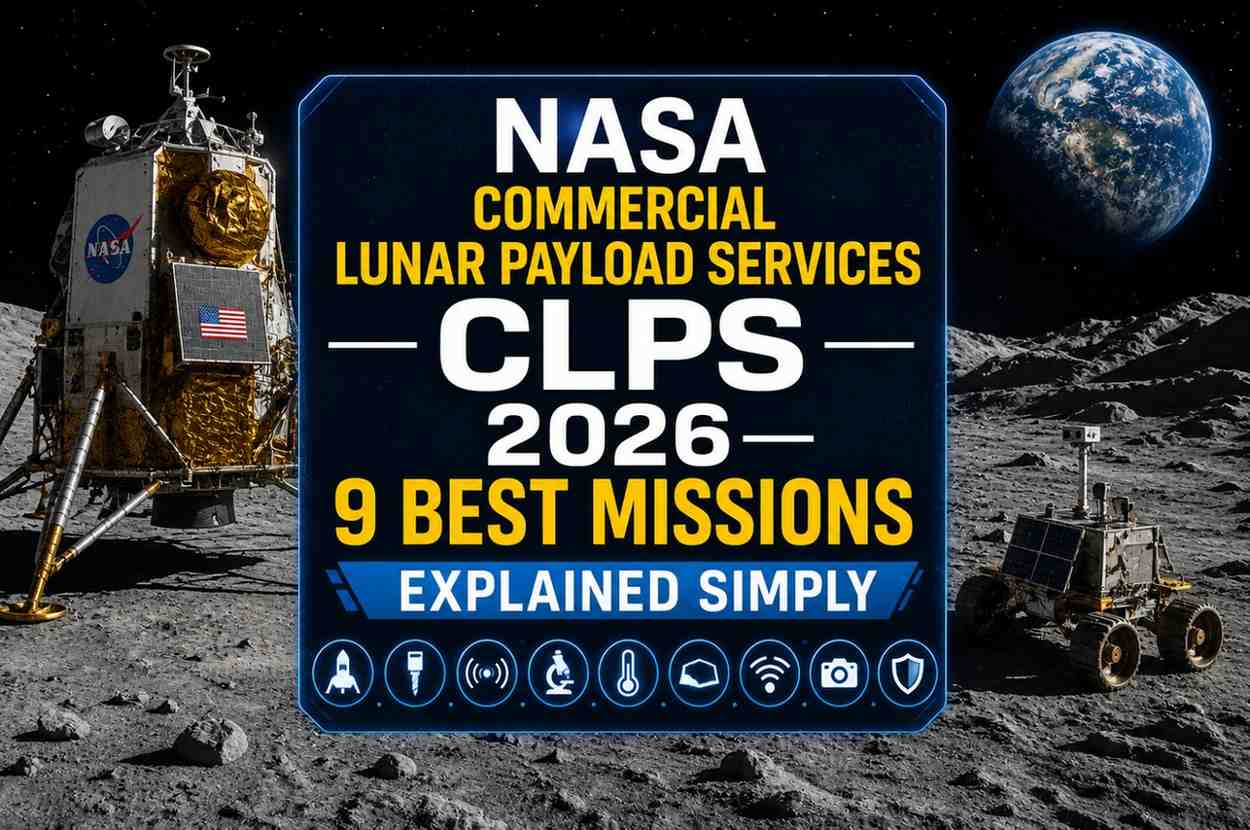
Introduction
The NASA Commercial Lunar Payload Services CLPS 2026 program is one of the most ambitious — and most misunderstood — initiatives in modern space exploration. NASA is paying private companies to send robots, instruments, and experiments to the Moon on its behalf. And in 2026, several of these commercial Moon missions are scheduled to launch or land.
If you’ve ever found yourself confused by acronyms like CLPS, VIPER, Blue Ghost, or Draper, this guide is for you. We’ll explain the NASA Commercial Lunar Payload Services CLPS 2026 program in plain language — what it is, which missions are happening, what they’re trying to accomplish, and why it matters for the future of human spaceflight.
Let’s start from the beginning.
What Is NASA CLPS? A Simple Explanation
CLPS stands for Commercial Lunar Payload Services. It is a NASA program, launched in 2018, that hires private American companies to deliver scientific instruments and technology experiments to the Moon — without NASA building or flying its own spacecraft.
Think of it like this: instead of NASA ordering a special government pizza and baking it itself, CLPS lets NASA order from a menu of commercial pizzerias. NASA decides what toppings (payloads) it wants, and the commercial company handles everything else — the dough, the oven, the delivery.
The advantages are significant:
- Cost: Fixed-price commercial contracts are far cheaper than traditional government-managed missions
- Speed: Commercial companies can move faster than traditional NASA procurement timelines
- Innovation: Multiple competing companies drive creativity and capability
- Risk tolerance: NASA explicitly accepts a higher risk of failure in exchange for lower cost and faster access
To date, NASA has awarded 11 lunar deliveries to five CLPS companies, with a combined maximum contract value of $2.6 billion through November 2028. The program has already achieved the first-ever commercial landing on the Moon — Intuitive Machines’ IM-1 mission in February 2024.
Who Are the CLPS Providers?
Before diving into the 2026 missions, here are the five companies currently under NASA CLPS contracts:
1. Astrobotic Technology (Pittsburgh, PA) — Builds the Peregrine and Griffin landers. Peregrine’s first mission (January 2024) suffered a propellant leak and didn’t land; Griffin Mission One is scheduled for 2026.
2. Intuitive Machines (Houston, TX) — Builds the Nova-C lander. Achieved the first commercial Moon landing in February 2024 (IM-1) and landed near the south pole in 2025 (IM-2). IM-3 targets Reiner Gamma in 2026.
3. Firefly Aerospace (Cedar Park, TX) — Builds the Blue Ghost lander. Blue Ghost Mission 1 landed successfully at Mare Crisium in early 2025. Blue Ghost Missions 2 and 3 are planned for 2026.
4. Draper (Cambridge, MA) — Working with ispace to land on the Moon’s far side in 2026 — a feat only China has accomplished.
5. Blue Origin (Kent, WA) — Building the Blue Moon Mark 1 cargo lander; Blue Moon Pathfinder targeting launch in 2026.
NASA Commercial Lunar Payload Services CLPS 2026: All Active Missions Explained
Mission 1: Astrobotic Griffin Mission One — Lunar South Pole
Company: Astrobotic Technology Lander: Griffin Target: Mons Mouton, near the lunar south pole Status: Scheduled for late 2026
The Griffin Mission One is perhaps the most consequential commercial Moon mission of the year. Astrobotic’s Griffin lander will attempt to touch down at Mons Mouton — a flat-topped mountain near the lunar south pole in permanent or near-permanent sunlight — making it an ideal future location for a human base.
Originally intended to carry NASA’s VIPER rover (which was cancelled in July 2024), the Griffin lander has been repurposed as a delivery test to the south pole. It will carry scientific instruments focused on characterizing the south polar environment — data that will directly feed into planning for Artemis crewed surface missions.
A successful Griffin landing would be a significant milestone, proving that commercial landers can operate in the challenging conditions of the lunar south pole — extreme temperatures, long shadows, and rugged terrain.
Mission 2: Intuitive Machines IM-3 — Reiner Gamma Magnetic Swirl
Company: Intuitive Machines Lander: Nova-C Target: Reiner Gamma (lunar near side) Key Payload: Lunar Vertex science suite + CADRE rovers
The third Intuitive Machines mission targets Reiner Gamma — one of the most mysterious features on the Moon. This striking, bright swirl on the lunar surface is associated with a weak local magnetic field, believed to be a remnant from an era when the Moon had a global magnetic field.
The Lunar Vertex payload suite — a combination of spectrometers and magnetometers on both the lander and a small rover — will study the swirl’s composition and map the surrounding magnetic field. This will help scientists understand the Moon’s magnetic history and how the solar wind shapes planetary surfaces throughout the solar system.
Even more exciting: IM-3 will deploy three CADRE rovers — three tiny, autonomous robots that will map the Reiner Gamma site collectively. Working as a team, they will demonstrate swarm robotics technology on the Moon for the first time, using multistatic ground-penetrating radar to create 3D images of the lunar subsurface down to 10 meters deep.
Mission 3: Firefly Blue Ghost Mission 2 — Lunar Far Side
Company: Firefly Aerospace Lander: Blue Ghost (with transfer stage) Target: Lunar far side + lunar orbit Key Payloads: LuSEE-Night + ESA Lunar Pathfinder satellite
This mission is a two-for-one: Firefly will not only attempt to land on the far side of the Moon — something only China has ever done — but will also deploy a communications satellite into lunar orbit.
The ESA Lunar Pathfinder satellite, developed by Surrey Satellite Technology Limited, will provide relay communications between Earth and future robotic and crewed missions on the Moon’s surface and in orbit — a first step toward Moonlight, ESA’s planned commercial lunar communications and navigation constellation.
The lander itself will carry LuSEE-Night — a first-of-its-kind scientific instrument designed to measure faint radio signals from the universe’s “Dark Age,” the period right before the first stars were born. The far side of the Moon is the only place in the solar system completely shielded from Earth’s radio noise — making it the ideal location for this kind of ultra-sensitive observation.
Mission 4: Draper / ispace APEX 1.0 — First Far Side Landing by a US Company
Company: Draper (with ispace-U.S. APEX 1.0 lander) Target: Schrödinger Basin, lunar far side Key Payloads: Seismometers, heat flow drill, electrical conductivity probes
This mission, managed by Cambridge-based Draper using an ispace-built lander, will be the first American commercial mission to the lunar far side — landing in the ancient, geologically rich Schrödinger Basin.
The scientific payload is outstanding. It includes:
- Long-lived seismometers to detect tectonic activity deep in the lunar interior and measure how often micrometeorites strike the surface
- A heat flow drill to measure how much heat is escaping from the Moon’s interior
- Electrical conductivity probes to investigate the near-surface geology
This data will help scientists understand the Moon’s internal structure and geological history — and will directly inform where future robotic and crewed missions should explore.
Mission 5: Blue Origin Blue Moon Pathfinder — South Pole Demonstration
Company: Blue Origin Lander: Blue Moon Mark 1 (MK1) Target: Shackleton crater, lunar south pole Key Payload: SCALPSS (NASA stereo cameras)
As discussed in the Blue Moon article, this uncrewed pathfinder mission is Blue Origin’s first attempt to land on the Moon — targeting the Shackleton crater at the lunar south pole. Its success will prove the Blue Moon lander’s engines, avionics, and precision landing technology.
The NASA payload — SCALPSS — will capture stereoscopic images of how the lander’s rocket plumes disturb the lunar surface during landing. This data will help engineers design landing pads and surface infrastructure for future Artemis crewed missions.
What Payloads Will These Missions Carry?
The NASA Commercial Lunar Payload Services CLPS 2026 missions collectively carry dozens of NASA science instruments. Here are some highlights:
LEMS (Lunar Environment Monitoring Station) — A compact, autonomous seismometer suite that will measure moonquakes and micrometeorite impacts at the lunar south pole. This same instrument is planned for deployment during the Artemis crewed surface missions.
LuSEE-Night — A radio telescope for the cosmic Dark Ages, deployed on the lunar far side, completely shielded from Earth’s radio interference.
CADRE Rovers — A trio of autonomous mini-rovers demonstrating swarm robotics technology on the lunar surface for the first time.
Lunar Vertex — A comprehensive magnetic field and surface composition science package studying the Reiner Gamma swirl.
SCALPSS — Stereo cameras studying rocket plume-surface interactions to inform future landing pad design.
Why Does NASA Accept Failures in the CLPS Program?
This is a question many people ask about the NASA Commercial Lunar Payload Services CLPS 2026 program. The answer is deliberate and principled.
NASA has explicitly stated that it accepts a higher risk of mission failure in exchange for the lower cost and faster pace of commercial development. When Astrobotic’s Peregrine Mission suffered a propellant leak in January 2024 and never reached the Moon, NASA treated it as a learning experience — not a program failure.
This philosophy is captured in NASA’s official position: “With any new endeavor there is a new level of risk. Even with a few risks, CLPS remains an affordable and beneficial approach to lunar exploration. And with every failure comes lessons learned that will improve future missions.”
This risk tolerance is what makes CLPS so powerful. It allows NASA to attempt more missions, more frequently, at a fraction of the cost of a traditional government program — accepting that some will fail while others succeed spectacularly.
According to NASA’s official CLPS program page, the program has already delivered more than 50 payloads to the Moon across completed and in-progress missions — and the pace is accelerating.
Internal Link: NASA Blue Moon Lunar Lander Mission 2026 vs SpaceX Starship — Full Comparison
How CLPS Connects to Artemis and Human Moon Landing
The NASA Commercial Lunar Payload Services CLPS 2026 missions are not just science projects in isolation. They are the advance scouts for human lunar exploration.
Every CLPS mission serves one or more of these purposes:
- Characterizing landing sites for Artemis crewed missions
- Testing technologies (drills, rovers, communications, landing systems) needed for a permanent Moon base
- Conducting science that answers fundamental questions about the Moon’s geology, magnetic field, resources, and history
- Building the commercial space economy that NASA will rely on for sustainable Moon and Mars exploration
The connection to Artemis is explicit. The Lunar Environment Monitoring Station (LEMS) — being deployed by commercial landers in 2026 — is also a science instrument selected for the first Artemis crewed landing on the Moon’s south pole.
Learn more about how this all fits together on The Planetary Society’s CLPS guide.
Internal Link: NASA Artemis III Moon Landing Mission 2026 — Complete Guide
Conclusion
The NASA Commercial Lunar Payload Services CLPS 2026 program represents a fundamentally new way of exploring the Moon. Instead of NASA doing everything itself, it is building a commercial ecosystem — paying American companies to land on the Moon, carry NASA’s science, prove new technologies, and generate the data needed for humans to follow.
In 2026 alone, multiple missions are targeting the lunar south pole, the never-visited far side, mysterious magnetic swirls, and ancient volcanic plateaus. Each one is a stepping stone toward the day humans walk on the Moon again.
Want to follow every CLPS mission from launch to landing? Bookmark NASA’s official CLPS deliveries page and watch humanity’s robotic vanguard lead the way.