 Ramrajeshbee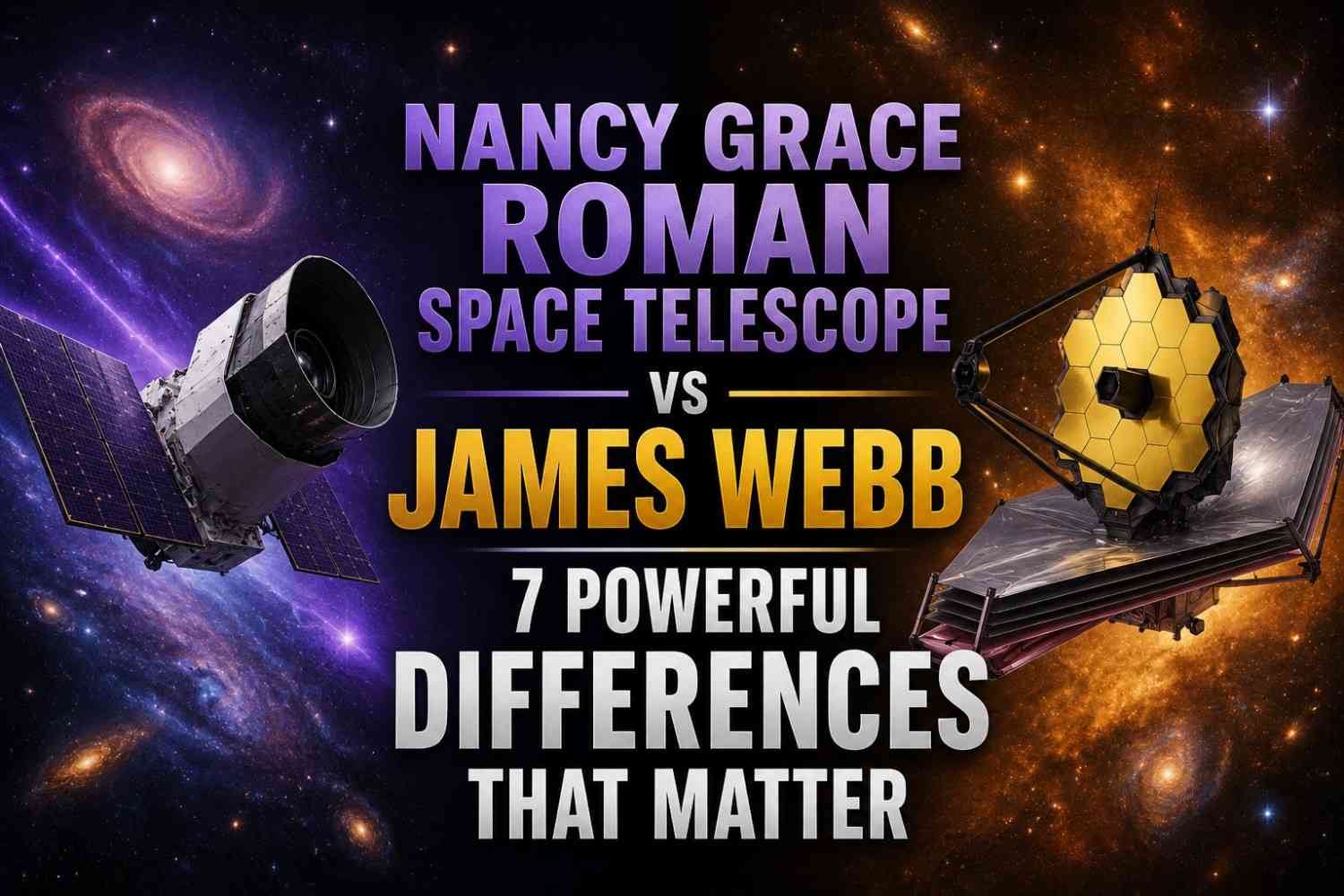
Introduction
The Nancy Grace Roman Space Telescope vs James Webb comparison is one of the most exciting conversations happening in astronomy today. Both are NASA flagship missions. Both observe in infrared. But they are built for fundamentally different scientific goals — and understanding those differences changes how you think about the universe.
Roman isn’t a replacement for Webb. It’s a complement. Together, they will transform our understanding of dark energy, exoplanets, and the large-scale structure of the cosmos.
Here’s exactly how they differ — and why it matters.
Background: What Are These Two Telescopes?
Before diving into the Nancy Grace Roman Space Telescope vs James Webb specifics, a quick primer.
James Webb Space Telescope (JWST) launched in December 2021. It operates at Lagrange Point 2 (L2), about 1.5 million km from Earth. Its primary mirror is 6.5 meters — the largest ever launched into space. Webb is optimized for deep, high-resolution, detailed study of specific targets.
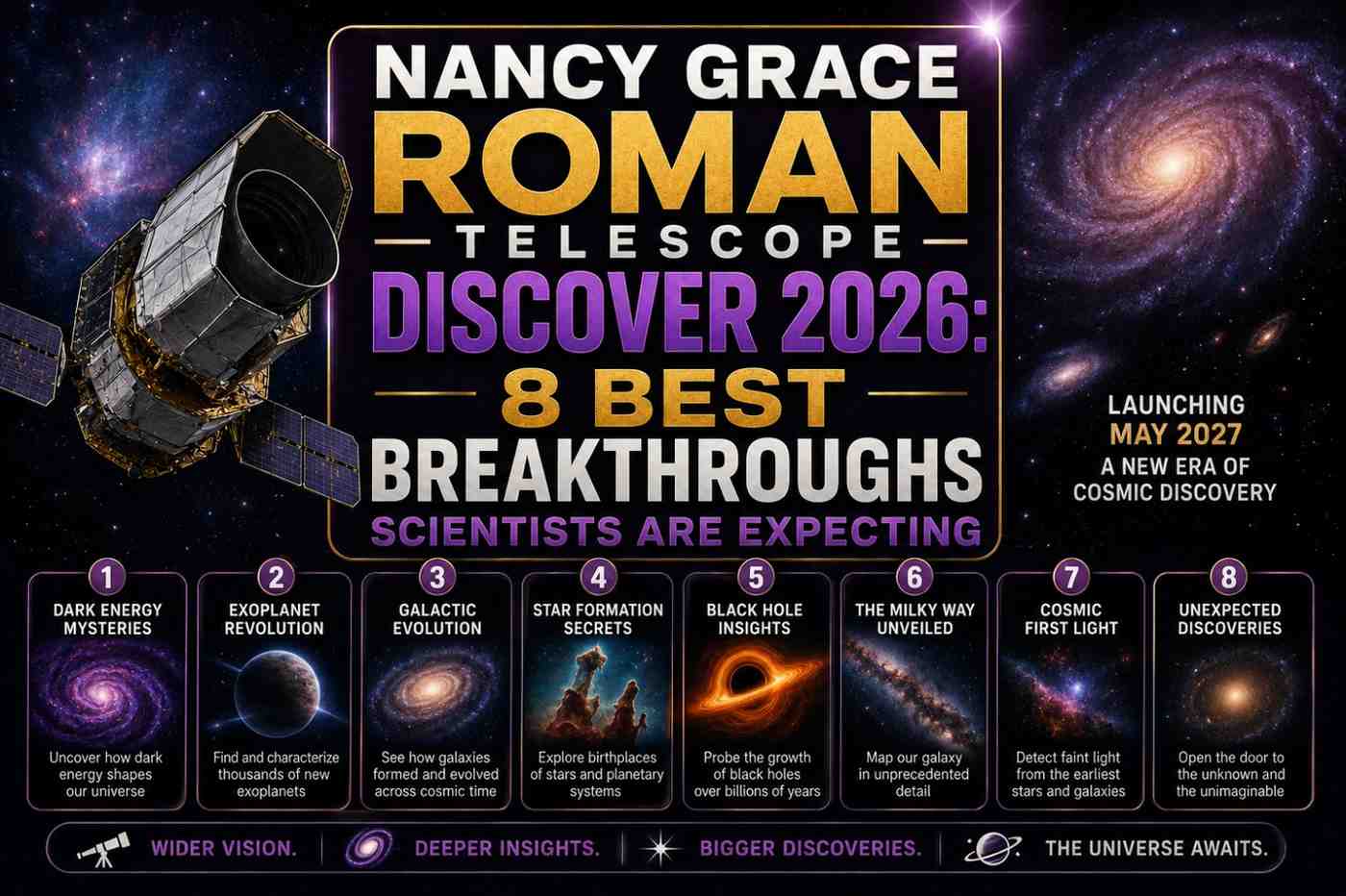
Nancy Grace Roman Space Telescope (formerly WFIRST) is NASA’s next flagship, targeting launch in 2026 or 2027. It has a 2.4-meter primary mirror — smaller than Webb — but its field of view is 100 times wider.
That single difference drives almost everything else in the Nancy Grace Roman Space Telescope vs James Webb comparison.
Difference 1 — Field of View: Roman Wins Overwhelmingly
The most fundamental distinction in the Nancy Grace Roman Space Telescope vs James Webb debate is field of view.
- Webb’s field of view: ~9.7 square arcminutes (NIRCam primary)
- Roman’s field of view: ~0.28 square degrees — roughly 100× wider than Webb
What This Means in Practice
Webb is like a powerful telephoto lens. Roman is like a wide-angle panorama camera — but with the same optical quality.
Roman can survey an area of sky in days that would take Webb years. This makes Roman ideal for statistical surveys — mapping millions of galaxies, thousands of exoplanets, and dark energy’s fingerprint across the universe.
Difference 2 — Primary Mission Goals
In the Nancy Grace Roman Space Telescope vs James Webb comparison, the science missions diverge significantly.
Webb’s primary goals:
- Observe the first galaxies after the Big Bang
- Study stellar and planetary system formation
- Characterize exoplanet atmospheres in detail
- Probe chemical composition of interstellar clouds
Roman’s primary goals:
- Map dark energy’s effect on cosmic expansion
- Conduct a galactic exoplanet survey via microlensing
- Perform wide-field infrared sky surveys
- Enable a guest observer program for diverse science
Roman will study how many and where. Webb studies what and why. Both questions are essential.
Related Article: James Webb Space Telescope Latest Images 2026
Difference 3 — Mirror Size and Light-Gathering Power
The Nancy Grace Roman Space Telescope vs James Webb comparison in raw light-gathering power:
- Webb mirror: 6.5 meters diameter, 25 m² collecting area
- Roman mirror: 2.4 meters diameter, 4.5 m² collecting area
Webb collects roughly 5.5 times more light than Roman. This makes Webb far more sensitive for faint, distant objects — early galaxies, dim stellar nurseries, faint exoplanet atmospheric signatures.
Roman compensates with its wide field, detector count, and survey speed. For its intended science goals, Roman’s mirror size is perfectly matched.
Difference 4 — Exoplanet Science Approaches
Both telescopes study exoplanets — but in very different ways. This is one of the most fascinating aspects of the Nancy Grace Roman Space Telescope vs James Webb comparison.
Webb’s approach: Transit spectroscopy — studying starlight filtered through a planet’s atmosphere to identify water, methane, CO₂, and other chemicals. Highly detailed, one planet at a time.
Roman’s approach: Gravitational microlensing — detecting the light-bending effect of planets around distant stars. This method can find planets Webb’s transit method misses, including free-floating rogue planets and planets far from their stars.
Roman is expected to discover thousands of new exoplanets — including the first statistical census of planets throughout the Milky Way.
Difference 5 — Dark Energy Research
This is where the Nancy Grace Roman Space Telescope vs James Webb comparison shows Roman’s unique strength.
Understanding dark energy — the mysterious force accelerating cosmic expansion — requires mapping millions of galaxies across billions of light-years.
Roman will:
- Survey 2 billion galaxies in its primary mission
- Measure weak gravitational lensing at cosmic scale
- Track Type Ia supernovae as standard candles across deep space
- Map baryon acoustic oscillations in galaxy distributions
Webb can study individual galaxies in extraordinary detail. Roman sees the cosmic web itself. Both perspectives are needed.
Related Article: Hubble Space Telescope vs James Webb vs Roman
Difference 6 — Coronagraph Technology
The Nancy Grace Roman Space Telescope vs James Webb comparison on direct exoplanet imaging:
Roman carries a dedicated coronagraph instrument — a technology demonstrator designed to block starlight and directly image exoplanets.
Webb has no coronagraph equivalent. It studies exoplanet atmospheres indirectly via transmission spectroscopy.
Roman’s coronagraph is expected to achieve 1 billion to 1 contrast ratios — blocking a star’s light to a level where nearby planets become visible. This is a stepping stone toward imaging Earth-like planets directly.
For technical specifications, see NASA’s Roman Space Telescope overview and ESA’s Webb telescope science page.
Difference 7 — Survey Speed vs Depth
The ultimate summary of the Nancy Grace Roman Space Telescope vs James Webb comparison:
| Feature | James Webb | Nancy Grace Roman |
|---|---|---|
| Mirror diameter | 6.5 m | 2.4 m |
| Field of view | Narrow | 100× wider than Webb |
| Sensitivity | Extremely deep | Moderate but vast |
| Primary strength | Detail & depth | Survey & statistics |
| Dark energy mapping | No | Yes (primary goal) |
| Exoplanet atmospheres | Yes (detailed) | Survey scale |
| Coronagraph | No | Yes (demonstrator) |
| Launch | Dec 2021 | 2026/2027 |
They are not rivals. They are teammates.
5 Short FAQs
Q1: Is the Nancy Grace Roman Space Telescope better than Webb? Neither is “better” — they’re optimized for different science. Roman surveys wide areas; Webb studies specific targets in extraordinary detail.
Q2: When will Roman launch? NASA targets the Nancy Grace Roman Space Telescope for launch no later than May 2027, with earlier launch windows possible in late 2026.
Q3: Why is it named Nancy Grace Roman? Nancy Grace Roman was NASA’s first Chief of Astronomy, instrumental in making the Hubble Space Telescope a reality. She’s often called the “Mother of Hubble.”
Q4: Will Roman and Webb work together? Yes. Scientists plan coordinated observing programs where Roman identifies targets at wide field and Webb follows up with deep, detailed study.
Q5: How far can the Roman telescope see? Roman will observe galaxies up to 10 billion light-years away during its dark energy surveys — mapping cosmic structure across a significant fraction of the observable universe.
Conclusion
The Nancy Grace Roman Space Telescope vs James Webb isn’t a competition — it’s the most powerful one-two punch in the history of observational astronomy. Webb goes deep. Roman goes wide. Together, they will answer questions about dark energy, exoplanet populations, and cosmic structure that neither could address alone.
Want to follow every Roman and Webb discovery? Stay with our space telescope coverage for every image, finding, and scientific breakthrough as humanity expands its view of the cosmos.